Tag Archives: Water

Putting conservation into conservatives —John S. Quarterman

My op-ed in the VDT today. -jsq

Gov. Deal (WABE, 14 Nov 2012) temporarily forgot that “conservative” includes conserving something, like Theodore Roosevelt and national parks, or when Franklin D. Roosevelt established the Okefenokee National Wildlife Refuge which also administers Banks Lake, when Richard Nixon started the EPA, and when Jimmy Carter signed the Soil and Water Conservation Act. If Gov. Deal wants to call conservation “liberal”, I’m happy to be a liberal working for water for our state!

Georgia Water Coalition’s Dirty Dozen

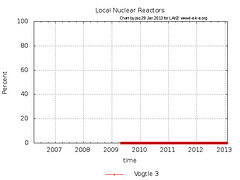
listed the biggest boondoggle of all as #11: the nuclear reactors at Plant Vogtle suck up more water from the Savannah River than all local agriculture and almost as much as the city of Savannah.

If the new Plant Vogtle nukes are ever completed, all four will use more water than Savannah. In 2009 the legislature approved and Gov. Deal signed a law letting Georgia Power charge its customers in advance for building that boondoggle, to the tune of about $1.5 billion so far!

Let’s not forget

Continue reading

Plant the seeds for viable water future

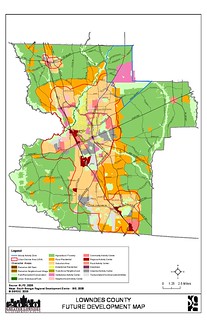
This AJC op-ed is about coastal wetlands, but much of it applies to wetlands such as cypress swamps and streams in Lowndes County and the rest of central south Georgia, especially since our state water plan for the Suwannee-Satilla Region points us at County-Level Population Projections from the Governor’s Office of Planning and Budget that project 45% growth in Lowndes County population in 20 years to 156,650 people by 2030, which means near doubling in 30 years to 2050. -jsq

David Kyler wrote for the AJC 29 December 2006, “Plant the seeds for viable coastal future”,

Recent population projections for the Georgia coast issued by 2010-2030 Change in Population of Georgia Counties Georgia Tech say nothing new. We’re growing at almost 20 percent a decade, meaning a near doubling every 35 years.

The Center for a Sustainable Coast projected a population of about 1 million by 2030 for the 11 counties in the coastal region as defined by the Department of Natural Resources, somewhat higher than the 844,000 predicted by Georgia Tech. This compares with a population of 538,469 reported in the 2000 Census report.

But the accuracy of projections is not the point. Increased population will result in more land clearing and environmental disturbance than in the past—there will be larger homes, bigger lots and fewer people per household.

National studies show up to twice as much land is

Continue reading

Fracking: coming soon to a state near you?

Lest you think fracking is something that happens only in faraway places like Alberta or Pennsylvania, look at this map of North American shale gas basins, extending right through the Appalachians from Pennsylvania through West Virginia, Virginia, Tennessee, and North Carolina into Georgia, Alabama, and Mississippi.

Source: Canada fracking creates ‘test tube‘ residents in B.C., Alberta,
by Lynn Herrmann for Digital Journal 5 January 2012.

How long before Georgia Power or Southern Company decide natural gas would be even cheaper if they fracked in Georgia or Alabama or Mississippi? How long until unavoidable human error starts fracking polluting our local groundwater and rivers? For that matter, isn’t it bad enough already that other people’s water is fracked for cheap gas in Georgia?

We could just get on with solar power, which doesn’t spill.

-jsq

Frack human error

What do you get in a solar spill? A sunny day. What do you get in a fracking spill? Polluted groundwater and drinking water. When do you get it? Whenever somebody makes a mistake, which turns out to be frequently.

Alberta Finds Mismanagement of Errors Causes Fracking Water Contamination,

“There is no amount of regulation that can overcome human error,” said Alberta’s Energy Resources Conservation Board (ERCB) spokesman Darin Barter. ERCB released an investigation report that cites inadequate management of risks as one of the main causes of a September 2011 accident that contaminated groundwater with toxic hydraulic fracturing chemicals, including the cancer causing agent known as BTEX (benzene, toulene, ethylbenzene, and xylene).

At least the company involved in this particular incident did something about it:

Personnel from Crew Energy told the Calgary Herald the company is “embarrassed” about the accident. Rob Morgan, chief operating officer for Crew said, “there’s no question of our appreciation of the severity of this,” adding, “pretty much all of the personnel who were involved in this particular circumstance are no longer with the company.”

But the groundwater is still contaminated. And where will they find replacement personnel who will never make mistakes?

Meanwhile, a solar spill is called a nice day.

-jsq


Fake fracking reports: professor and institute head quit, other institute disbanded

From Austin to Buffalo, fake science for fracking is increasingly being exposed, Frack U with academic consequences: lead professor resigns, institute head quits, another institute disbanded. The image on the right (Frack U) is not a reputation any university wants to see. At least academia takes conflicts of interest seriously; now if government and the voters would do the same…. Or energy companies. Remember, shale gas (plus nuclear) is what Georgia Power and Southern Company are shifting to from coal, while shading us from the finances that would enable solar power for jobs and energy independence in south Georgia.

Terrence Henry wrote for NPR 6 December 2012, Review of UT Fracking Study Finds Failure to Disclose Conflict of Interest (Updated)

The original report by UT Austin’s Energy Institute, ‘Fact-Based Regulation for Environmental Protection in the Shale Gas Development,’ was released early this year, and claimed that there was no link between fracking and water contamination. But this summer, the Public Accountability Initiative, a watchdog group, reported that the head of the study, UT professor Chip Groat, had been sitting on the board of a drilling company the entire time. His compensation totaled over $1.5 million over the last five years. That prompted the University to announce an independent review of the study a month later, which was released today.

The review finds many problems with the original study, chief among them that Groat did not disclose what it calls a “clear conflict of interest,” which “severely diminished” the study. The study was originally commissioned as a way to correct what it called “controversies” over fracking because of media reports, but ironically ended up as a lightning rod itself for failing to disclose conflicts of interest and for lacking scientific rigor.

Unrepentant as recently as July, Professor Groat resigned in November. Plus this:

Raymond Orbach of UT’s Energy Institute has resigned after the group became engulfed in controversy over a study of fracking.

And elsewhere even more drastic results have ensued:

Continue reading
2012 Drought more expensive than Hurricane Sandy

You thought Hurricane Sandy was bad? You were right, but economically, the ongoing drought is worse economically. But we already know a much brighter path.

Weather Underground founder Dr. Jeff Masters wrote 16 November 2012, Lessons from 2012: Droughts, not Hurricanes, are the Greater Danger,

Sandy’s damages of perhaps $50 billion will likely be overshadowed by the huge costs of the great drought of 2012.

By Dr. Masters’ estimate, the 2012 drought will cost more than half again as much as Hurricane Sandy.

Also notice Hurricane Katrina still at the top of that table, with almost three times the economic damage and far more deaths than Hurricane Sandy. We could have gotten the message back in 2005, but hey, those were only poor southern people, so who, in for example New York City, really cared? Yes, I know many of us did and many of you actively helped, but I’m sure you see my point that when greater New York gets the storm, suddenly the country pays attention and a lot more people want to find out how to keep that from happening again.

What’s that drought look like for us here in Georgia at the moment, according to U.S. Drought Monitor?

Continue reading

Renewables are Winning, Nukes are Dead, and Coal is Crashing

Somebody is willing to read the sunshine writing: Renewables are Winning, Nukes are Dead and Coal is Crashing, as Kathleen Rogers and Danny Kennedy wrote for EcoWatch 14 Dec 2012.

As I wrote back in April when formerly coal-plotting Cobb EMC went solar:

Coal is dead. Nuclear is going down. Solar will eat the lunch of utilities that don’t start generating it.

Can Georgia Power and Southern Company (SO) read that handwriting on the wall? They can’t fight Moore’s Law, which has steadily brought the cost of solar photovoltaic (PV) energy down for thirty years now, and shows no signs of stopping. This is the same Moore’s Law that has put a computer in your pocket more powerful than a computer that cost hundreds of thousands of dollars in 1982 and was used by an entire company. Solar PV costs dropped 50% last year. Already all the new U.S. electric capacity installed this September was solar and wind. As this trend continues, solar will become so much more cost-effective than any fossil or nuclear fuel power that nobody will be able to ignore it.

Rogers and Kennedy explained this phenomenon:

The seismic shift in how we all use cell phones and mobile technology to access the internet almost snuck up on the incumbent technologies and the monopolies that made money selling us landline telephones and a crappy service. Now, we’re all using apps on smartphones all of the time. So too, the shift to a scaled, solar-powered future built around the modular technology at the heart of solar power—the photovoltaic solar cell—will come as a surprise to many. We call it the solar ascent, and it is happening every day in a million ways.

Will SO and Georgia Power continue to prop up that 1973 legal wall that inhibits solar financing in Georgia? Companies and even economic development authorities are starting to find ways around it, and of course there’s Georgia Solar Utilities (GaSU) trying to wedge into the law as a utility. After Hurricane Sandy, rooftop solar for grid outage independence has suddenly hit the big time (Austin Energy caught onto that back in 2003). The U.S. military got solar and renewable energy back in Afghanistan and are now doing it bigtime everywhere.

SO and Georgia Power can try to ignore Continue reading

Rezoning near Moody: fire code would prohibit a single entrance @ LCC 2012-12-10 @ LCC 2012-12-10

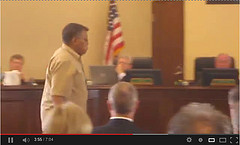
Commissioner Crawford Powell may have found solid grounds to deny the proposed rezoning for a development near Moody AFB, he revealed at this morning’s Work Session of the Lowndes County Commission.

County Planner Jason Davenport explicitly linked this rezoning case,

7.a. REZ-2012-17 Lowndes Development, LLC, Davidson Rd MAZ II and MAZ III to R-10, County Water & Sewer, ~23.49 acres

to the zoning text code amendment on the same meeting agenda.

7.d. TXT-2012-02 MAZ II Residential Density

He also mentioned the TRC (the Technical Review Committee composed mainly of Lowndes County and Valdosta staff) had a split vote on this item, although he didn’t say how it was split. And he said the Commissioners had the Planning Commission recommendation before them, although he didn’t mention the Planning Commission recommended against.

Commissioner Crawford Powell brought up a good point:

The fire department and the TRC say in the notes that it fails to comply with fire rescue ingress-egress requirements.

Fire Chief Guyton appeared to confirm that was the case, although since he wasn’t at a microphone, it’s hard to hear. Commissioner Powell continued:

Continue reading

Glimmers of open discussion about Moody AFB zoning by the County Commission @ LCC 2012-12-10

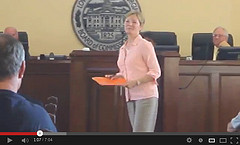
Lowndes County Commissioners had a small amount of open discussion about the proposed changes to the zoning code related to Moody Air Force Base at their Work Session this morning. However, most of the discussion was not about the changes currently proposed, which the County Planner once again explicitly linked to a rezoning case on the same agenda. At least they discussed tabling the zoning code changes until there could be more discussion. They did not, however, say they would make drafts available to the public or invite the public to discuss those drafts.

County Planner Jason Davenport introduced agenda item 7.d. TXT-2012-02 MAZ II Residential Density:

This text amendment is part of the response to some of the questions that were raised with the additional rezoning. At the end of the day what this text amendment is going to do is to take that very outer blue color, the lightest color, which is the MAZ-3, and recommend change the zoning to 1 acre. Currently it’s 2 and a half acres.

He mentioned they missed the 30 day requirement to inform Moody AFB by about a week, but Moody responded anyway. Hm, that’s not what he said to the Planning Commission; there he said they had allowed 31 days.

Commissioner Richard Raines said he’d prefer to table this amendment until next year, because:

I think there are other issues that we’ve discussed related to MAZ. If you have a mobile home and it becomes unlivable, under the restrictions you can’t replace it….

Chairman Ashley Paulk responded that he didn’t have a problem with that, and:

Continue reading

Arctic sea ice melting faster than expected —WMO

A major source of the water for the sea level rise already affecting Savannah and Jacksonville is melting Arctic Ocean sea ice. WMO Press Release No. 966: 2012: Record Arctic Sea Ice Melt, Multiple Extremes and High Temperatures,

“Naturally occurring climate variability due to phenomena such as El Niño and La Niña impact on temperatures and precipitation on a seasonal to annual scale. But they do not alter the underlying long-term trend of rising temperatures due to climate change as a result of human activities,” said WMO Secretary-General Michel Jarraud.

“The extent of Arctic sea ice reached a new record low. The alarming rate of its melt this year highlighted the far-reaching changes taking place on Earth’s oceans and biosphere. Climate change is taking place before our eyes and will continue to do so as a result of the concentrations of greenhouse gases in the atmosphere, which have risen constantly and again reached new records,” added Mr Jarraud.

30 years of Arctic sea ice 15 September 1982 vs 16 September 2012

The Arctic reached its lowest annual sea ice extent since the start of satellite records on 16 September at 3.41 million square kilometers. This was 18% less than the previous record low of 18 September, 2007. The 2012 minimum extent was 49 percent or nearly 3.3 million square kilometers (nearly the size of India) below the 1979—2000 average minimum. Some 11.83 million square kilometers of Arctic ice melted between March and September 2012.

WMO noted other effects of climate change outside the arctic, including:

Continue reading