Tag Archives: Little

Ask Georgia Power to conserve our water –Garry Gentry for WWALS @ GA PSC 2013-06-18

Garry Gentry read the

WWALS Watershed Coalition letter

at

the Georgia Public Service Commission meeting Tuesday 18 June 2013
.

The recent rains have swollen our blackwater rivers, Withlacoochee, Willacoochee, Alapaha, and Little, under our longleaf pines and Spanish-moss-covered oaks, and filled up the tea-colored tannin waters in our frog-singing pocosin cypress swamps here in central South Georgia. But that was only a dent in our protracted drought that ranges from mild to extreme, with projections not much better….


There is no need to use our Floridan Aquifer water to build more
baseload power plants while Georgia lags behind Michigan,
Massachusetts, and even tiny New Jersey and Maryland in solar power.

WWALS calls on the PSC to ask Georgia Power to conserve our water
and to bring jobs to south Georgia through solar power and wind off
the Georgia coast.

You can read

the complete letter
.
Here’s

the video:


Ask Georgia Power to conserve our water –Garry Gentry for WWALS

Georgia Power proposed closing of coal plants,

Administrative Session, GA Public Service Commission (GA PSC),

Doug Everrett (1: south Georgia), Tim Echols (2: east Georgia), Chairman Chuck Eaton (3: metro Atlanta), Stan Wise (5 north Georgia), Bubba McDonald (4: west Georgia),

Video by John S. Quarterman for Lowndes Area Knowledge Exchange (LAKE),

244 Washington Street SW, Atlanta, GA, 30334-9052, 18 June 2013.

-jsq

Watershed meeting organized by Army Corps of Engineers


The

U.S. Army Corps of Engineers (USACE)
didn’t know there was
a large water problem hereabouts, but now they do, and they want
to take a watershed-wide approach, from the headwaters to the Gulf of
Mexico, including both surface water and aquifer issues,
perhaps starting with redrawing FEMA’s flood maps,
and maybe even including once again funding the state water council.


Thursday 11 April 2013 there was a rather large governmental meeting
organized by USACE in response to

the City of Valdosta’s request of 11 March 2103
.
Yesterday,

Valdosta City Council District 5 Tim Carroll
sent the appended
list of attendees, augmented by a conversation with him on the phone 13 April
and a blog comment by him later that same day on
the original post on the WWALS blog,
in which he also remarked:

Very good preliminary meeting that hopefully will yield real action on
our region wide water issues. Thanks for sharing this info with WWALS.

We know little else, because no media or private citizens were invited.

  • USACE Savannah office: Jeff Morris, Georgia Silver Jackets Coordinator and Beth Williams, Hydraulic Engineer
  • USACE Jacksonville office: David Apple, Chief, Watershed and Restoration Planning Section
  • GADNR: Christopher Hill and Tom Shillock, GAEPD Floodplain Management Unit
  • GEMA: Dee Langley, Planning Program Manager and Terry Lunn, Director, Hazard Mitigation Division
  • GEMA: Gary Rice – Regional Field Coordinator
  • USGS: Brian McCallum, Supv. Hydrologist/ADir and Keith McFadden, Physical Scientist
  • FEMA Region 4: Susan Wilson, CFM, Floodplain Management and Insurance Branch Chief and Janice Mitchell, Insurance Specialist and Lender Compliance

Those state and national agencies were brought by:

Continue reading

County response to 10 inches of rain —Ashley Tye @ LCC 2013-02-26


Emergency Services Director Ashley Tye spoke about Local weather conditions
at the

26 Febuary 2013 Lowndes County Commission meeting.

He said the
Withlacoochee River at Skipper Bridge Road
was expected to crest at 20 feet within hours.
He didn’t expect Valdosta’s Withlacoochee Wastewater Treatment Plant to flood.

He said most of the rain fell to the west of Valdosta, so
the Little River actually absorbed more water than the Withlacoochee this time.
Only Shiloh Road and a few other roads were closed.

The boat ramps at Langdale Park were closed in conjunction with Parks and Rec.

A few schools were closed, but all expected to reopen the next day.

Commissioner Demarcus Marshall asked

Continue reading

What does Lowndes Comprehensive Plan say about river corridor protection?


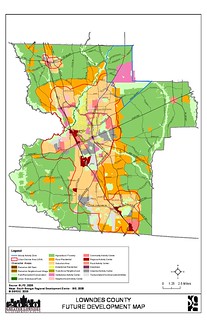
Future Development Map Lowndes County 2030 Comprehensive Plan

Is the Lowndes County Commission a “Qualified Local Government”?
Georgia state law says perennial river corridors

shall be protected
,
all of the major rivers in Lowndes County
(Alapaha, Withlacoochee, Little)

qualify as perennial
,
and

GA EPD rules say

to be a “Qualified Local Government” a comprehensive plan including
River Corridor Protection Plans with protection for a natural vegetative
buffer area bordering each protected river is required.

GA DCA keeps a list of

all the comprehensive plans in the state.

Here’s

Lowndes County’s 2030 Comprehensive Plan.

The main document is the

Community Agenda

and here is

the map.

Hm, the map shows a light blue color for “Park/Recreation/Conservation”
for parts of the Little, Withlacoochee, and Alapaha Rivers in Lowndes
County, but not all.
What about the rest of those rivers in the county?


What does the Community Agenda say?
It doesn’t mention any River Corridor Protection Plans.
However, it does say this:

Continue reading

Putting conservation into conservatives —John S. Quarterman

My op-ed in the VDT today. -jsq

Gov. Deal
(WABE, 14 Nov 2012)
temporarily forgot that “conservative”
includes conserving something,


like

Theodore Roosevelt and national parks
,
or when

Franklin D. Roosevelt established the Okefenokee National Wildlife
Refuge
which also

administers Banks Lake,
when

Richard Nixon started the EPA,

and when

Jimmy Carter signed the Soil and Water Conservation Act.

If Gov. Deal wants to call conservation “liberal”, I’m happy to
be a liberal working for water for our state!


Georgia Water Coalition’s Dirty Dozen


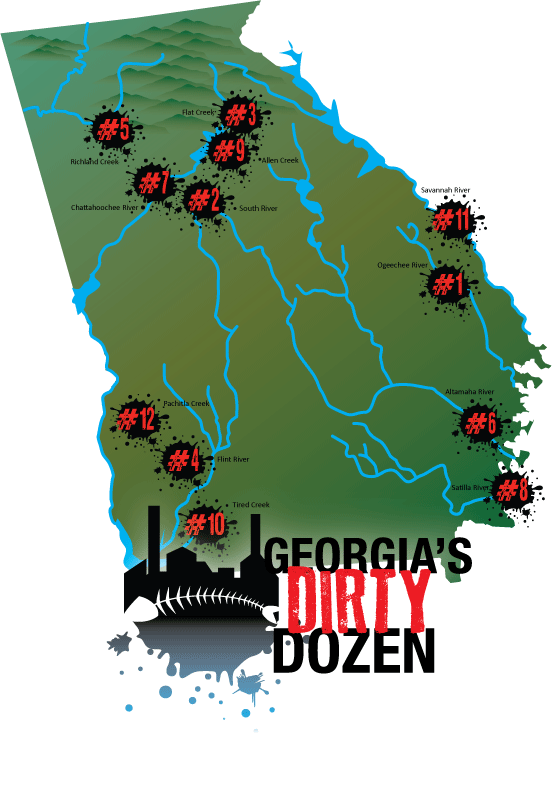
listed the biggest boondoggle
of all as

#11: the nuclear reactors at Plant Vogtle

suck up more water from the Savannah River than all local agriculture and almost
as much as the city of Savannah.

If the new Plant Vogtle nukes

are ever completed,
all four will use more water than Savannah. In

2009 the legislature approved and Gov. Deal signed a law

letting Georgia
Power charge its customers in advance for building that boondoggle,
to the tune of

about $1.5 billion so far!

Let’s not forget

Continue reading

Plant the seeds for viable water future

This AJC op-ed is about coastal wetlands, but
much of it applies to wetlands such as cypress swamps and streams
in Lowndes County and the rest of central south Georgia,
especially since

our state water plan for the Suwannee-Satilla Region

points us at

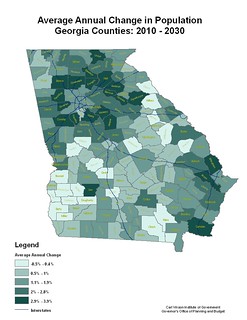
County-Level Population Projections from the Governor’s Office of Planning and Budget

that project 45% growth in Lowndes County population in 20 years to 156,650 people by 2030,
which means near doubling in 30 years to 2050. -jsq

David Kyler wrote for the AJC 29 December 2006,
“Plant the seeds for viable coastal future”,

Recent population projections for the Georgia coast issued by

2010-2030 Change in Population of Georgia Counties

Georgia Tech say nothing new. We’re growing at almost 20 percent a
decade, meaning a near doubling every 35 years.

The Center for a Sustainable Coast projected a population of about 1
million by 2030 for the 11 counties in the coastal region as defined
by the Department of Natural Resources, somewhat higher than the
844,000 predicted by Georgia Tech. This compares with a population
of 538,469 reported in the 2000 Census report.

But the accuracy of projections is not the point. Increased
population will result in more land clearing and environmental
disturbance than in the past—there will be larger homes,
bigger lots and fewer people per household.

National studies show up to twice as much land is

Continue reading

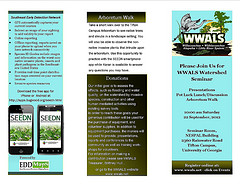
Watershed seminar tomorrow in Tifton


Boating, walking, birding, hunting, fishing: our watersheds provide
us all that, plus what goes in upstream comes out in your drinking
water. Withlacoochee, Willacoochee, Alapaha, and Little Rivers: WWALS
Seminar tomorrow in Tifton. Good talks, good food, good water. Y’all come!

-jsq

10:00 – 10:20 Dave Hetzel,
WWALS President

Welcome/Introductions
10:20 – 10:35 Karen Hendrix, WATER MATTERS: Co-Chair

WATER MATTERS:
Focus & Function
10:35 – 11:10 Neill Herring,
Veteran Conservation Lobbyist
at the GA General Assembly

The Political Economy of Water
Conservation in Georgia
11:10 – 11:45 Jesslyn Shields, Georgia River Network

River Protection Success Stories in Georgia
11:45 – 11:55 Break
11:55 – 12:10 Bret Wagenhorst

Water Trails: Conservation and
Development
12:10 – 12:45 Babe McGowan,
Forester

Best Management Practices for
Riparian Ecosystems
12:45 – 1:00 Karan Rawlins,
University of Georgia

SEEDN smartphone app
1:00 – 2:00 Dave Hetzel

Open Discussion
and Pot Luck Lunch
2:00 – 4:00pm Walk to the Arboretum and
Practice SEEDN App
WWALS Watershed Seminar
10:00 am Saturday

22 September, 2012

Seminar Room

NESPAL Building

2360 Rainwater Road

Tifton Campus

University of Georgia
WWALS
WWALS Watershed
Coalition is an Advocacy
Organization working for
watershed conservation
of the Willacoochee,
Withlacoochee, Alapaha,
and Little River Systems
watershed in south
Georgia and north Florida
through awareness,
environmental
monitoring, and citizen
advocacy.
Introducing WWALS Board
Dave Hetzel — President

John S. Quarterman — VP

Brittney Hull — Treasurer

Nathan Wilkins — Secretary

Gretchen Quarterman

Bret Wagenhorst

Garry Gentry

Karan A. Rawlins

Al Browning
Pot Luck Lunch
All Attendees, please bring
your favorite dish to share

WWALS is Providing
the Main Course

In the spirit of conservation
please bring your own set up:
Plate, fork, knife, spoon, cup

Clean streams to attract business —Al Browning


Al Browning of

WWALS

made a point yesterday that I haven’t heard mentioned
by local Chambers of Commerce or economic development agencies:

Suppose there’s a business looking to south Georgia, to move into an area.
They can go to the

Adopt-A-Stream website
for that particular area,
and get an idea of where the best water is.
And they may choose… that Berrien County has terrible water;
I’m going to go to Cook County, or Lowndes!

Here’s

the video:

That’s

Georgia Adopt-A-Stream
,
which currently doesn’t show any water quality testing sites
for any of those counties, but that could change soon.
Maybe economic development organizations should help it change,
because that lack could be steering businesses elsewhere.

A prominent local economic development appointee asked me last year,

Why would you want absolutely clean ear or water?

Well, businesses considering moving here might want those things
because their employees do.
And their employees might want those things because they
don’t want to get sick.
And besides, who doesn’t like clean air and water?

-jsq

Ben Copeland on water and growth in south Georgia


Ben Copeland asked the big question: “How much growth do we want?”
He related it to regional water in the aquifer, rivers, growth, and planning,
speaking at the Lake Park Chamber of Commerce annual dinner, 28 January 2011.

Copeland is Past Chairman of the Board, Wiregrass Technical College.
He serves on the regional water planning council.
He said

those councils were started due to worries
about Atlanta not having a reliable water supply.

He said the councils were

planning for water and wastewater to 2050.

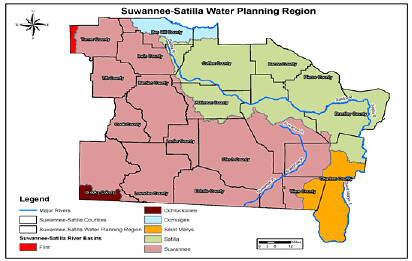
The local regional council is the

Suwannee-Satilla regional water council.


He described the

extent of the water planning region
(see map).
He
expects finalization of the water plan by May.

He talked about the Floridian aquifer, and how he’s worried not so much about Atlanta taking our water as about Orlando, Jacksonville, and Tallahassee.
“Because they all have their straws in that same aquifer.”

Finally, Ben Copeland asked the big question:

“How much growth do we want?”

“Do we want to be Jacksonville?
Do we want to be Tallahassee?
Do we want to be a large metropolitan region?

Folks are going to move to south Georgia, I can tell you that,
because of all the resources that we have.
I’m a great believer in the free enterprise system.
How much do we try to limit that?

Continue reading