ESPLOST will win by 4 to 1.
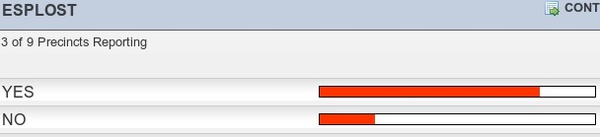
Going not very far out on a limb, with only 3 of 9 precincts reporting,
but with
79+ yes to 20% no at 8:30 PM,
I predict ESPLOST will win.
Oops, make that 7 of 9 precincts; changed while I was writing this.
-jsq
ESPLOST will win by 4 to 1.
Going not very far out on a limb, with only 3 of 9 precincts reporting,
but with
79+ yes to 20% no at 8:30 PM,
I predict ESPLOST will win.
Oops, make that 7 of 9 precincts; changed while I was writing this.
-jsq

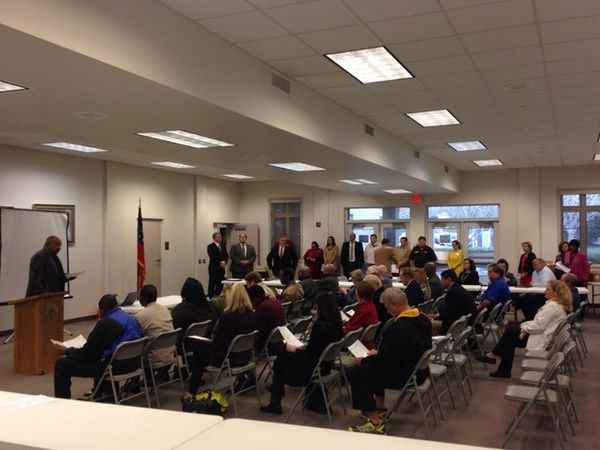
Co-Chair Jerome Tucker emphasized that ESPLOST helping
public schools also helps economic development.
See below for who we now know are the
committee members for the Educational Special Local Option Sales Tax (ESPLOST).
It’s mysterious why that information wasn’t in
the PR before the meeting,
but now we know, since Gretchen went and took the videos
and collected the flyers you’ll find below.
Early voting already started that same day and continues through March 13th,
with the final Election Day 17 March 2015.
Lowndes/Valdosta Citizens for Excellence in Education
Education Special Purpose Local Option Sales Tax
For Lowndes County Schools and Valdosta City Schools Continue reading
A committee of unknown members is holding a kickoff meeting today
for the Educational Special Local Option Sales Tax.

Various local news media carry the announcement below,
but none of them seem to have the names of the committee members
beyond one co-chair.
I guess we’ll find out from the videos Gretchen is going there now to take.
In the City of Valdosta’s
In The City This Week, Feb. 23-28,
Feb. 24: ESPLOST V Campaign. The ESPLOST joint committee will host a
campaign kickoff on Tuesday, Feb. 24, at 5 p.m., in the Valdosta
City Hall Annex Multi-Purpose Room. At the meeting, committee
members will share proposed projects for Lowndes County and Valdosta
City Schools with citizens. Early voting runs Feb. 23 through March
13. The final opportunity to vote will be on the official Election
Day, March 17. For more information, email Co-Chair John Eunice at
jleunice@yahoo.com.
-jsq
Lowndes Schools’ decrease of $4.1 million in annual bond payments after 2013
is more than the total
$3.6 million in bonds Dublin Schools issued
to pay for their
megawatt of solar power.
So Lowndes Schools could float bonds for
solar panels at Lowndes High School
like Dublin Schools did for
Dubin High School.
Or on the new Pine Grove Middle School,
which already has some
energy efficiency features.
Either would decrease outgo in the future, thus evening up the financial structural balance and increasing reserve levels.
The SPLOST mentioned by Moody’s is the educational ESPLOST,
which
passed by more than 4 to 1 in March 2011.

Moody’s PR 17 July 2013,
Moody’s confirms Lowndes County School District, GA’s Aa3 GO rating,
$34.9 million in GO debt affected
New York, July 17, 2013 — Moody’s Investors Service has confirmed the Aa3 general obligation
rating of Lowndes County School District, GA. The Aa3 rating
affects $34.9 million in outstanding general obligation
bonds. The bonds are secured by the district’s general obligation,
unlimited tax pledge but are expected to be paid from proceeds of a one
percent Special Purpose Local Option Sales Tax (SPLOST). The district
has an additional $10 million in general obligation bonds not rated
by Moody’s.SUMMARY RATING RATIONALE
The confirmation of the Aa3 rating reflects the district’s sizeable
and growing tax base, SPLOST support of debt service, modest
debt burden, and rapid payout. The rating also incorporates
the district’s below average socioeconomic indicators and recent
trend of General Fund operating deficits. Excluding a slight 1.7%
decline in fiscal year 2011, Lowndes County School District has
consistently experienced growth in the $3.87 million tax
base, which is expected to continue going forward. The base
benefits from the institutional presence offered by Moody Air Force Base,
Valdosta State University (A1/stable), and South Georgia Medical
Center (A2/stable). The current SPLOST is authorized through September
2017 and should provide sufficient revenues to make debt service payments.
In fiscal year 2012, SPLOST revenues were $12.4 million
compared to debt service payments of $12.2 million.
Following fiscal year 2013’s payment of $12.1 million,
the district’s payments will decline to just under $8 million
annually. Amortization is rapid with all debt fully matured by
fiscal year 2018. The district does not have any plans to issue
additional debt.
Michigan, Massachusetts,
and

New Jersey,
plus Georgia.
Why are so many states attempting pro or con charter school referendums
this year?
Because many states have a push for charter schools,
especially
Louisiana.
Where’s that coming from, at the same time in so many states?
ALEC, that’s where.
Ed Anderson wrote for The Times-Picayune 12 January 2011,
Gov. Bobby Jindal says charter school proposal is based on Florida initiative,
Jindal said his proposal will be fashioned on
a Florida law known as
“Charter-Schools-in-the-Workplace Initiative” which also has been
introduced in 14 other states.
Excuse me?
Which “also has been introduced in 14 other states”?
Then it’s not just a Florida law, is it?
And who introduced it?
Mattreichel wrote for FireDogLake 5 April 2012,
Jindal Puts Louisiana’s Schools Up for Sale: ALEC’s Education Reforms Rammed Through
The poster child for charter school privatization is Louisiana.
It started in New Orleans after Hurricane Katrina,
but the man-made education disaster has spread to the whole state.
Mattreichel wrote for FireDogLake 5 April 2012,
Jindal Puts Louisiana’s Schools Up for Sale: ALEC’s Education Reforms Rammed Through
Louisiana Governor Bobby Jindal has wasted no time this legislative
session in pushing wide-reaching education reforms designed to
expand the charter school footprint, while opening the door to
vouchers and tying teacher tenure to student test results. In the
early hours of the morning on March 23rd, after a marathon session,
the Louisiana State House passed two bills that form the core of a
wide-reaching education reform agenda designed to expand the charter
school footprint, while opening the door to vouchers and tying
teacher tenure to student test results. Governor Bobby Jindal wasted
no time in pushing these reforms through in the first weeks of the
legislative session, and the urgency with which he has advanced this
agenda has infuriated teachers and left even some charter-school
advocates alarmed. “The governor’s expression of urgency for
these bills is specious at best. [They] did not have to be passed
under cover of darkness,” says Louisiana Federation of
Teachers (LFT) president Steve Monaghan. Even Senator Mary Landrieu,
a Democrat who has been an avid charter school advocate, criticized
the Governor’s haste: “I am by no means naïve, and know full
well the Administration’s political advantage of pushing legislation
through with as little debate as possible.” With these bills,
Louisiana is set to join Florida, Ohio and Minnesota amongst the
states that have enacted the most far-reaching of these school
reforms. This marks the latest wave in a concerted nation-wide
effort by right-wing advocacy organizations and their corporate
supporters to ravage the public sector.
While “reform” usually has connotations of “making better”,
in this case, “better” means more profit for private school companies,
not better education for students.
Why would Louisiana’s legislators vote for something so counterproductive
for education?
Here’s another potential charter school referendum
that
BallotPedia doesn’t seem to have caught yet, in New Jersey.
John Mooney wrote for NJ Spotlight 3 February 2012,
Assembly Committee Votes to Put Charters Under Local Control:
Bill calls for local referendum on any school that wants to be granted a charter in a NJ district,
The Assembly education committee yesterday moved a bill that would
give local voters the right to approve new charters in their home
districts. If passed by both houses, the law would make New Jersey
only the third state to require charter schools to face a local
referendum.First proposed last year, the new bill has been toughened for the
new session. Amendments filed with the bill would make those
referendums retroactive for as many as 30 urban and suburban schools
awaiting their final charters.The votes would come after the state’s preliminary approval, but
often as much as a year can lapse before the final charter is
granted and a school can open.
NJ bill A1877 seems to have
gotten stuck in the NJ state Senate Education Committee back in May.
It has 21 sponsors, starting with
Patrick Diegnan (D-Middlesex),
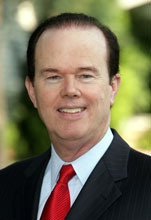
shown in the picture above.
Related bill A2147
got as far as a second reading in the Assembly in February.
Charter schools in Georgia already have to be approved by local school boards.
Let’s not give up that local control.
Vote No on the charter school referendum in November.
-jsq
Thanks to Jim Galloway, we learned that charter school proponents say
“No other state has had a positive outcome for a charter-positive ballot initiative.”
OK, what other states have had any sort of charter school referendums?
Such ballot initiatives have at least been tried in
Massachusetts,
Michigan,
and
Washington.
BallotPedia
records some state charter school referendums.

In Massachusetts,
charter school proponents couldn’t even get enough signatures to put a
pro-charter school referendum on the ballot this year.
The measure would have removed limits on number of charter schools,
their funding, and enrollment. Other changes would have been made in
laws that governed charter schools, including requiring approval of
qualified applications for charter schools to be in districts where
there was low student performance.
In Michigan,
a referendum to ban for-profit charter schools
may be on the ballot in November:
A recent poll shows markedly lower support
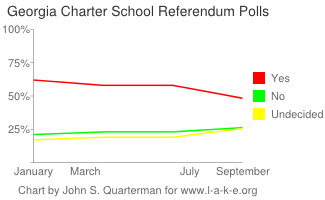
for the November charter school
referendum than polls in March and July, which were already down from January.
At this rate, the charter school referendum can lose as badly in November
as T-SPLOST did in July.
Maybe people are catching on that diverting local taxes to control by
a state appointed body is a bad idea,
especially this time when the money would end up going to private profit.
Georgia Family Council wrote, presumably in January,
Poll Shows Support for Charter School Changes,
On January 24, the Georgia Charter School Association and My School,
My Choice Georgia held a news conference on Capitol Hill to release
the results of a new study regarding public school choice….The new numbers showed that 52 percent of voters are dissatisfied
with the public system as it currently stands. A whopping 72 percent
feel that a group other than local school boards should be able to
authorize charter schools, the basis for HB 881. Moreover, Georgia
voters tend to support a “money follows the child” approach to
charter school funding.
So there’s a baseline for January for what proponents
of charter schools claimed: 72% support for something very like
the charter school referendum that ended up on the November ballot.
Or not.
That writeup includes a link to
georgiaschoolchoice.com,
but that domain is no longer registered.
This is probably it over on
the snazzy new gacharters.org website.
The gacharters.org writeup doesn’t mention 72%, and does say:
T-SPLOST proponents are up to their old tricks again,
starting with the preamble to the charter school referendum.
And
Bert “Little Goose” Brantley,
formerly of Lowndes County, defends that wording.
Paul Crawley wrote for 11alive.com September 12 2012,
Is Charter Schools Amendment wording biased?
Here we go again, apparently another ballot issue with questions
about whether it’s worded fairly.First, it was the July 31st transportation sales tax issue, known as
T-SPLOST, which Georgia voters rejected overwhelmingly.Opponents howled when they found out the ballot preamble wording
promised to “create jobs” and “relieve traffic congestion”.Now, opponents of a November ballot question are also crying foul.
They’re upset over the preamble wording for the Charter School
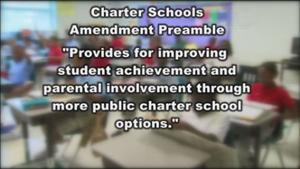
Commission Amendment.It reads, “Provides for improving student achievement and parental
involvement through more public charter school options.”
How can the preamble say that?