Tag Archives: Economy

15 month delay for new Plant Vogtle nukes —state inspector at PSC


Southern Company's new nukes are delayed at least fifteen months,
at least a billion over budget and rising,
and not organized to meet safety filing requirements,
yet the Georgia PSC yesterday
let SO pass the buck to contractors and Georgia Power
continue charging customers for that boondoggle,
despite 40 to 1 opposition from attendees.

Ellen Reinhardt wrote for GPB News yesterday,

Plant Vogtle Construction Costs Rising
,

An independent auditor told utility regulators Plant Vogtle
construction will be delayed at least 15 months and go millions of
dollars over budget.

Nuclear engineer William Jacobs said poor construction material,
contractor mistakes and oversight delays will mean the Unit 3
reactor won't be ready until July of 2017.

That's 15 months later than planned.

Surprise!
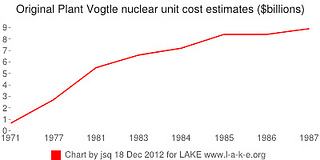
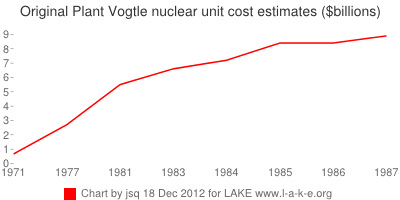
From $0.66 to $8.87 billion: original Plant Vogtle nuclear costs

Who could have expected that, given that back in the 1970s and
1980s

costs blew up 26 times the original estimate.

Back then SO complained about paperwork after Three Mile Island.
They're trying that same excuse now,
but even a former Commissioner-turned-lobbyist is incredulous,
as Kristi Swartz reported for the AJC yesterday,

Monitor: Paperwork problems a drag on Vogtle schedule
,

“It's taken eight months to handle paperwork
deficiencies?” asked Bobby Baker, a former PSC commissioner
who now represents Resource Supply Management, an energy consultant
that works with large commercial, institutional and industrial
electric customers.

A current Commissioner was almost as incredulous:
Continue reading

Original nuclear Plant Vogtle cost overruns

Why should we expect Southern Company to be any better at controlling
costs now than back in the 1970s and 1980s when its original
nukes on the Savannah River went massively over budget?
Massively as in 26 times as much per unit as originally projected.

Kristi Swartz wrote for the AJC 30 Jan 2012,

A financial look at Plant Vogtle nuclear projects
,


From $0.66 to $8.87 billion: original Plant Vogtle nuclear costs

When the two original nuclear units at Plant Vogtle were planned,
the total cost estimate was $660 million.

Yet, as

Jon Gertner reported for NYTimes 16 July 2006
,

The plant took almost 15 years to move from blueprints to being
operational. And by the time it began producing electricity in the
late 1980’s, its total cost, $8.87 billion, was so far overbudget
that Vogtle became yet another notorious example of the evils of
nuclear energy….

The grand plan was to have four reactors. Instead, it was scaled
back to two, Vogtle Unit 1 (finished in 1987) and Vogtle Unit 2
(1989).

That’s right, 4 nuclear units were planned for $660,000,000
fifteen (15) years later only 2 units were built,
for $8,870,000,000.
That’s more than $8 billion in cost overruns,
or more than 13 times the original cost estimate.
So per unit, that’s more than 26 times the original estimate,
or more than $4 billion per unit.

Swartz provided a handy table of cost estimates by year:

Continue reading

Farewell Chairman Ashley Paulk @ LCC 2012-12-14


At the county’s farewell reception for retiring Chairman Ashley Paulk Friday,
Attorney General Sam Olens gave him something to hang on the wall,

Paulk said a few words
,
County Manager Joe Pritchard

read a letter from incoming Chairman Bill Slaughter
,
and

Pritchard said a few words
and gave Paulk a rocking chair, in which he declined to sit.

At some later date maybe I’ll post a retrospective about my neighbor
Ashley Paulk, but for now I think the many posts in this blog will serve,
and meanwhile I look forward to seeing what the new Commission will do
with new Commissioners Demarcus Marshall (District 4), John Page (District 5),
and new Chairman Bill Slaughter.

Here’s

a video playlist:


Farewell Chairman Ashley Paulk, Lowndes County Commission (LCC),

Video by Gretchen Quarterman for Lowndes Area Knowledge Exchange (LAKE),

Valdosta, Lowndes County, Georgia, 14 December 2012.

-jsq

2012 Drought more expensive than Hurricane Sandy


You thought Hurricane Sandy was bad?
You were right, but economically, the ongoing drought is worse economically.
But we already know a much brighter path.

Weather Underground founder Dr. Jeff Masters wrote 16 November 2012,

Lessons from 2012: Droughts, not Hurricanes, are the Greater Danger
,

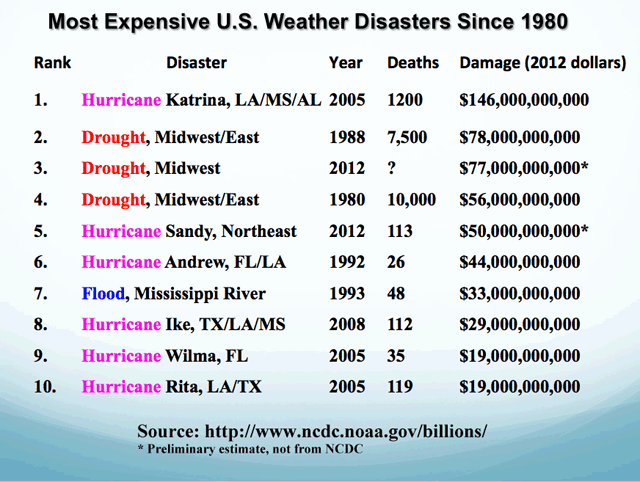
Sandy’s damages of perhaps $50 billion will likely be overshadowed
by the huge costs of the great drought of 2012.


By Dr. Masters’ estimate, the 2012 drought will cost more than half again
as much as Hurricane Sandy.

Also notice Hurricane Katrina still at the top of that table, with almost
three times the economic damage and far more deaths than Hurricane Sandy.
We could have gotten the message back in 2005, but hey, those were only
poor southern people, so who, in for example New York City, really cared?
Yes, I know many of us did and many of you actively helped, but I’m
sure you see my point that when greater New York gets the storm,
suddenly the country pays attention and a lot more people want to find
out how to keep that from happening again.

What’s that drought look like for us here in Georgia at the moment,
according to

U.S. Drought Monitor?

Continue reading

Same old agenda at VLCIA tonight @ VLCIA 2012-12-18

According to their

website

(but curiously

not their facebook page
):


VLCIA logo

The Valdosta-Lowndes County Industrial Authority’s Regular Monthly
Meeting is scheduled for Tuesday, December 18, 2012, 5:30 PM at the
Industrial Authority Conference Room, 2110 N. Patterson Street.

I mentioned to a VLCIA board member Friday that the agendas never changed,
except for the dates for minutes of previous meetings and of financial statements.
I really must apologize!
This one also differs from last month’s agenda in three more ways:

old Executive Director’s Report-Allan Ricketts on behalf of Andrea Schruijer


new
Executive Director’s Report- Andrea Schruijer


old Adjourn General Meeting into Executive Session

old Adjourn Executive Session into General Meeting

old Adjoujrn General Meeting

new Adjourn General Meeting

That’s right: apparently Andrea Schruijer is in town this time,
there’s no scheduled Executive Session, and a typo is fixed.

However, they didn’t change any of the lists of existing or prospective
businesses, or meetings attended, or changes to the website, or acreage owned.
Because the agenda never lists any of those things, nor anything else of substance.
While that sort of secrecy was perhaps useful in trying to sneak
in a private prison and a biomass plant, I wonder if it really helps

attract high tech business like Richmond County

or

attract a solar park like Decatur County
?

Here’s
the agenda.

-jsq

Valdosta-Lowndes County Industrial Authority

Agenda

Tuesday, December 18, 2012 5:30 p.m.

Industrial Authority Conference Room

2110 N. Patterson Street

Continue reading

Are Augusta and Richmond County special in transparency?

So why does

Augusta have the second highest high tech job growth in the country?

I can only speculate, but local government transparency could be a factor.
If you had a high tech company and were looking to open an office,
would you go for a place where you couldn't tell what the local governments
were up to, or one where you could easily find out?
Augusta's combined City Council and County Commission meetings
(it's a consolidated government)

are on video, online.

Their agendas are available in either HTML or PDF,

with attachments
.

Here's an example, their


5 December 2012 Commission Meeting.

It includes

a proposed amendment to their land subdivision code.

The actual proposed ordinance

is linked right into the agenda
so everybody can see it.

And yes, they link attachments into their agendas before
their meetings;
here's

Augusta's agenda for their meeting tomorrow 18 December 2012,

already with attachments, such as this one

about a zoning exception,

which was apparently submitted on a standard agenda submittal form,
and approved by the Clerk of Commission.

Meanwhile, the outgoing Lowndes County Chairman


complained the Chamber of Commerce hadn't read a proposed
zoning code change

even though

that change is not linked into the agenda (nor is anything else)

and
last year

the same Chairman said no drafts would be published.

Tuesday last week, Lowndes County Commissioners passed changes to the
solid waste ordinance
and to the

alcohol ordinance

that voters and taxpayers and business owners did not get to see
before the Commission voted on them.
Those ordinances seem to be on the county website now that it's
too late to provide input on them: alcohol and waste.
Both ordinances were revised with no public hearings.
And the Chairman even

forgot to hold a scheduled public hearing on special tax lighting districts.

Oh, and they

apparently now have property owners paying on almost $9 million
in bonds for a county palace
that only two years ago they said was already completely paid off
out of sales taxes.

If you had a high tech company and were looking to open an office,

Continue reading

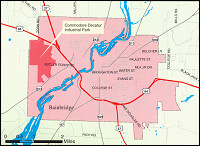
Decatur County already went from private prison to solar park

Decatur County, that’s

turning an industrial park into a solar park
;
why is that county familiar?


Because it’s

the other county that thought it was getting a CCA private prison last year!

Decatur County has already moved on from that boondoggle
that would
have prisoners competing with local workers

while

not increasing local employment
.
Decatur County is already well along towards a solar park that could bring

“400 hundred thousand a year in tax revenue”
.
Has our Industrial Authority got anything in negotiations for a solar park?
How about our Airport Authority?
And what is Georgia Power doing to help?

-jsq

West Point aiming for net zero energy use

U.S. Army is serious about solar, installing solar panels as a
“very visible and a very recognizable part of
our renewable energy initiative that can immediately click with the
general public”
as it makes its military academy net zero, while
encouraging cadets to become renewable energy leaders.
Hm, sounds like

Decatur County with its solar industrial park

and what we could do here with

solar Lowndes High.

Mike Strasser wrote Army PR 29 November 2012,

Solar panels deliver new energy to West Point’s Net Zero initiative,


The installation of solar panels on the roof of the Lichtenberg
Tennis Center—780 panels, to be exact—in recent weeks
represents West Point’s continuing efforts to achieve energy
sustainability.

Since becoming a Net Zero Energy pilot installation last April, West
Point has been making strides toward the ultimate goal of producing
as much energy as it uses by 2020. According to an environmental
assessment for the U.S. Army Environmental Command and West Point
Garrison, the installation currently generates less than .02 percent
of the energy it consumes from renewable sources. Matt Talaber,
Department of Public Works engineer and director, said the solar
panels will be a step in the right direction.

“The solar panels are very visible and a very recognizable part of
our renewable energy initiative that can immediately click with the
general public,” Talaber said. “It’s a positive image that shows
West Point is interested in renewable energy and is working on its
Net Zero energy goals.”

And they’re also improving conservation and efficiency.
Plus this:

Continue reading

AZ invites CCA to help get more customers in School to Prison Pipepline

We could have slipped down this slippery slope with

that proposed CCA private prison,

down to where Casa Grande Arizona is, inviting CCA’s
guards and dogs into our schools to collect our children as
private prison customers.

Sadhbh Walshe wrote for the Guardian 13 December 2012,

Arizona funnels business to CCA through its school-to-prison pipeline:
Casa Grande invited a private prison firm to help make a high-school marijuana bust. Can you spot the conflict of interest?

Drug sweeps of schools are not uncommon occurrences in the recent


past in America, much to the chagrin of civil rights advocates, who
see such sweeps as an efficient means of diverting certain kids to
prison — in some cases, even before they make it to
adolescence, via the much-criticized

“school-to-prison pipeline”
.
What was unusual about this particular raid, however, is that, among
the team of law enforcement personnel and canines put together by
the local Casa Grande police department, there were prison guards
employed by the Corrections Corporation of America (CCA), the
country’s largest for-profit prison company, which owns and operates
several prisons in the area. CCA was also kind enough to provide
their sniffer dogs for the raid.

What’s even more unusual about this is that pretty much nobody in a
position of authority in and around Casa Grande seems to think
there’s anything wrong with that.


That’s where “jobs, jobs, jobs” with no consideration of the consequences
leads you.
Some jobs are not worth having.
Private prison jobs are among them.

The state of Georgia spends a billion dollars a year locking people up,
many of them for minor drug offenses, and around 85% of them for
drug-related offenses.
What if instead we spent a fraction of that money on drug counselling
and mental health care, and the rest on public education?
Then we’d have healthier people more prepared for real jobs.

-jsq

PS: Owed to Dante Acevedo.

Renewables are Winning, Nukes are Dead, and Coal is Crashing


Somebody is willing to read the sunshine writing:

Renewables are Winning, Nukes are Dead and Coal is Crashing
, as
Kathleen Rogers and Danny Kennedy wrote for EcoWatch 14 Dec 2012.

As I wrote

back in April when formerly coal-plotting Cobb EMC went solar:

Coal is dead. Nuclear is going down.
Solar will eat the lunch of utilities that don’t start generating it.

Can Georgia Power and Southern Company (SO) read that handwriting on the wall?


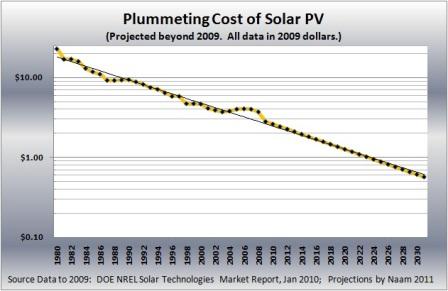
They can’t fight Moore’s Law, which has steadily brought the cost
of solar photovoltaic (PV) energy down for thirty years now, and
shows no signs of stopping.
This is the same Moore’s Law that has put a computer in your pocket
more powerful than a computer
that cost hundreds of thousands of dollars in 1982
and was used by an entire company.

Solar PV costs dropped 50% last year.

Already
all the new U.S. electric capacity installed this September
was solar and wind.

As this trend continues, solar will become so much more cost-effective
than any fossil or nuclear fuel power that nobody will be able to ignore it.

Rogers and Kennedy explained this phenomenon:

The seismic shift in how we all use cell phones and mobile technology to access the internet almost snuck up on the incumbent technologies and the monopolies that made money selling us landline telephones and a crappy service. Now, we’re all using apps on smartphones all of the time. So too, the shift to a scaled, solar-powered future built around the modular technology at the heart of solar power—the photovoltaic solar cell—will come as a surprise to many. We call it the solar ascent, and it is happening every day in a million ways.

Will SO and Georgia Power continue to prop up

that 1973 legal wall


that

inhibits solar financing in Georgia?

Companies and even economic development authorities are

starting to find ways around it,

and of course there’s

Georgia Solar Utilities (GaSU)
trying to

wedge into the law as a utility.

After Hurricane Sandy,

rooftop solar for grid outage independence

has suddenly hit the big time
(Austin Energy caught onto that back in 2003).
The

U.S. military got solar and renewable energy

back in Afghanistan and are now doing it bigtime everywhere.

SO and Georgia Power can try to ignore

Continue reading