Tag Archives: Internet

Rural broadband economics slides


Use of fast Internet access by as many people as possible improves
local income and jobs, and fast Internet access is necessary for
creative workers, according to a nationwide detailed study.

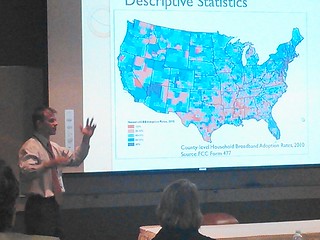
Courtesy of lead author Brian Whitacre (pictured),
here are the slides from

Broadband’s Contribution to Economic Health in Rural Areas: A Causal Analysis
,
presented at the

Telecommunications Policy Research Conference

and previously blogged here as

General broadband adoption improves rural economic health
.
They’re a lot easier to see than my blurry pictures.
You can see the Valdosta MSA on the maps of some of their underlying data.

-jsq

U.S. broadband among most expensive worldwide: why?

We don’t have to continue letting the duopoly gouge us for
slow and expensive Internet access.

We don’t have to wait for Washington

or Atlanta
, either.
We do need our local leaders to stop defining away the issue
and get on with doing something about.

Tom Geoghegan wrote for BBC News 27 October 2013,

Why is broadband more expensive in the US?

Home broadband in the US costs twice as much as it does in Europe
and three times as much as it does in South Korea, according to a
new report. Why?

Because we let the duopoly get away with it,
as

Susan Crawford has been reminding us for a while now
. Continue reading

General broadband adoption improves rural economic health

Want more income, jobs, and creative workers?
Get as many people as possible to use fast affordable Internet connections:
that’s the result of a nationwide detailed study.
Adoption matters more than availability, and speed matters
for creative workers.
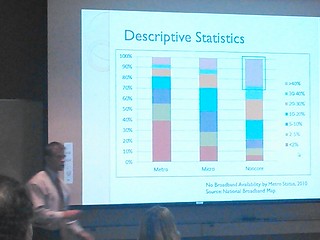

No Broadband Availability by Metro Status, 2010


Broadband’s Contribution to Economic Health in Rural Areas: A Causal Analysis

Brian Whitacre, Oklahoma State University; Roberto Gallardo, Mississippi State University; Sharon Strover, University of Texas at Austin,
presented at the Telecommunications Policy Research Conference,
September 2013.

Conclusion and Policy Implications

Title slide with Brian Whitacre

This research yields important findings on the effect of broadband
on economic gains, namely on household income and employment levels.
The ability to do matched county comparisons, specifically in
non-metro counties, demonstrates the influence of adoption (as
opposed to availability) in producing these positive outcomes, and
constitutes another indication that development efforts should focus
on mobilizing populations to subscribe to and use broadband
capabilities. Again, cultivating local leadership, mobilizing the
services of cooperative extension educators nationwide, and working
more closely with each State Broadband Initiative could be fruitful
avenues for targeting adoption.

We’re in a fertile field for economic improvement this way:
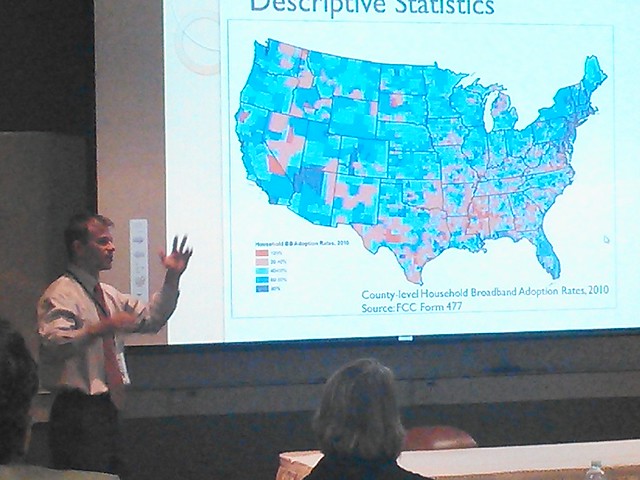

County-level Household Broadband Adoption Rates, 2010

Figure 1 displays Continue reading

Solar power will win like the Internet did

Remember BITNET, FidoNet, or UUCP?
Nope, the Internet overtook all of those.
And in 20 years that’s how young people will remember coal and natural gas plants,
although the waste-disposal costs of nukes will be with us for ten thousand years.
Solar power is going to overtake all other power sources within a decade.
Here’s why I think that.

Jerry Grillo quoted me in Georgia Trend July 2013,

Sun Dancing: As Georgia’s solar capacity shoots skyward, a new state utility is proposed
,


“Solar power is the fastest-growing industry in the world, and
it’s growing along in the same way the Internet did,” says
John S. Quarterman, a Harvard-educated author and Internet pioneer
who launched the first commercial online newsletter, among other
things, and who lives in rural Lowndes County.

“Think back 20 years to 1993. How many people had heard of the
Internet? And look at how far we’ve come. What I’m seeing with solar
energy is the same kind of exponential growth. It’s clean energy
that works, and it generates jobs.”

Here are 1992 ten-year graphs of Internet
growth from that newsletter, Matrix News,
using Continue reading

Softbank buying Sprint buying Clearwire for better Internet

About nine months ago

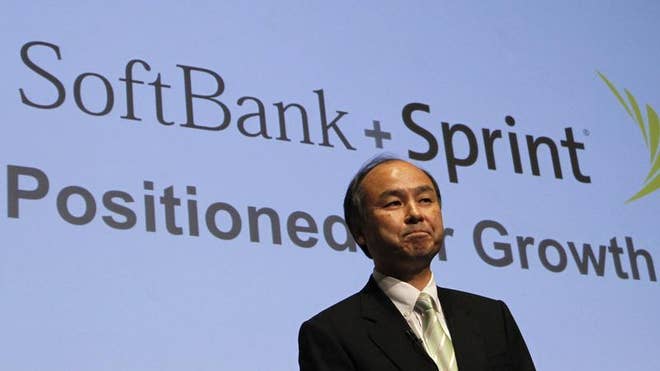
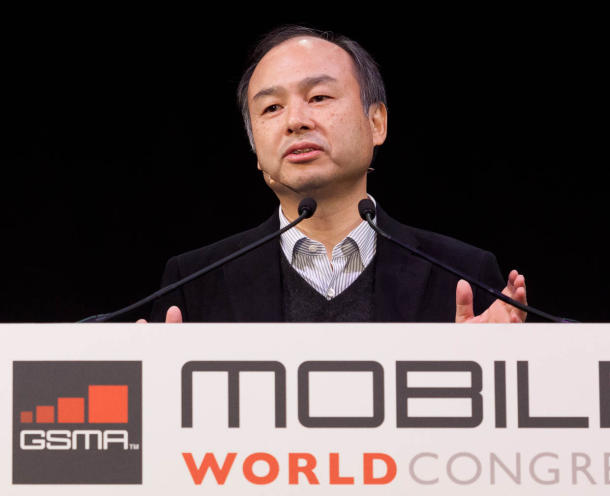
Softbank CEO Masayoshi Son said he wanted to buy Sprint


because he was tired of poor U.S. Internet service.
The FCC has approved that merger.
And Clearwire shareholders have approved Sprint buying Clearwire,
which will provide more spectrum for Sprint to work with.
Sprint, Verizon, and AT&T competing in 4G LTE or faster
wireless Internet services would almost be like a real market!
Today’s the day.


Jordan Crook wrote vfor TechCrunch Monday,

After 9 Months, The Softbank-Sprint Merger Will Be A Done Deal On July 10
,

“SoftBank Corp. will invest approximately USD 21.6 billion
(approximately JPY 1.8 trillion*) in Sprint Nextel Corporation and
currently anticipates consummating the transaction on July 10, 2013
(EDT).”

Continue reading

SO’s plan to make the Southeast a net exporter of the energy from solar and wind? –John S. Quarterman @ SO 2013-05-22

SO CEO Tom Fanning didn’t budge from nuclear and coal,
but he did announce a tiger team to get on top of
distributed solar and wind through a smart grid,
headed by SO’s COO,
at the

22 May 2013 Southern Company Stockholder Meeting
.


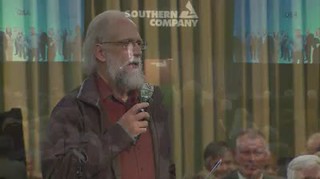
Next question --Tom Fanning

Mr. John S. Quarterman from Lowndes County, Georgia, and he holds
220 shares of Southern Company.

TF: Hello, John. Good to see you again this year.


jsq with SO fade

jsq: Hi. I’ve come to compliment Tom Fanning and Paul Bowers. Last
year, Tom Fanning was so persuasive I ran out and bought $10,000
worth of stock.

TF: Bless you.
[Applause]

However,
apparently because of

SO’s admission a few minutes before in that same meeting

that it was going to have to eat Kemper Coal cost overruns,


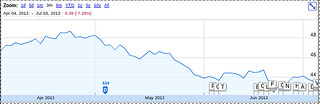
SO stock tanked that same day
,
causing my stock to stop out,
and Standard & Poor’s downgraded SO the following day
because of Kemper Coal, noting that if the same thing happened
with SO’s nuclear project at Plant Vogtle, S&P’s would probably Continue reading

Senate Farm Bill adds Rural Gigabit Amendment

The U.S. Senate just adopted an amendment to invest in gigabit
(1,000 megabit per second) rural broadband networks.


Our local leaders need to lobby for the House to pass this,
if they are serious about fast affordable Internet service for everyone here.
Senator Leahy’s tiny Vermont, with the population of a single Congressional district,

is already well along towards gigabit Internet
.
Our three House members can help get south Georgia on the road to better
jobs, education, and health care through better Internet service.

Jennifer Reading wrote today for WCAX,
Leahy’s high-speed internet amendment passes,

What I want to make sure is that a rural area can compete the same
way an urban area can. It’s actually the argument, the debate that
went on before I was even born about whether you had rural
electricity, rural telephone or not and if we hadn’t done that much
of this country would be a wasteland,” said Sen. Leahy.

Don’t we want that, too?

Continue reading

A grid with a million solar rooftops


Bill McKibben wrote for Rolling Stone 11 April 2013,

The Fossil Fuel Resistance
,

A grid with a million solar rooftops feels more like the Internet
than ConEd; it’s a farmers market in electrons, with the local
control that it implies.

Distributed solar power is
exactly what electric utilities fear.
There’s a reason why

Southern Company CEO Thomas A. Fanning
consistently ranks “renewables” as his second-to-last power
source
;
the only thing worse for big baseload utilities is his last one:
efficiency, which could remove all demand for additional electrical supply in Georgia.

How big of an opportunity for the rest of us is this threat to the
cozy business model of big baseload utilities? Continue reading

Rotary Clubs need broadband @ VLCIA 2013-02-19


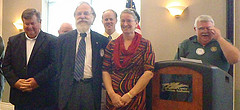
Bill Slaughter, Dennis Marks, John Page, Gretchen Quarterman @ Valdosta Rotary Club 2012-09-12

Before

the Industrial Authority 19 February 2013
meeting,

Gretchen told Bill about how she’s now videoing at Rotary

and

putting playlists on the web
with some delay.
Bill and Gretchen (and Commissioner John Page) go to the same

Valdosta Rotary Club
.
This is yet another use of Internet access:
attracting participants to local community groups,
and getting their speakers to a wider audience.

-jsq


Japan’s Softbank buys Sprint because CEO Son says U.S. networks too slow

U.S. car manufacturers decades ago milked profits out of poor technology
and got outcompeted by Japan on both quality and price.
The same thing is happening right now with fast Internet service.
We may not have to wait for Verizon and AT&T to get around
to offering

affordable fast 4G LTE Internet service:

Sprint may do it first, now that Japan’s Softbank is stepping in.

Roger Chang wrote for CNET News 15 October 2012,

Japan’s Softbank poised to supercharge Sprint network:
Softbank CEO complains that U.S. networks are too slow, and with his $20 billion bid for Sprint, he aims to do something about that.


Softbank CEO Masayoshi Son isn’t impressed with the high-speed
wireless networks in the United States.

“Everytime I come to the U.S., I say ‘Oh my God, the mobile phone
network is so slow,'” Son said during a conference call with
analysts today.

Now, Son is in a position to change things to his liking after
Softbank and Sprint Nextel agreed on a deal in which Softbank would
take a 70 percent stake in the U.S. carrier.

Sprint, which has struggled as a distant No. 3 carrier behind AT&T
and Verizon Wireless, could get a boost from the deal, in which
Softbank spends $12.1 billion to buy the controlling stake and
another $8 billion in investment into the company.

What’s he aiming at improving?

Continue reading