Tag Archives: Sharon Strover

Rural broadband economics slides


Use of fast Internet access by as many people as possible improves
local income and jobs, and fast Internet access is necessary for
creative workers, according to a nationwide detailed study.

Courtesy of lead author Brian Whitacre (pictured),
here are the slides from

Broadband’s Contribution to Economic Health in Rural Areas: A Causal Analysis
,
presented at the

Telecommunications Policy Research Conference

and previously blogged here as

General broadband adoption improves rural economic health
.
They’re a lot easier to see than my blurry pictures.
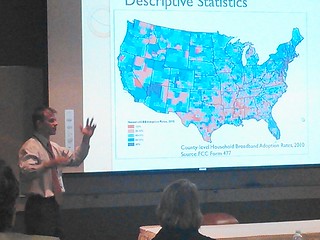
You can see the Valdosta MSA on the maps of some of their underlying data.

-jsq

U.S. broadband among most expensive worldwide: why?

We don’t have to continue letting the duopoly gouge us for
slow and expensive Internet access.

We don’t have to wait for Washington

or Atlanta
, either.
We do need our local leaders to stop defining away the issue
and get on with doing something about.

Tom Geoghegan wrote for BBC News 27 October 2013,

Why is broadband more expensive in the US?

Home broadband in the US costs twice as much as it does in Europe
and three times as much as it does in South Korea, according to a
new report. Why?

Because we let the duopoly get away with it,
as

Susan Crawford has been reminding us for a while now
. Continue reading

General broadband adoption improves rural economic health

Want more income, jobs, and creative workers?
Get as many people as possible to use fast affordable Internet connections:
that’s the result of a nationwide detailed study.
Adoption matters more than availability, and speed matters
for creative workers.
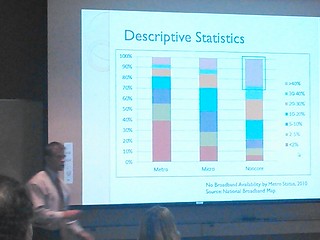

No Broadband Availability by Metro Status, 2010


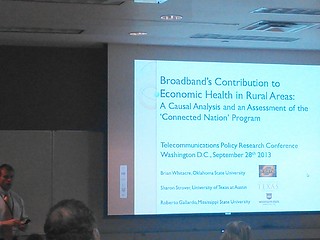
Broadband’s Contribution to Economic Health in Rural Areas: A Causal Analysis

Brian Whitacre, Oklahoma State University; Roberto Gallardo, Mississippi State University; Sharon Strover, University of Texas at Austin,
presented at the Telecommunications Policy Research Conference,
September 2013.

Conclusion and Policy Implications

Title slide with Brian Whitacre

This research yields important findings on the effect of broadband
on economic gains, namely on household income and employment levels.
The ability to do matched county comparisons, specifically in
non-metro counties, demonstrates the influence of adoption (as
opposed to availability) in producing these positive outcomes, and
constitutes another indication that development efforts should focus
on mobilizing populations to subscribe to and use broadband
capabilities. Again, cultivating local leadership, mobilizing the
services of cooperative extension educators nationwide, and working
more closely with each State Broadband Initiative could be fruitful
avenues for targeting adoption.

We’re in a fertile field for economic improvement this way:
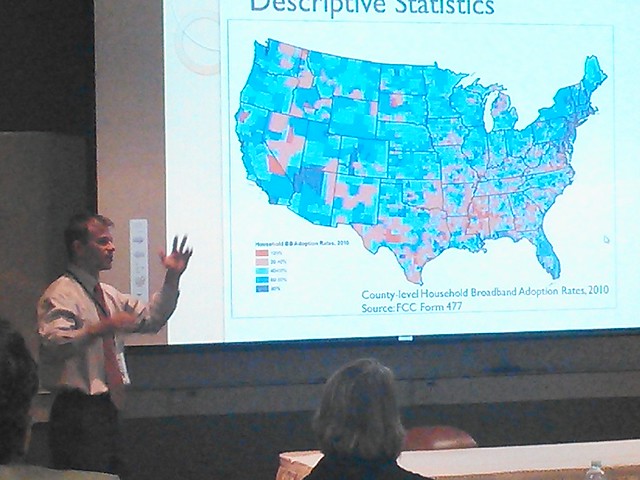

County-level Household Broadband Adoption Rates, 2010

Figure 1 displays Continue reading