Tag Archives: knowledge-based

Rural broadband economics slides


Use of fast Internet access by as many people as possible improves
local income and jobs, and fast Internet access is necessary for
creative workers, according to a nationwide detailed study.

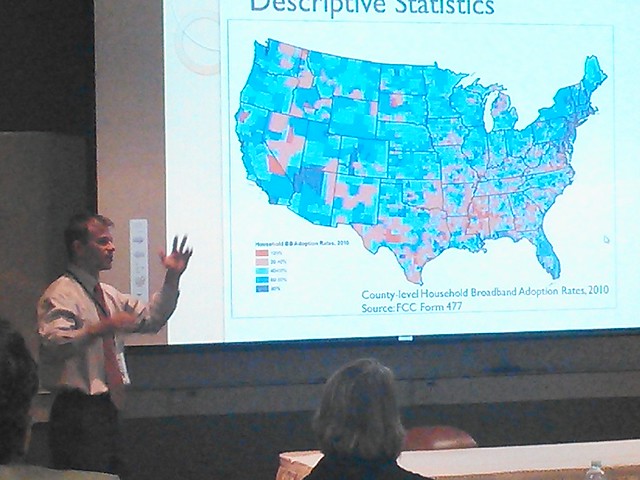
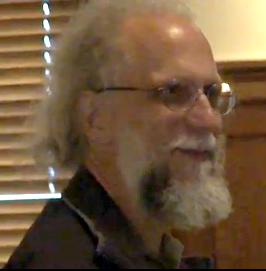
Courtesy of lead author Brian Whitacre (pictured),
here are the slides from

Broadband’s Contribution to Economic Health in Rural Areas: A Causal Analysis
,
presented at the

Telecommunications Policy Research Conference

and previously blogged here as

General broadband adoption improves rural economic health
.
They’re a lot easier to see than my blurry pictures.
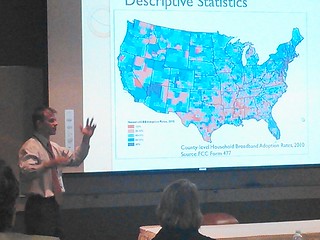
You can see the Valdosta MSA on the maps of some of their underlying data.

-jsq

General broadband adoption improves rural economic health

Want more income, jobs, and creative workers?
Get as many people as possible to use fast affordable Internet connections:
that’s the result of a nationwide detailed study.
Adoption matters more than availability, and speed matters
for creative workers.


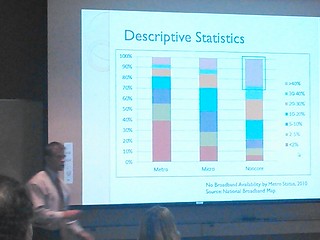
No Broadband Availability by Metro Status, 2010


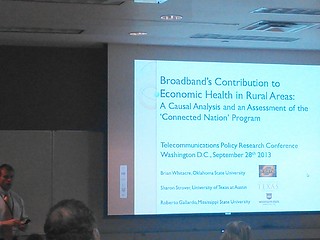
Broadband’s Contribution to Economic Health in Rural Areas: A Causal Analysis

Brian Whitacre, Oklahoma State University; Roberto Gallardo, Mississippi State University; Sharon Strover, University of Texas at Austin,
presented at the Telecommunications Policy Research Conference,
September 2013.

Conclusion and Policy Implications


Title slide with Brian Whitacre

This research yields important findings on the effect of broadband
on economic gains, namely on household income and employment levels.
The ability to do matched county comparisons, specifically in
non-metro counties, demonstrates the influence of adoption (as
opposed to availability) in producing these positive outcomes, and
constitutes another indication that development efforts should focus
on mobilizing populations to subscribe to and use broadband
capabilities. Again, cultivating local leadership, mobilizing the
services of cooperative extension educators nationwide, and working
more closely with each State Broadband Initiative could be fruitful
avenues for targeting adoption.

We’re in a fertile field for economic improvement this way:


County-level Household Broadband Adoption Rates, 2010

Figure 1 displays Continue reading

VDT and Chamber feuding about which is the most negative


popcorn


Image courtesy Fir0002/Flagstaffotos under GFDL v1.2

Break out the popcorn!
The VDT and the Chamber of Commerce are feuding.
About which one is the most negative!
Also, the Chamber hates agriculture.
And everything good around here is to the Chamber’s credit,
but anything bad is not their fault; just ask them.

The VDT editorialized 18 October 2012,

Is Valdosta really one of the poorest?

mostly criticizing

the recent report
that ranked
Valdosta MSA as the third poorest in the country.
The VDT added:

Now that the world wide web has broadcast this story, what can be
done locally to combat this image? And what are the various entities
involved in job and business recruitment, i.e. the Chamber of
Commerce and the Industrial Authority primarily, doing to fix the
underlying problem — low household income and the high
percentage of individuals living below the poverty line.

Valdosta can attract retailers. But can Valdosta step it up and
attract larger industries offering high paying jobs? Has the
community turned away from what made this a successful, viable up
and comer in the state, namely manufacturing and agriculture? These
industries sustained Valdosta for many years and provided good, well
paying, solid blue collar and middle income jobs. Educational
opportunities are far greater today, there are more high school,
tech and college graduates in the area than ever, and blaming the
quality of the work force is starting to lose its luster as a viable
excuse for not bringing in industry. We have the land, we have the
workers, we have the infrastructure and we have a great location
with a good quality of life.

Perhaps the community leadership should focus on the assets that are
already here and less on what’s not. Then maybe the next time a
story like this appears on the Internet, Valdosta won’t be cast in
such a poor light.

The Chamber fired back a broadside to its members, which
I’ve included below here, since I don’t think you can find it online elsewhere.
Here’s the most precious part:

Second, while there is still farmland in Lowndes County, it’s
shrinking and when it sells, it’s for uses at prices that rule out
agricultural use. Agriculture had begun moving to nearby more rural
counties even before the cotton field at the end of Baytree Road
was paved over for Valdosta Mall. Our largest tractor and farm
implement dealers followed.

That’s right, farmland is good for nothing but paving over,
so says the Chamber!
Nevermind that knowledge-based workers generally like

Continue reading

Want knowledge-based jobs? Welcome gays and lesbians


The Chamber, the Industrial Authority, and various other local leaders
say they want knowledge-based jobs, or creative jobs.
We won’t get those just by teaching students to show up on time and
do what they’re told: that’s how you train factory workers,
not knowledge-based employees.
For creative jobs we also need Technology, Talent, and Tolerance.
How do you measure Tolerance?
One key component is the concentration of gays and lesbians.
So today’s

South Georgia Pride Festival

is a good sign for creative jobs in south Georgia!

Richard Florida wrote 16 July 2012 for The Atlantic,

The Geography of Tolerance
,

The map above shows how metros across the U.S. score on the
Tolerance Index, as updated for The Rise of the Creative Class,
Revisited. The chart below shows the top 20 metros. Developed by my
Martin Prosperity Institute colleague Kevin Stolarick, it ranks U.S.
metros according to three key variables—the share of
immigrants or foreign-born residents, the Gay Index (the
concentration of gays and lesbians), and the Integration Index,
which tracks the level of segregation between ethnic and racial
groups.


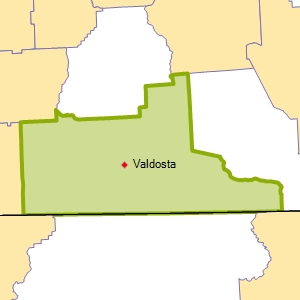
Do you recognize that shape in the middle of south Georgia?
That’s the Valdosta Metropolitan Statistical Area,
consisting of Lowndes, Echols, Lanier, and Brooks Counties.
Looks like about 0.4 on the Tolerance Index.
So sure, we’re no Austin, Texas, but we’re in the same range as oh,
Charlotte, NC.

If you want to help promote creative jobs in south Georgia,
there’s a festival going on today:


South Georgia Pride Festival


noon until 6PM

John W Saunders Park

1151 River Street

Valdosta, Georgia

food and music all day

Who knows,

the Mayor of Valdosta
might even be there; what do you think?
He certainly gave the festival

plenty of earned media.

-jsq

Industrial Authority goes solar, broadband, and conversational!

The Industrial Authority apparently listened to its focus groups,
and discovered that broadband and solar energy are important
to attract industry.
Andrea Schruijer even recommends conversation,
which has been sorely lacking in recent years.
Congratulations, Industrial Authority!

Jason Schaefer wrote for the VDT today,

Authority analyzes Valdosta business:
Broadband, solar power, professional services targeted for growth,



The Authority also plans to work toward the availability of more
broadband Internet service and solar power in Valdosta and
surrounding communities. These amenities would help support local
industries as well as draw new ones to the greater Valdosta area for
the creation of new jobs.

That’s a good start. Although it’s not clear from the writeup that VLCIA quite got it about
Internet access.

As part of presenting Valdosta as an attractive package for


prospective industries, the Authority attempts to ready the land set
aside for development before beginning the recruitment process. This
means investing in infrastructure, including broadband internet.

“It’s not that we don’t have broadband,” Schruijer said.
“What we’re looking at is the technology behind the broadband.
We have it in certain areas, but in order for us to grow some of
these core targets, such as professional services, we need that
infrastructure.”

Well, actually, no,


we don’t have broadband.

6Mbps is the fastest most people can get around here,
and 30Mbps is the slowest you can even buy in many countries.
Plus, it’s not just fast Internet to industrial sites that’s needed:

it’s fast Internet access everywhere knowledge-based employees
may want to live.

But they’re on the right track:

Because the Authority can’t “buy” industries into coming
to Valdosta—though it can offer tax abatements—it is
necessary to make sure that new businesses have what they will need
before ground is even broken, Schruijer said. To this effect, the
Authority will “stimulate the conversation” to actively
attract more broadband companies to the area.

A conversation!
Now there’s something we’ve been needing around here.
And it’s a refreshing change from only
a year ago when all we heard was


“Debate is not allowed.”

Maybe the Industrial Authority will be the organization that will show the
rest of us how to hold civil discussions about things that affect all of us!

The VDT’s writeup skips quickly over another big change:

Continue reading

Lowndes County: commuter rail hub

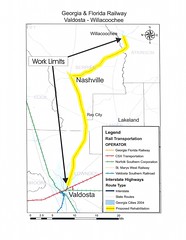
Look at all those other railroads converging on Valdosta in


that GFRR project proposal map.

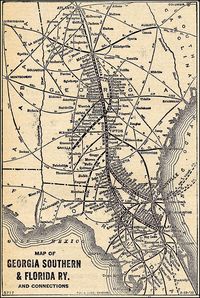
Valdosta is a historical rail hub for passenger traffic to Atlanta,
Savannah, Jacksonville, Orlando, Thomasville, Tallahasssee, and
beyond. All the tracks are still in place and still in use for freight.
With some rolling stock and a few deals with the railroads, Valdosta
and Lowndes County could become again a passenger rail hub with a mass
transit system for local commuting to jobs and for long distance travel.


Add

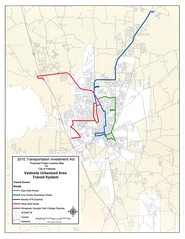
a bus system
and local commuting becomes very practical.
People could take the train to town and catch a bus to work.
Many people could walk or take a bicycle to their work from the
train station.
This could work the other way around, too.
People could live in Valdosta and work in Ray City or Lakeland or
Hahira or Lake Park or Clyattville and not have to drive to get there.
That would save

a lot of wasted time and wasted fuel.

This kind of mass transit would attract the knowledge-based workers
we supposedly want around here.


Including jobs our high school and college graduates could take,
so they wouldn’t have to move elsewhere.

And upgrading the railroads, building stations, building
and refurbishing houses and apartments near the stations, etc.,
would employ a lot of construction workers;
probably as many as road projects and sprawling subdivision projects,
but without the sprawl.

-jsq

Real discussion for real education: Shanghai

Here’s how they do it in the best education system in the world:


Shanghai’s education system is distinctive and superior—and not
just globally, but also nationally. Hong Kong, Beijing, and ten Chinese
provinces participated in the 2009 PISA, but their results reflected
education systems that were still the same-old knowledge acquisition
models, whereas Shanghai had progressed to equipping students with
the ability to interpret and extrapolate information from text and
apply it to real world situations—what we would normally refer to
as ‘creativity.’ Twenty-six percent of Shanghai 15 year-olds could
demonstrate advanced problem-solving skills, whereas the OECD average
is 3 percent.

I do mean that literally, the best in the world:

Every three years, the Organisation for Economic Co-operation and
Development (OECD) administers its worldwide
Programme for International Student Assessment
(PISA) to measure how well a nation’s education
system has been preparing its students for the global knowledge
economy. Nations such as South Korea, Finland, and Singapore have
traditionally topped the rankings, but, apparently, even they are no
match for Shanghai, which shoved the others into lower positions in its
very first year of participation in the programme, in 2009.

That’s according to
Jiang Xueqin writing in the Diplomat 1 August 2011,

How Shanghai Schools Beat Them All
.

So, how did they do it?

Continue reading

Andrea Schruijer’s Opportunity —John S. Quarterman

Here’s my op-ed in the VDT today. -jsq

Welcome

Andrea Shuijer Schruijer
to a great opportunity as the new Executive
Director of the Valdosta-Lowndes County Industrial Authority (VLCIA)!


For a year I’ve been asking for a list of jobs attracted by the
Authority. We welcome your marketing expertise so we’ll know
the Authority’s successes!

We welcome your communications expertise to inform the community
affected by the process of bringing new jobs. VLCIA could publish
its agendas, minutes, and videos of its meetings, events, and
new jobs on its web pages, and facebook, maybe even twitter.

We welcome your stewardship of the Authority’s $3 million/year in taxes.
Maybe some

Continue reading

Expert says Valdosta lags behind Thomasville in Internet speed for business

Let’s leapfrog Thomasville in the 21st century equivalent of roads, rail, and airports: Internet speeds!

Here’s another point from Chris Miller at the

2011 Economic Summit
,
according to the VDT story by Dawn Castro 18 May 2011,
:


“Thomasville didn’t have hi-speed internet,
so the process of moving products quickly was not possible,”
he said, “With Rose Net hi-speed broadband, it is now able to
work 25 times faster.
That one simple step boosted economic product growth,
and as we all know, the technical industry creates a
wage growth path.”


Georgia Internet Speed Results by www.speedmatters.org

So if the Chamber wants, as it says,

knowledge-based businesses and jobs
,

Continue reading

Renewable Energy Network at Opportunity Central

Renewable energy for jobs: that’s something that would interest
a Chamber of Commerce.

Partly due to

MAGE SOLAR at Lowndes High School


(thanks, Jerome Tucker!), the Valdosta – Lowndes County Chamber of Commerce (VLCoC) has taken an interest in renewable energy.
ReKasa Deen,

Business Development Director
,
already heads the Chamber’s

Opportunity Central
:


The Valdosta-Lowndes Chamber is positioning Metro Valdosta as Opportunity
Central with opportunities for business to grow and thrive, career
opportunities for well-educated young professionals and opportunities
for cultural interests and active lifestyles.


The key phrase I keep hearing from

VLCoC president Myrna Ballard

is

“knowledge-based businesses and jobs.”

As it says on a recent

Opportunity Central blog post:

New jobs follow bright and creative professionals…

Ms. Ballard and Ms. Deen have repeatedly said they see renewable energy
as a source of jobs for graduates of our local high schools and colleges.

What do they mean by renewable energy?

Continue reading