Category Archives: Water

How long until solar beats gas?

We’ve heard even German coal importers say solar beats coal. How long until clean solar beats dirty natural gas fracking?

Southern Company has already cut energy production from coal in half, from 70 or 80% to 35%. Unfortunately, SO did that mostly by shifting to natural gas. Natural gas produced through “a revolution in shale gas”, commonly known as fracking. Do we want to trade dirty water for clean air?

Unlike Johnson & Johnson and Dell (and Coke and Pepsi and Amazon and and more than a dozen more, including even Wal-Mart), the Southern Company has not cut ties with ALEC and its pro-fracking and anti-solar campaign. Why is the Southern Company betting on a dirty horse?

How long until SO CEO Thomas A. Fanning’s “one day” when renewable energy becomes economical? Sooner than his prediction of next decade, as in two years ago solar crossed nuclear, wind is already at parity with nuclear, and even Southern Company realizes coal doesn’t beat anything anymore.

How long before solar beats natural gas, relegating gas to much-reduced use as a backup for sun and wind power, as John Blackburn already projected in March 2010 can happen in North Carolina?

How long will it take for the sun and the wind, with a little water and even less natural gas, to power the world? How long? Not long.

Because the arc of the solar Moore’s Law is long, but it bends down for price per watt, while the price of fracking, no matter the quakes and dirty water for ever, does not.

-jsq

Johnson & Johnson and Dell dump ALEC: where’s Southern Company?

J&J and Dell ditched ALEC, for two dozen bailing out of that ship of dubious lobbying. Where's The Southern Company? Still supporting ALEC's pro-fracking and anti-solar campaign?

A week ago Rebeka Wilce reported for PR Watch that Johnson & Johnson 19th Company, 23rd Private Sector Member, to Cut Ties with ALEC. Today Scott Keyes reported for ThinkProgress that Dell Becomes 21st Company To Drop ALEC. So many companies have ditched the corporate-legislative private-public partnership American Legislative Exchange (ALEC) that it's hard to keep count. Yet we still haven't heard from The Southern Company (SO), even as ALEC continues its drive to dismantle incntives for renewable energy and preserve fracking loopholes, and The Southern Company continues expanding use of natural gas (knowing it comes from fracking) while putting off solar and wind until "one day" some time next decade maybe, and (through its subsidiary Georgia Power) actively opposing fixing Georgia legislative hurdles to renewable energy. All that plus wasting Georgia Power customer cash and taxpayer dollars on useless new nukes at Plant Vogtle.

Come on, Southern Company and CEO Thomas A. Fanning: you can do better than that! Turn to the sun and the wind for clean green jobs for community and profit.

If you're a Georgia Power customer and you'd like to help persuade SO, you can pay your Plant Vogtle Construction Work in Progress (CWIP) charge in a separate check and write on it what you'd like instead. Even if you're not, it's election season, and every member of the Georgia legislature is running: you can contact your candidate and find out what they're willing to do to get us solar and wind for energy independence, jobs, community, and profit.

-jsq

REZ-2012-09 Copeland rezoning @ LCC 2012-06-12

How can a man with health care financial troubles make a living with a shop he’s had for decades when some of the neighbors complain about a rezoning that is now required? A controversial case that raised issues ranging from wetlands to public safety to Moody Air Force Base jets flying out of Valdosta Airport made its way through two appointed boards to a Solomonic rezoning decision by the elected Lowndes County Commission. Nobody wanted to deny a man a living, but many people wanted to limit potential commercial uses of the subject property. The Commissioners attempted to take all that into account, yet failed to incorporate two major considerations raised by neighbors, mentioning one of them only to disparage it. Even that isn’t the end of it, since it may head back to the Zoning Board of Appeals for a buffer variance. Here are videos of REZ-2012-09 Copeland at the Lowndes County Commission.

It had been to the Planning Commission for a recommendation on rezoning, it had been to the Zoning Board of Appeals for a buffer variance, Monday morning it had been to the County Commission Work Session at which we learned a bit more, and Tuesday evening it went to the Lowndes County Commission Regular Session for a vote on rezoning.

Monday 11 June 2012 Work Session

At the 8:30 AM Monday Work Session, County Planner Jason Davenport had several updates since Commissioners had received their packets the previous week.

  • An email from a Mr. Bradford in opposition.
  • Some open records requests to be filled after the work session.
  • Some opponents of the rezoning had hired a lawyer. (Those of you who watched Bill Nijem at the Zoning Board of Appeals meeting already would have guessed that. Nijem also spoke the next day at the Regular Session.)
  • Davenport had met with the applicant, Mr. Copeland, who had provided more materials because he believed there were some accusations about lack of continuous operations in the building.

Davenport summarized that he thought there were three camps:

  1. Those not supporting the case.
  2. Those supporting the case,
  3. Those supporting the case with conditions,

He said one possibility would be for he and the county attorney to meet with the opposition attorney to try to work out some conditions.

Tuesday 12 June 2012 Regular Session

The agenda item was

6. Public Hearings – REZ-2012-09 Copeland, 3258 & 3264 Loch Laurel Rd, R-A & R-1 to C-C, well & septic, ~5 acres

Here’s a list of every citizen speaking for, at any of GLPC, ZBOA, or County Commission: John A. Copeland (the applicant), Kevin Copeland (applicant’s son), Nancy Hobby, Charles Miles, Fuller Sorrell, Alan Davis, Robert Roffe, and Norman Bush, plus a petition for.

Here’s a list of every citizen speaking against, at any of GLPC, ZBOA, or County Commission: Bill Nijem (attorney for several neighbors), Jimmy Hiers, Gail Hiers, Greta Vargas, and Patty Haynes.

For the rezoning

Continue reading

Better cities and counties make better watersheds

Want jobs, low taxes, and less flooding? Help maintain our watersheds with good local planning.

What’s a watershed? Kaid Benfield wrote for Atlantic Cities today, The Cost of Sprawl on Clean Water:

Watersheds are topographic areas where all the rain that falls eventually ends up in a namesake steam, river, lake, or estuary.

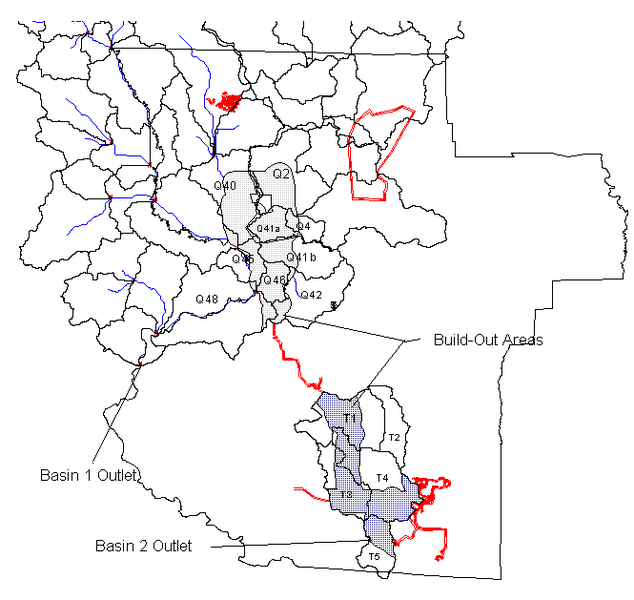
These are our local watersheds. Purple is the Little River Watershed, blue is the Withlacoochee Watershed, and Valdosta is where the Little River flows south into the Withlacoochee. Green is the Alapaha watershed, and Tifton is where all three meet. Every drop of rain or used well water or wastewater overflow or pesticide runoff or soapy shower water or clearcut mud that runs downhill into one of these rivers is in their (and our) watersheds.

Becoming greener doesn’t just mean a municipality’s adding a pleasant new park here and there, or planting more trees, although both components may be useful parts of a larger effort. How a town is designed and developed is related to how well it functions, how well it functions is related to how sustainable it really is, and how sustainable it is, is directly related to how it affects its local waters and those who use those same waters downstream.

Compact, mixed-use, well-designed in-town growth can take some of the pressure off of its opposite on the outskirts — or beyond the outskirts — of towns and cities. We know that sprawling growth is generally pretty bad for maintaining environmental quality in a region (air pollution from cars that become necessary in such circumstances, displacement of open land, water pollution from new roads and shopping centers that are begot by such growth patterns).

We also know, as UGA Prof. Dorfman told us several years ago,

Local governments must ensure balanced growth, as
sprawling residential growth is a certain ticket to fiscal ruin*
* Or at least big tax increases.

Kaid Benfield explains how town planning is related to watersheds:

Continue reading

Video Playlist @ LCC 2012-05-08

An appointment, a road abandonment, three rezonings, and a bunch of for considerations: they did take longer than five minutes. Here are videos of the entire Tuesday 8 May 2012 Regular Session of the Lowndes County Commission. Here’s the agenda. Here are videos of the previous morning’s work session.

They unanimously reappointed four people to the Lowndes County Development Authority. They held a public hearing about abandoning part of an unopened right of way off US 41 South. Nobody spoke either for or against, and they approved the abandonment unanimously.

They heard several items we saw discussed at much more length in the GLPC 30 April videos.

They zipped through everything else on the agenda, approving everything unanimously, including a no-bid item for $60,354.32 to Scruggs Company. There was some discussion about the need for a contract with an audit firm they hadn’t used for three years. They tabled that one, unanimously, of course.

One citizen spoke, me, about Internet speed and access in Lowndes County as necessary for knowledge-based jobs and businesses.

Here’s a video playlist:

Video Playlist
Regular Session, Lowndes County Commission (LCC),
Valdosta, Lowndes County, Georgia, 8 May 2012.
Video by Gretchen Quarterman for Lowndes Area Knowledge Exchange (LAKE).

-jsq

Clean green jobs for community and profit

Tell me who doesn’t want clean jobs for energy independence and profit?

“Environmental sustainability… can lead to more and better jobs, poverty reduction and social inclusion,”

The above quote is Juan Somavia in an article Stephen Leahy wrote for Common Dreams 1 June 2012, For an Ailing Planet, the Cure Already Exists,

Germany’s renewable energy sector now employs more people than its vaunted automobile industry.

No wonder, when German solar power produces more than 20 nuclear plants. How many jobs? According to Welcome to Germany 13 April 2012, Renewable Energies Already Provide More Than 380,000 Jobs in Germany, which cites a report from the German government,

The boom in renewable energies continues to create new jobs in Germany. According to a recently published study commissioned by the Federal Environment Ministry, the development and production of renewable energy technologies and the supply of electricity, heat and fuel from renewable sources provided around 382,000 jobs in 2011.

This is an increase of around 4 percent compared to the previous year and more than double the 2004 figure.

“Current employment figures show that the transformation of our energy system is creating entirely new opportunities on the job market,” said German Environment Minister Norbert Röttgen.

“It is the major project for the future for German industry. This opens up technological and economic opportunities in terms of Germany’s competitiveness as an exporter and location to do business.”

Wouldn’t we like some of that here in sunny south Georgia, a thousand miles south of Germany?

Back to the Stephen Leahy article:

Globally, the renewable energy sector now employs close to five million workers, more than doubling the number of jobs from 2006-2010, according to a study released Thursday by the International Labor Organization (ILO).

The transformation to a greener economy could generate 15 to 60 million additional jobs globally over the next two decades and lift tens of millions of workers out of poverty, concluded the study, “Working towards sustainable development”.

Everyone will benefit. Everyone can benefit starting right now.

Continue reading

Powering North Carolina with wind, sun, and water

Here's some hard evidence of FERC Chairman Jon Wellinghoff's assertion back in 2009 that baseload is outdated, we don't need any new nukes or coal, because we can get all the new power we need from sun and wind. This study from North Carolina goes further: we don't need coal or nukes at all.

John Blackburn, Ph.D. wrote a report March 2010, Matching Utility Loads with Solar and Wind Power in North Carolina: Dealing with Intermittent Electricity Sources,

Takoma Park, Maryland, and Durham, North Carolina, March 4, 2010: Solar and wind power can supply the vast majority of North Carolina's electricity needs, according to a major report released today. Combined with generation from hydroelectric and other renewable sources, such as landfill gas, only six percent of electricity would have to be purchased from outside the system or produced at conventional plants.

Hourly Power Generation and Load for a sample day in July

"Even though the wind does not blow nor the sun shine all the time, careful management, readily available storage and other renewable sources, can produce nearly all the electricity North Carolinians consume," explained Dr. John Blackburn, the study's author. Dr. Blackburn is Professor Emeritus of Economics and former Chancellor at Duke University.

"Critics of renewable power point out that solar and wind sources are intermittent," Dr. Blackburn continued. "The truth is that solar and wind are complementary in North Carolina. Wind speeds are usually higher at night than in the daytime. They also blow faster in winter than summer. Solar generation, on the other hand, takes place in the daytime. Sunlight is only half as strong in winter as in summertime. Drawing wind power from different areas — the coast, mountains, the sounds or the ocean — reduces variations in generation. Using wind and solar in tandem is even more reliable. Together, they can generate three-fourths of the state's electricity. When hydroelectric and other renewable sources are added, the gap to be filled is surprisingly small. Only six percent of North Carolina's electricity would have to come from conventional power plants or from other systems."

Six percent is a small number. That means most coal plants could be shut down, and no nukes are needed.

Continue reading

Videos @ LCC 2012 05 07

Here are videos of the entire approximately eight minute 7 May 2012 Work Session of the Lowndes County Commission. They vote in Regular Session tonight at 5:30PM. Here’s the agenda.

See other post about “5. Appointments – Lowndes County Development Authority”.

Two weeks ago they decided to hold a public hearing about abandoning part of the Right of Way of old US 41 South, but this time it’s on the agenda as a Resolution, and it appears part of the request has been withdrawn, and some people would be left landlocked with no access to a public road, so it seems the Resolution will be to table at least part of it to an undetermined future date. Yet the County Engineer seemed to reccomend going ahead with the rest of the abandonment. Where’s the public hearing?

Two rezonings had no comments. The third, just north of Hahira, got opposition at the Planning Commission; see the other post on that.

A developer wants, according to County Planner Jason Davenport, a letter from the Commission so it can more readily get tax credits from the federal government. He didn’t say what the tax credits would be for. For a concrete front yard? Or for solar on the roof? It will be interesting to see how the anti-grant Commissioners vote on this one, when it’s a developer who benefits.

It sounds like the county wants to award a contract to Continue reading

Valdosta confused about water uses

Is there an outdoor water restriction in Valdosta, or isn’t there? The city and the newspaper seem confused about that. Also remember much of Lowndes County gets its water indirectly from Valdosta through the county’s utility system. And that with groundwater levels at all-time lows, we need to be conserving all the time anyway, and thinking about how much and what kind of growth we want.

The City of Valdosta front page says:

In the Spotlight

The City of Valdosta has issued an outdoor water restriction suspending all outdoor water uses for 72-hours, or until further notice. Click here for more.

Yet if you click there, you get this error page:

Error The page you have requested does not exist. Please click here to go back to the home page.

Similarly, there was a VDT article on that subject, but that link also goes nowhere now.

Stephen Abel wrote for WALB yesterday, Temporary water restrictions in effect for Valdosta,

Folks in Valdosta need to think twice about washing their cars, or doing anything else that uses much water, this weekend.

“The city of Valdosta is urging all citizens to immediately cease outdoor irrigation use and all other nonessential uses of water. Now and throughout the weekend,” said Public Information Officer Sementha Mathews.

Severe vibrations in the water pumps is what put them out of commission. “The city’s water treatment plant experienced some mechanical issues this week with two of its raw water well pumps which caused the low levels in water,” said Mathews.

So, did the city fix its pumps? Or is it just confused about what to do?

WCTV posted this update, and seemed to indicate the water restrictions were still in place:

The City of Valdosta sincerely thanks the citizens who responded quickly to its request today to cease all outdoor irrigation and non-essential use of water. Currently, there are no water quality issues in the system, and the water provided by the city is safe for all purposes.

People should be conserving all the time anyway. These suggestions from the city are pretty good for a start:

Continue reading

Coal ash at Plant Scherer considered harmful for your health

Penny-wise, pound foolish, that's coal and coal ash, we're all discovering.

S. Heather Duncan wrote for the Macon Telegraph 14 April 2012, Plant Scherer ash pond worries neighbors as Georgia Power buys, levels homes,

The home among the trees was supposed to be Mark Goolsby's inheritance. His 78-year-old mother now lives in the large, white, wood farmhouse that his family built before the Civil War.

But Goolsby says he'll never live there now.

That's because across the street and through those trees is one of the largest coal ash ponds in the country. It belongs to Plant Scherer, a coal-fired plant that came to the neighborhood considerably later than the Goolsby family. In the mid-1970s, Goolsby said, “when (Georgia Power) bought 350 acres from my dad, they told him we'd never know they were there.”

Those acres are now part of an unlined pond where Georgia Power deposits about 1,000 pounds of toxic coal ash a day. Neither federal nor Georgia rules require groundwater monitoring around the pond. The federal Toxic Release Inventory shows that in 2010 alone, the pond received ash containing thousands of pounds of heavy metals and radioactive compounds including arsenic, vanadium, and chromium.

The U.S. Environmental Protection Agency estimates that up to 1 in 50 residents nationally who live near ash ponds could get cancer from the arsenic leaking into wells. The EPA also predicts that unlined ash ponds can increase other health risks, such as damage to the liver, kidneys and central nervous system, from contaminants such as lead.

A massive 2008 spill from a Tennessee coal ash pond led to greater scrutiny of the dams that hold these ponds in place, and the EPA promised new rules for storing coal ash. The process led to broader awareness of a more long-term health threat: groundwater contamination from the ponds.

So what's Georgia Power's solution?

Monroe County property records show Georgia Power has spent about $1.1 million buying property near Plant Scherer between 2008 and the end of 2010. But the true number may be higher.

They're going to have to keep doing that until they buy up a lot more property, I predict.

Wouldn't it be cheaper for the future bottom line of Georgia Power and its parent the Southern Company to invest in solar and wind power?

-jsq