Category Archives: Water

Updated LAKE front page with some current hot topics

The LAKE front page is updated with some current hot topics to make LAKE blog posts on them easier to find.

There's a primary election on right now, and in addition to candidates, there's a referendum on T-SPLOST, a new 1 percent transportation sales tax on everything including food that would create a new regional level of government run by GDOT in Atlanta and does nothing for public transportation, bicycles, or pedestrians. It's on the 31 July 2012 primary ballot, and early voting has already started.

Other topics include nuclear and how it's holding back solar and wind, water and how planning can affect it, and the ongoing problem of incarceration including ALEC, the lobbyist-legislator public-private partnership that's pushing all sorts of bad laws. Those and more topics are available through the Categories links on the right hand side of the blog, but some of them are especially current right now, so they're also at the top of the LAKE front page.

-jsq

Privatizing water: could it happen here?

Water, the next oil: many big companies have already been betting on that for years now. Do we want privatize companies controling our water supplies for their profit, running up prices at our expense? We can prevent that, and we should get on with it.

Jeneen Interlandi wrote for Newsweek 8 October 2010, The New Oil: Should private companies control our most precious natural resource?

…privately owned water utilities will charge what the market can bear, and spend as little as they can get away with on maintenance and environmental protection. Other commodities are subject to the same laws, of course. But with energy, or food, customers have options: they can switch from oil to natural gas, or eat more chicken and less beef. There is no substitute for water, not even Coca-Cola. And, of course, those other things don’t just fall from the sky on whoever happens to be lucky enough to be living below. “Markets don’t care about the environment,” says Olson. “And they don’t care about human rights. They care about profit.”

Well, that couldn’t happen here. Or could it? What about this:

Many of us have no idea where our water comes from….

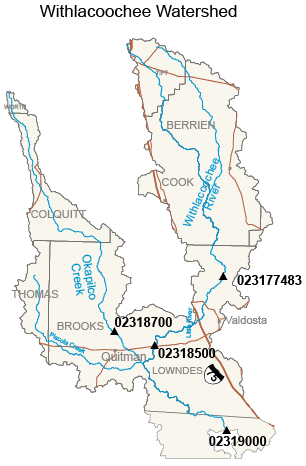
Do you know what’s upstream of you, that might be getting into your water? Do you know what’s downstream of you, that your runoff migh be getting into? If you’re like me, you’ll have to look that up.

Remember what Ben Copeland said: Orlando, Jacksonville, and Tallahassee “all have their straws in that same aquifer.” The Floridan aquifer, which is the source of most of our drinking water. Our rivers and streams help replenish the Floridan aquifer, but we’re using it up faster than rain falls.

The article goes on about Bolivia privatizing water as a condition of “austerity”, until Continue reading

Profits per Market Cap in the Forbes 2000: solar and wind still win

We saw that two out of three of the most profitable electric utilities in the world emphasize solar and wind energy: ENEL of Italy and Iberdrola of Spain, both of which operate in multiple countries, including Iberdrola claiming second most wind power in the U.S. Well, maybe those companies are small, so their profits are a fluke. Nope. We get similar results for profits divided by market cap:

ENEL of Italy is still number 1, with no nuclear and a lot of solar and wind energy. Iberdrola is #4 in profits/market instead of #3 in profits alone. However, Electricité de France (EDF) is #7 instead of #2, and Exelon is #9 instead of #4. Number 2 is Energias de Portugal (EDP), which is heavily into wind power including owning Horizon Wind Energy LLC:

Continue reading

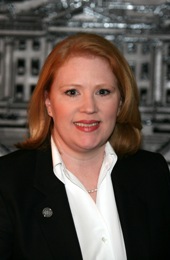
Gretchen Quarterman is running for Lowndes County Chairman

In case you haven’t heard, one of the LAKE crew, Gretchen Quarterman, is running for Chairman of the Lowndes County Commission. Today she’s at the Spirit of America Celebration at Valdosta Mall (next to Buffalo Wild Wing). As you can see, she’s been practicing.

Here’s her campaign website and her facebook campaign page. According to the VDT, 8 May 2012,

“Anyone who is entrusted with the resources of another human being or thing, you have to be a good steward of tax money, air, and water. They are entrusted to us and need to be handled with responsibility.”

Continue reading

Nuclear and coal burning water: solar doesn’t

Solar power is the smart thing to do for jobs, energy independence, and profit. It’s also what we need to do to save water.

Julia Pyper and ClimateWire wrote for Scientific American 29 June 2012, Electricity Generation ‘Burning’ Rivers of Drought-Scorched Southeast: A new report reckons the water cost of electricity generation

Power plants are guzzling water across the United States and increasing the risk of blackouts in the Southeast, where the precious resource is drying up.

“Burning Our Rivers,” a new report by the River Network, found that it takes about 40,000 gallons of water to meet the average American household’s energy needs, which is five times more than the amount of water used directly in that home….

Table 3. Total Water Footprint of a Kilowatt-hour
(Gallons per kWh)
2009 U.S. Electric Grid
(National weighted average)
Hydroelectric 29.920
Coal 7.143
Natural Gas 1.512
Nuclear 2.995
Geothermal 0.002
Solar 0.002
Wind 0.001
Total 41.575

In the Southeast, which has been battling a drought for more than a year, the impact of power plants is especially worrisome and could lead to brownouts and blackouts throughout the summer and beyond.

“The conflicts between energy and water needs are ones we’ve seen before … and will only worsen as the frequency of drought increases and water temperatures rise driven in part by climate change,” said Ulla Reeves, regional program director at the Southern Alliance for Clean Energy.

The report’s number 1 recommendation:

1. As a nation, we should focus on renewable energy sources and low water technologies.

Why?

Continue reading

It’s only going to get hotter: time for solar power

Looks like the heat wave is going to continue for a while, according to NOAA’s maximum heat index forecasts. Reuters wrote today,

A heat wave baking the eastern United States in record temperatures is set to continue on Sunday after deadly storms killed at least 12 people, downed power lines from Indiana to Maryland and left more than 3 million customers without power….

Utilities in Ohio, Virginia and Maryland described damage to their power grids as catastrophic.

Laura J. Nelson wrote for the LA Times Friday, As a heat wave rolls across U.S., scientists predict more to come

Continue reading

Record Georgia temperatures above 100 degrees

Driving north Friday, the temperatures kept getting hotter. John C. Griffin recorded these temperature signs, used here by permission. Friday 29 June 2012:

Record heat wave with triple digits in Macon, Georgia on Riverside Drive at Arkwright Road
Photography by John Griffin (c) 2012 All Rights reserved

I can attest it was still over 100 in Macon after dark Friday.

And it only got worse Saturday 30 June 2012:

Arkwright Road at Riverside Drive – I-75 Exit 169 – Macon, Georgia Record Heat Wave
Photography (c) John Griffin All Rights Reserved

That’s 107 on Friday and 111 Saturday in Macon, where the previous record high for June was 106.

You know, Macon, where Georgia Power is still “studying” and “experimenting” with solar power. Solar power that continues to generate in the heat with no water use. Solar power that Continue reading

Electric Utility Profits in the Forbes Global 2000 from 2006 through 2012

Which are the most and least consistently profitable electric utilities in the world? Hint: the biggest losers all lost on nukes. But the biggest winners may surprise you.

Following up on Southern Company CEO Thomas A. Fanning’s brag that “We are a great, big company from an energy production standpoint,” I looked in the Forbes Global 2000 to see which are the biggest electricities in the world. Indeed, Southern Company (SO) is the biggest in the U.S. and number 6 in the world for 2012. But what about the rest, and what about previous years? Here’s a graph of profits for the top 40 electric utilities from 2006 through 2012. SO is the blue line muddling along in the middle:

Profits

Profits
Graph by John S. Quarterman from

What’s that dark red line dropping way below the rest? Tokyo Electric Power (TEPCO), owner of the Fukushima nuclear plants. And the red line starting at the top and ending up near the bottom? E.ON, the company that owns most of Germany’s nuclear plants, as Germany shifts away from nuclear energy, after Cheronobyl and now Fukushima. The blue line that ends up as low as E.ON? Korea Electric Power (KEP), also an owner of nuclear plants. All the big losers are nuke owners.

What about the winners? The light green line ending up second by profits is Electricité de France (EDF), also an owner of nuclear plants, but one which has not yet had a major accident.

But what’s that purple line that starts near the top and ends up at the top?

Continue reading

Strategies for Lowndes County? —John S. Quarterman

My op-ed in the VDT today. -jsq

Our high schools and college graduates mostly have to go somewhere else, because jobs here are few and many of them don’t pay enough for a decent living. Should we not care enough about our families and our community to come up with strategies that grow existing businesses and attract new ones that will employ local people?

We need discussions and strategies that involve the whole community, going beyond just the usual planning professionals, to include all groups and individuals with information or opinions, whether they got here generations ago or last week: for fairness and for freedom.

Sometimes we see local strategy. Winn Roberson organized Drive Away CCA. Ashley Paulk verified there was no business case for a biomass plant in Lowndes County after many people successfully opposed it. School “unification” opponents, out-financed 10 to 1, still defeated that referendum 4 to 1.

How do we go beyond opposing things and move on to sustainable strategies that build clean industry?

The Industrial Authority focus group meeting I attended Wednesday was refreshing, because their consultants asked the opinions of people some of whom previously had to picket outside. The previous day, VLCIA Chairman Roy Copeland said this strategic planning process was a long time coming. I agree, and while nobody can say what will come of it at this point, I hope it does produce a real Economic Development Strategy.

Building on the Valdosta City Council’s annual consideration of affordable housing,

Continue reading

TS Debbie and south Georgia extreme drought —Ashley Tye @ LCC 2012-06-25

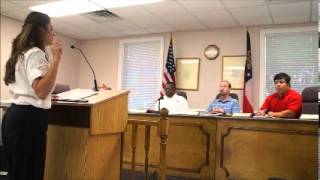
Lowndes County Emergency Management Agency Director Ashley Tye correctly predicted no tornadoes and quite a bit of rain for when Tropical Storm Debbie made landfall. He also mentioned our chronic drought, and Commissioner Richard Raines was surprised about that.

Raines asked:

What kind of conditions would it take for us, because you and I talked a couple of weeks ago, and I was I was surprised when you said that. I guess there’s a difference between drought and extreme drought. What kind of rain conditions would we need to get out of that, I guess in terms of inches, for the water table….

Tye answered:

For them to officially declare us out of the drought, the latest numbers I’ve seen were about 15 inches over the next 30 days, or over the next 3 months, it would have to be like 25 to 30 inches. So we still need a lot of rain. But every little bit is going to help. With the rain we’ve got recently we’re better off than we were, but we’re still technically classifed as in extreme drought.

Here’s the video:

TS Debbie and south Georgia extreme drought —Ashley Tye
Work Session, Lowndes County Commission (LCC),
Video by Gretchen Quarterman for Lowndes Area Knowledge Exchange (LAKE), Valdosta, Lowndes County, Georgia, 25 June 2012.

Readers of this blog know we were already in drought more than a year ago. According to U.S. Drought Monitor, we’ve been in a protracted extreme drought since then. According to USGS, our groundwater levels are all red, as in extremely low. Extremely low as in at historically low levels, as in they’ve hardly ever, if ever, been this low.

-jsq