Tag Archives: Thomas A. Fanning

Bloomberg links MS Kemper Coal cost overruns to GA Plant Vogtle nukes


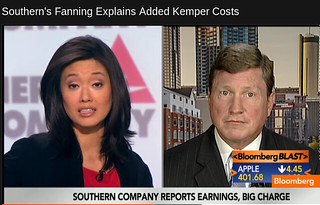
Betty Liu of Bloomberg quizzes Thomas A. Fanning of Southern Company

Bloomberg has

video of Southern Company CEO Thomas A. Fanning
trying to explain away

how cost overruns at SO’s nuclear Plant Vogtle in Georgia are
linked to cost overruns SO’s coal Plant Kemper in Mississippi
.

Betty Liu: This project along with the Vogtle project…
has some investors wondering maybe Southern Company has
stretched itself too thin, with these two major projects you’ve got under way….

Fanning: In fact, the Vogtle project is going beautifully.
We have delayed the in-service date by a year, but….

That’s funny, GA PSC and the AJC say Continue reading

How can we get Georgia to move ahead in solar power?


If we

can’t expect Georgia Power or Southern Company to change their tune about solar power
,
what can we do?
Legislate and raise public pressure, while getting on with installing what
solar power we can.


Maybe it’s time to pass something like

HB 267
that would limit Georgia Power’s profits on

that 19-month-late and $1 billion over budget nuclear boondoggle at Plant Vogtle
.
Instead of pouring more money down that broken concrete pit on the Savannah River,
we need something like

GA SB 51, The Georgia Cogeneration and Distributed Generation Act
,
to fix

Georgia’s special solar financing problem
,
the antique 1973 Territorial Electric Service Act.
That’s the 40-year-old antiquated law that SO CEO Thomas A. Fanning says
“we need to protect”.
Maybe SO does, for Fanning’s
huge raises in compensation
.
Georgia Power and SO are not only defending that antique law,
they’re preventing
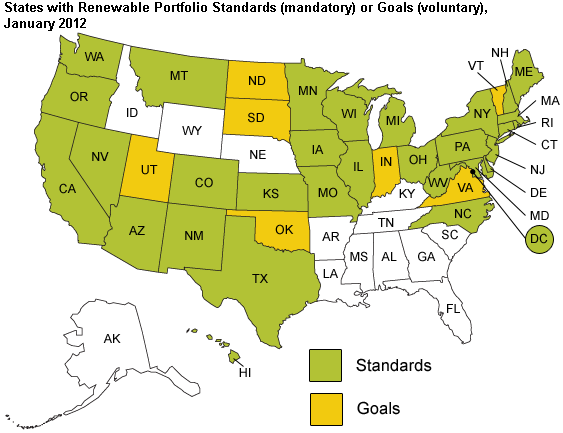
a Georgia Renewable Portfolio Standard (REPS) by stopping passage of bills like
HB 503
.
Georgia Power, SO, and super-lobby ALEC

systematically oppose renewable energy standards
.


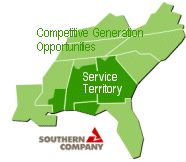
They do this so successfully there are no REPS in Southern Company (SO)’s
service territory, nor in most of SO’s surrounding
“Competitive Generation Opportunities” states.
One of the few exceptions is North Carolina, and

a bill was introduced there to eliminate NC’s REPS
.

Maybe it’s even time to do something about

Georgia Power’s 11% guaranteed profit
.
Isn’t Georgia Power supposed to be a utility operating for the good of
Georgians?
Why does it get a guaranteed profit to pass on to Southern Company
shareholder dividends and SO executive bonuses?


Georgia Power and even Southern Company could suddenly flip for solar power
like
Austin Energy did in 2003
and Cobb EMC did in 2012.
But that probably won’t happen without a lot of public pressure,
legal requirements by the Georgia legislature or PSC,
or a shareholder revolt.
So let’s start with

the public pressure
….

-jsq

Dragging Georgia behind in solar power: Georgia Power and Southern Company

As long as we leave it to Georgia Power and Southern Company, Georgia
will remain

far behind in solar power
jobs, profits, and energy independence.
Hear

Southern Company CEO Thomas A. Fanning say
:


We remain very bullish on solar. When we think about renewables, I
think renewables are exceedingly important to this nation’s future.
My sense is until we see significant technology innovation, my sense
is that that will probably very late in this decade or beyond that,
we still are gonna get by far the lion’s share of electricity from
central stations.

SO’s “bullish on solar” means nuclear, “clean coal”, and natural gas
big baseload power stations, and forget about solar or wind.
That’s why


Georgia Power has raised customer rates to pay for gas and nuclear plants

while complaining about solar.
Here’s Georgia Power CEO Paul Bowers:

“Renewable (energy sources are) going to have a sliver,”
Bowers said of fuels to create electricity. “Is it going to be
2 or 4 percent? That’s yet to be determined. Economics will drive
that. But you always remember (that renewable energy is) an
intermittent resource. It’s not one you can depend on 100 percent of
the time.”

What is to be done?

-jsq

$1.88 billion and more on Kemper Coal to be charged to Mississippi Power customers


Risks at

Southern Company’s Kemper Coal plant in Mississippi
?
Push those costs onto the public, of course!
Southern Company and its subsidiary Mississippi Power
got the MS Public Service Commissioners to approve super-CWIP
(Construction Work in Progress)
for Kemper Coal: automatic rate increases for MS Power customers for years.
Just like Southern Company and its biggest subsidiary Georgia Power
got the Georgia legislature to approve Super-CWIP for the new nukes
at Plant Vogtle back in 2009.
And both CWIP projects are already over budget.
How about we cancel those boondoggles and build solar and wind instead?

AP reported 13 December 2012,

After spending $1.88 billion, Southern Co. still faces risks on plant in Kemper County
,

Continue reading

Solar cars and charging stations: who wouldn’t?

Tired of Southern Company CEO Fanning’s

maybe “next decade”
for solar power?


Tired of Georgia Power’s Bowers

trying to push solar off for fifty years?

Let’s hear from somebody who takes on big tasks and gets them done:
Elon Musk, who’s already built a rocket that is resupplying the International
Space Station, and who is also building all-electric cars.

Carl Hoffman wrote for Smithsonian magazine December 2012,

Elon Musk, the Rocket Man With a Sweet Ride

When he’s not launching rockets, Musk is disrupting the notoriously
obdurate automobile industry (see National Treasure, p. 42). While
industry giants like Chevrolet and Nissan and Toyota were dithering
with electric-gasoline hybrids, this upstart kid said he would
design and manufacture an all-electric car that would travel
hundreds of miles on a single charge. The Tesla Roadster hit the
streets in 2008 with a range of 200 miles, and the far more


functional Model S, starting at $57,000, was introduced in June.
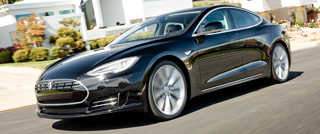
It’s the world’s first all-electric car that does everything my old
gasoline version does, only better. The high-end model travels 300
miles on a single charge, leaps from zero to 60 in 5.5 seconds,
slows from 60 to a dead stop in 105 feet, can seat up to five, has
room for mulch bags and golf clubs, handles like a race car and its
battery comes with an eight-year, 100,000-mile warranty. If you
charged it via solar panels, it would run off the sun. One hundred a
week are being produced in a former Toyota factory in Fremont,
California, and nearly 13,000 people have put deposits on them….

And since that story:

Continue reading

Fake fracking reports: professor and institute head quit, other institute disbanded

From Austin to Buffalo, fake science for fracking is increasingly being exposed,

Frack U

with academic consequences: lead professor resigns,
institute head quits, another institute disbanded.
The image on the right (Frack U) is not a reputation any university wants to see.
At least academia takes conflicts of interest seriously;
now if government and the voters would do the same….
Or energy companies.
Remember, shale gas (plus nuclear) is what Georgia Power and
Southern Company are shifting to from coal,
while shading us from the finances that would enable solar power
for jobs and energy independence in south Georgia.

Terrence Henry
wrote for NPR 6 December 2012,

Review of UT Fracking Study Finds Failure to Disclose Conflict of Interest (Updated)

The original report by UT Austin’s Energy Institute,


‘Fact-Based Regulation for Environmental Protection in the Shale Gas
Development,’
was released early this year, and claimed that there
was no link between fracking and water contamination. But this
summer, the

Public Accountability Initiative
, a watchdog group,
reported that the head of the study, UT professor Chip Groat, had
been sitting on the board of a drilling company the entire time. His
compensation totaled over $1.5 million over the last five years.
That prompted the University to announce an independent review of
the study a month later, which was released today.

The review finds many problems with the original study, chief among
them that Groat did not disclose what it calls a “clear
conflict of interest,” which “severely diminished”
the study. The study was originally commissioned as a way to correct
what it called “controversies” over fracking because of
media reports, but ironically ended up as a lightning rod itself for
failing to disclose conflicts of interest and for lacking scientific
rigor.

Unrepentant
as recently as July,
Professor Groat resigned in November.
Plus this:

Raymond Orbach of UT’s Energy Institute has resigned after the group
became engulfed in controversy over a study of fracking.

And elsewhere even more drastic results have ensued:

Continue reading

Financing solar energy: Georgia’s special problem

In most states, financing solar energy is largely a matter of learning
all the local ropes.
In Georgia, there’s a bigger problem.

Michael Mendelsohn
wrote for RMI 5 December 2012,

How Do We Lower Solar Installation Costs and Open the Market to Securitized Portfolios: Standardize and Harmonize
,

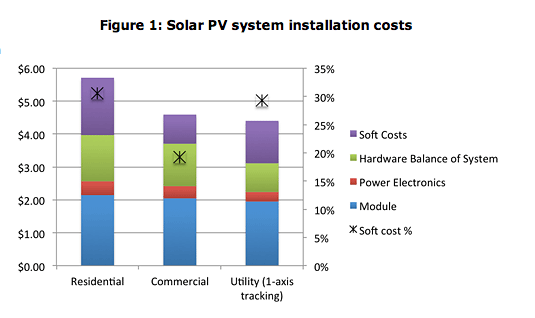
Soft costs can be pretty tough. The cost of solar installations can
be generally separated into “hard” costs — representing
primary components such as modules, racking, inverters — and
soft costs including legal, permitting, and financing. While the
former group — particularly modules — have dropped
dramatically over the last several years, the latter have not.
According to a recent NREL analysis, these costs represent roughly
30% of both residential and utility installations (slightly less for
commercial-host systems). See Figure 1.


In fact, soft costs are so critical to the overall success of solar
adoption, their reduction is a primary focus of the Department of
Energy’s SunShot Initiative to make solar energy cost-competitive.
In order to reduce the cost of financing, NREL recently completed
and continues to work on various efforts to tap public capital
markets and enable other vehicles that securitize project
portfolios.

We’ll come back to tapping public capital markets and the like,
because that’s the key to what

Georgia Solar Utilities (GaSU) is trying to do.

But there’s a special problem in Georgia, buried in the next paragraph:

Continue reading

GaSU wins at GA PSC, but will GaSU help all of us win in the legislature?

GA PSC Stan Wise’s 2009 nuclear CWIP lobbying points eerily matched Southern Company’s,
but suddenly he’s got separation-of-powers religion about Georgia Solar Utilities (GaSU).
The PSC recommended GaSU’s utility bid anyway.
When the legislature takes that up in a month or so, will GaSU CEO Robert Green,
unlike SO or Georgia Power or Stan Wise, help the rest of us little people
fix the 1973 Territoriality law so we can sell our solar electricity
on a free market?

Dave Williams wrote for the Atlanta Business Chronicle yesterday,

Georgia Public Service Commission moves ahead on solar energy
,


Georgia Power logo

The Georgia Public Service Commission approved a plan by Georgia
Power Co. Tuesday to acquire an additional 210 megawatts of solar
generating capacity, more than tripling its investment in solar
energy.

GA PSC PR about 20 November 2012 decisions

But a sharply divided PSC also gave a potential competitor to
Georgia Power its blessing to appeal to the General Assembly to
amend a 39-year-old law that gives the Atlanta-based utility the
exclusive right to continue serving existing customers.

Under Georgia Power’s Advanced Solar Initiative, the company will
buy solar power produced by both large “utility-scale”
solar farms and from smaller projects operated by residential and
commercial property owners.

Right, that’s actually

only 10 Megawatts from “smaller projects”,

maintaining Georgia Power’s monopoly while throwing throwing
a bone to the rest of us.

While the PSC supported Georgia Power’s plan unanimously, a
subsequent motion by McDonald encouraging other solar utilities
interested in serving Georgia to pursue their plans with the
legislature passed by the narrow margin of 3-2.

Georgia Solar Utilities Inc., a company launched in Macon, Ga.,
earlier this year, filed an application with the PSC in September
for authority to generate solar energy in Georgia on a utility
scale.

The two Nay votes were from the two recently-reelected PSC members,
apparently now thoroughly in the pocket of the incumbent utilities.
Here’s one of them now:

Continue reading

Wind for Georgia jobs and electricity?

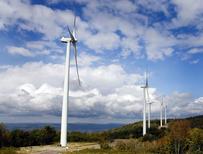
Georgia is already benefiting by jobs from wind manufacturing. What if we increased that, and generated wind energy, too?

Kristi E. Swartz wrote for the AJC 2 June 2012, Ga. blown away by wind’s potential,

The state already is home to more than a dozen companies that make components that either go into wind turbines or that assist in building them. Such development has been a way for Georgia and the Southeast to capitalize on the wind energy industry even though the state lacks a steady wind needed for the giant turbines to spin constantly and create electricity.

“It’s … to have some visibility in the industry and to let those industry players know that this is an industry that’s important to Georgia, that it is on our radar screen, and it’s one of our targeted industries,” said Tom Croteau, director of the Economic Development Department’s food, energy, logistics and agribusiness projects division.

That’s good, let’s do more of it. Except that part about “lacks a steady wind”: we know Georgia does have wind offshore.

Here’s why we’re not generating wind electricity in Georgia. Hint: the answer is

Continue reading

Who will let the sun shine on Georgia?

Someone asked who to vote for who will represent the people more than the electric utilities, on Elect Georgia legislators and Public Service Commissioners who will let the sun shine on Georgia! OK, here’s my opinion.

Sec. State provides you with a sample ballot.

For PSC, vote for somebody who isn’t an incumbent (the incumbents are marked on the ballot). The election today is a primary, so you need to select a Democratic ballot (Steve Oppenheimer District 3 is not an incumbent) or a Republican ballot (Pam Davidson District 5 and Matt Reid District 3 are not incumbents).

For the legislature, here is a list of who voted for the nuke stealth tax as a charge on Georgia Power bills for electricity nobody will get for years if ever. On your ballot, see if somebody else is running against them. Around here, somebody is: Bikram Mohanty for State Senate District 8, Teresa Lawrence for State House District 174, and JC Cunningham for State House District 175, all Democrats, since the incumbents switched parties after being elected last time.

So, if you want solar and wind energy for jobs, energy independence, and profit in the state of Georgia, instead of Georgia Power’s bet-the-farm nuclear risk at Plant Vogtle and Southern Company’s natural gas fracking, that’s who I would vote for.

If, like me, you didn’t already vote early, today is the final day to vote in this primary, and you and I’ll be going down to the precinct polling place to cast a ballot. Today’s the day!

-jsq