Tag Archives: Moody AFB

Wiregrass Alley for local agricultural knowledge-based jobs

What jobs and businesses can we

build out of local agriculture and VSU and Wiregrass Tech and GMC
and SGMC and Moody
? Build like the way Silicon Valley grew out of
Stanford and HP and Intel, but different, drawing on our local strengths?
Various things, no doubt, but the companies
the VDT listed in its

agricultural heartland
article
suggest maybe Wiregrass Alley:

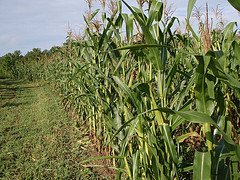
When you factor in businesses such as South Georgia Pecan, PCA, the
Langdale Company,


Shiloh Farms, Dupont, Arizona Chemical, ERCO
Worldwide, Coggins Farms, Carter and Sons, and the additional
farmers represented by Farmer Browns, the impact of agriculture in
Lowndes County alone is one of the largest private, non-governmental
industries. Across the region, ag and forestry sustain the economies
of a number of counties.
Many of those are obviously agricultural, but Dupont, Arizona Chemical,
and ERCO?
OK, I’ll buy

Arizona Chemical

which turns pine products into adhesives and smells.
But DuPont?
Sure, they make chemical fertilizer,
but that’s like listing Chevron as a home heating company.

And what’s this

ERCO Worldwide
, which provides chemicals like caustic soda for PCA?
ERCO Worldwide’s other name hereabouts is
Sterling Pulp Chemicals.
That’s right, the VDT listed Sterling Chemicals as an agricultural company!
Well, that’s hard to deny, because,
according to

FundingUniverse
,
Sterling Chemicals
“was founded in 1986 to acquire and operate Monsanto Co.’s petrochemical plant in Texas City, Texas.”
Nobody can say Monsanto isn’t agricultural, when 90+% of corn, soybeans,
cotton, and peanuts grown hereabouts are grown from Monsanto seeds.
Which is why we have so many chemical fertilizers and poisonous
pesticides being used around here.
Is that really the direction we want to go?

What if we turn the VDT’s list around,

and start with the “additional farmers”
represented by Farmer Brown and Carters?
You know, the ones who sell at Valdosta Farm Days?
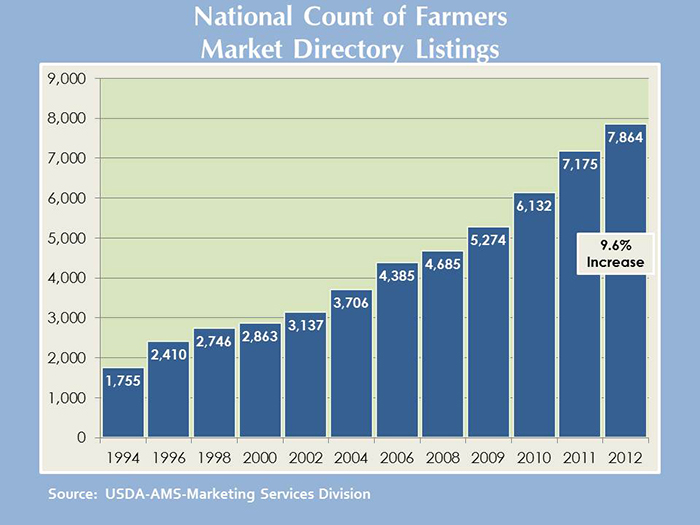
Farmers markets have

increased 6% on average for the past decade.

Why is that?
Partly because of
the conversations and community
at a farmers market.
Anybody who has gone to Valdosta Farm Days or Hahira Farm Days can attest to that.
And it’s not just anecdotal:
there is

research to demonstrate that in farmers markets compared to supermarkets:

On average, the sociologists found, people were having ten times as
many conversations per visit.

Another reason farmers markets are spreading so fast is
people are paying attention to the increasing number of scientific
reports that “conventional” agriculture is poisoning us,
such as

the recent one that demonstrates that even the inert ingredients
in Roundup are poisonous

or the one that links the active ingredient, glyphosate,

to Parkinson’s disease.

Maybe they’ve heard about Monsanto

being sued for “devastating birth defects” and chemical poisoning.

And most farmers market customers seem to like fresh local foods that
taste good and that support local farmers.
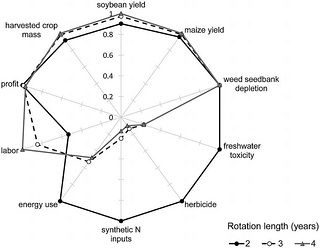


So what if we started with those “additional farmers”
that sell at Farmer Brown and Carters and Valdosta Farm Days?
They are the ones already starting in a different direction.
A direction that is actually

more profitable
,
in addition to healthier (and less flooding and more wildlife).
Crop rotation takes more thought and more labor (more jobs!)
than just spraying,
but it also takes a lot less expense on patented seeds and chemicals,
for a net financial profit.

Which could help explain why

the USDA says
:

Consumer demand for organically produced goods has shown
double-digit growth for well over a decade, providing market
incentives for U.S. farmers across a broad range of products.

The USDA is talking certified organic, which has so many hoops
to jump through that most local producers are not certified, yet many
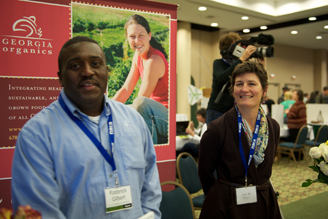

also aren’t using a lot of chemical inputs and are using
crop rotation and other organic techniques.
Techniques which many old-timers around here will recognize,
because they used to use them a half century ago,
but with new wrinkles such as computerized records and
recent research that may make them even more effective.
That’s right:
modern organic and local agriculture is a knowledge-based industry.

What has all this got to do with the colleges and SGMC and Moody?
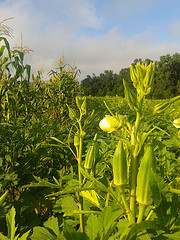

Moody could be a big customer for local agricultural produce,
as could the local K-12 schools; VSU already is.
Wiregrass Tech can (and already is) help teach people how to grow
organic or with fewer manufactured inputs.
VSU and GMC can study how that’s working out,
in conjunction with SGMC, which eventually will have fewer
cases of some kinds of diseases to deal with.
How many cases, of what kinds of diseases?
There’s a field of research we could lead,
along with the agricultural industry to cause such improvements in health:
healthy jobs from planting to PhDs!

And if we do want other kinds of knowledge-based businesses and workers
(which is where Silicon Valley usually gets mentioned),
I think we’ll find they like a place that produces local healthy foods.

-jsq
Agriculture considered beneficial —VDT

The VDT’s first recent agriculture story
started to connect the dots to

building on local strengths

to growing local knowledge-based jobs in

Wiregrass Alley.

“Staff Writer” wrote for the VDT 14 November 2012,

Valdosta-Lowndes: An agricultural heartland
,

When the Valdosta Daily Times and its sister newspapers in Tifton,


Thomasville, Cordele, Americus and Moultrie decided to launch an
agriculture magazine in January 2011 to be distributed across South
Georgia, it was unknown how it would be received.

Well, the first couple of issues were quarterly, and then due to
overwhelming response and requests, it is now a bi-monthly
publication going into its third year.

While Valdosta may not consider itself an agriculture community, we
sometimes forget just how much acreage and economic benefit derives
from the ag and forestry industries locally. With a farmgate value
of $70 million and more than two thirds of our entire county taxable
digest in agriculture and forestry use, Lowndes County remains
dependent on this economic sector almost as much as the surrounding
counties, which we consider far more rural than ours.

That’s great, and I congratulate the VDT.
Their conclusion is also good as far as it goes,
but it could go further:

Continue reading

Thumbs up for agriculture —VDT

The VDT continues to congratulate agriculture as a mainstay of the
local economy.
It’s amazing what a little investigative reporting can turn up!
Now if the VDT would connect a few dots of local strengths and suggest how
we could take a few tips from Silicon Valley on how to become
the Wiregrass Alley of agricultural knowledge-based industry.

The VDT opined Friday,

Thumbs up
,


THUMBS UP: To the region’s farmers and people involved in the
agricultural industry. While some may think agriculture is a thing
of South Georgia’s past, a Times story revealed this week that
Lowndes County’s farmgate has a $70 million value, making it one of
the strongest private-sector industries after South Georgia Medical
Center. Given the continued financial clout on the economy, we offer
a green thumbs up.

The “some people” would presumably include the Chamber,
which made it pretty clear

it considers agriculture mostly good for paving over for a shopping mall
.

The VDT story mentioned in the Thumbs Up was apparently not
Kay Harris’

agriculture alive and well
,
rather another one of the same day.
See
next post.

-jsq

Agriculture alive and well in Lowndes: even Kay Harris says so

The VDT went out and did some research and discovered that
agriculture is not only still here in Lowndes County,
it’s one of the biggest industries here, and by some
measures it’s increasing.
What if the local elected and appointed and self-appointed
boards and authorities helped promote agriculture
as a local industry?

Kay Harris wrote for the VDT yesterday,

South Georgia agriculture alive and well
,

Agriculture and forestry remain among the strongest economic engines
in South Georgia, including Lowndes County.

A look at the recent farmgate value for 2011 for Lowndes County
shows a $70 million effect on the local economy, making it one of
the strongest private-sector industries in the county following
South Georgia Medical Center.

The popularity of The Times’ bi-monthly sister publication Ag Scene
led this newspaper to look at the ag/forestry industry to see if it
has diminished in economic importance over the years.


Actually, the number of farms in Lowndes County

has slightly increased in recent some recent years.

The VDT proceeded to do som research, asking Jake Price,
Lowndes County Extension Agent, who noted there are actually
more farms in Lowndes County than in some surrounding counties,
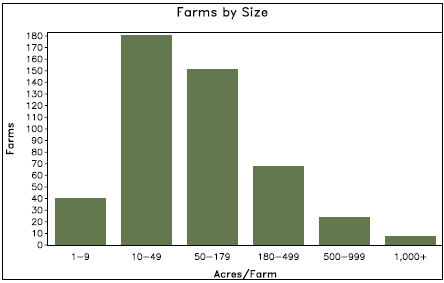
because they tended to be smaller here, with quite a few people
farming on the side.
That and agriculture-based events have become more popular,
such as last week’s Hog Show.
(And he didn’t mention the new last year Valdosta Farm Days.)
He continued:

Continue reading

Help the military stop climate change through sustainable renewable energy

In memory of Armistice Day, the eleventh hour of the eleventh day of the
eleventh month, when World War I ended,
let’s help the military get us off of oil
and to deal with climate change so fewer people will die in wars.

John M. Broder wrote for NYTimes 9 November 2012,

Climate Change Report Outlines Perils for U.S. Military
,

Climate change is accelerating, and it will place unparalleled strains on


American military and intelligence agencies in coming years
by causing ever more disruptive events around the globe,
the nation’s top scientific research group said in a
report
issued Friday.

The group, the National
Research Council
, says in a study commissioned by the
C.I.A. and other intelligence agencies that
clusters of apparently unrelated events exacerbated by a warming climate
will create more frequent but unpredictable crises in water supplies,
food markets, energy supply chains and public health systems.


Hurricane Sandy provided a foretaste
of what can be expected more often in the near future, the report’s
lead author, John D. Steinbruner, said in an interview.

“This is the sort of thing we were talking about,” said
Mr. Steinbruner, a longtime authority on national security. “You
can debate the specific contribution of global warming to that storm. But
we’re saying climate extremes are going to be more frequent, and
this was an example of what they could mean. We’re also saying it
could get a whole lot worse than that.”

Climate-driven crises could lead to internal instability or international
conflict and might force the United States to provide humanitarian
assistance or, in some cases, military force to protect vital energy,
economic or other interests, the study said.


This is in addition to the even more obvious
connection between war and U.S. dependence on foreign oil

which the veterans in Operation Free want to fix

by helping us shift to clean renewable energy.

“In Iraq… the lines would stretch up to ten miles long under
the hot sun, under constant risk of attack by extremists. I realized
then just how vulnerable it makes any country to be dependent on
oil, especially the United States, which uses nearly a quarter of
the world’s supply.”

We also heard last year from

Col. Dan Nolan (U.S. Army ret.) that the Marines in Afghanistan
realized

Continue reading

Agenda @ GLPC 2012-10-29


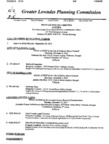
GLPC Agenda 2012-10-29

The Greater Lowndes Planning Commission (GLPC) meets tonight.
Here’s the

agenda.

The agenda was

faxed by GLPC Chairman Bill Slaughter
to Gretchen Quarterman for LAKE
, at her request;
GLPC itself still doesn’t have agendas online, fifteen months after
SGRC stopped posting them.

In his fax cover letter of 23 October 2012, Bill Slaughter noted:


Videos of 30 Club Candidates Forum 2012-10-22

Great Job Last Night!

See You Wed. Evening!


Videos of AAUW Candidates Forum 2012-10-24

Presumably he was referring to her appearance at the

22 October Candidates Forum 30 Club at Serenity Church

and the then-upcoming

24 October Candidates Forum by AAUW at Valdosta High School.

Gretchen Quarterman and Bill Slaughter are the two candidates
for Chairman of the Lowndes County Commission.
You can see LAKE videos of

all four Candidate Forums
online.

There is one Valdosta permit case on tonight’s GLPC agenda,
and three rezoning cases, one from Hahira, and two from the county.
I have been transcribing these faxes, but I don’t have time today,
so here’s a brief summary table.

Valdosta,

Final action

Thursday
8 Nov 2012
2. CU-2012-07 Stafford Properties

1609 Norman Drive, Valdosta

Request for a Conditional Use Permit (CUP for a Car Wash in a Community Commercial C-C zoning district.
Hahira,

Final action

Thursday
1 Nov 2012
3. HA-2012-01 Gateway Pines

1022 W. Stanfill Street, Hahira

Request for a Variance to Parking Requirement prescribed by Section 7-1.1, 7-4, and 9-3.2 of the Hahira Zoning Ordinance
Lowndes County,

Final action

Tuesday
13 Nov 2012
4. REZ-2012-16 Cook County Land Ventures

SW corner of Georgia Highway 122 East and Cat Creek Road, Hahira

Request to rezone ~2 acres from E-A (Estate Agriculture) to C-C (Crossroads Commercial)
5. REZ-2012-17 John Henry Davis dba Lowndes Development, LLC

Davidson Road, Valdosta

Request to rezone 23.49 acres from MAZ-II and MAZ-III (Moody Activity Zone)
to R-10 (Suburban Density Residential)

-jsq

Fire on U.S. 122, Lowndes County, Georgia, 7 August 2012

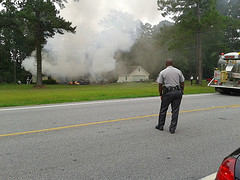
Deputy watching fire A house burned down this morning on US 122 east of the Boys Ranch. Multiple Lowndes County Fire and Rescue trucks were there, one from as far away as Shiloh, plus Moody Fire Emergency Services, an SGMC Paramedic Unit, and a Sheriff’s deputy directing traffic. The location was 5522 E Highway 122.

Here’s Part 1 of 3:

Fire on U.S. 122, Lowndes County, Georgia, 7 August 2012 Part 1 of 3:
Video by Gretchen Quarterman for Lowndes Area Knowledge Exchange (LAKE), Hahira, Lowndes County, Georgia, 7 August 2012.

The SGMC unit appeared to have nothing to do,

Continue reading

County puts a cap on a construction contract! @ LCC 2012-06-26

The county can put a cap on a construction contract! That's welcome news.

At their 26 June 2012 Regular Session the Lowndes County Commission approved an item listed on the agenda as "9. FY 2010 Community Development Block Grant". They added three qualifications:

  1. That the grant applicant delivers the deed to the Board of Commissioners that is acceptable to the Board of Commissioners.
  2. That the construction contract not exceed 700,000.
  3. That the grant applicant is in agreement with the Board of Commissioners to pay the difference between the grant funds and project costs.

That's all admirable, and quite a difference from the approach the Commission took to another grant-funded project: the no-bid contract with Scruggs Co. for the new Moody AFB gate. Did we the taxpayers ever find out how much the final contract was for and how much the final cost overrun was?

Of course, in this new case, we never learned who the construction contractor was, or whether there were bids, of anything else about the contract. Why doesn't the Commission want us to know such things?

-jsq


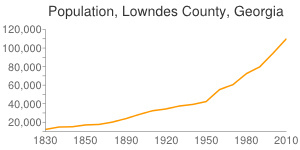
Historical Population, Lowndes County, Georgia

Increased population is using increasing resources in Lowndes County, Georgia:

Increased population is using increasing resources

Increased population is using increasing resources
Chart by John S. Quarterman for Lowndes Area Knowledge Exchange (LAKE) from Georgiainfo data.

Census Pop.
1830 2,453
1840 5,574
1850 7,714
1860 5,249
1870 8,321
1880 11,049
1890 15,102
1900 20,036
1910 24,436
1920 26,521
1930 29,994
1940 31,860
1950 35,211
1960 49,270
1970 55,112
1980 67,972
1990 75,981
2000 92,115
2010 109,233
Georgiainfo data

The population of Georgia has almost tripled during my lifetime, has about doubled since 1970, and has increased 18% in just the ten years from 2000 to 2010. That blip up between 1950 and 1960 is Moody Air Force Base.

That kind of growth doesn’t happen without increased resource use. If we want a livable county and region for ourselves and our descendants, we need to think about what we’re doing, with water, with transportation, and with energy, not to mention education, jobs, and pretty much everything else. We already cut down and sold off almost all the forests. Now we need better ways than using up all the resources that were here.

Hm, how about some knowledge-based jobs in energy and telecommunications and agriculture?

Speaking of Moody, the U.S. military learned in Afghanistan that shipping oil to places where you can generate solar energy produces a vulnerable supply chain. Moody is already leading in local solar energy. How about we help our base help us help them to move ahead in solar for everybody in Lowndes County and the state of Georgia?

-jsq

Strategies for Lowndes County? —John S. Quarterman

My op-ed in the VDT today. -jsq

Our high schools and college graduates mostly have to go somewhere else, because jobs here are few and many of them don’t pay enough for a decent living. Should we not care enough about our families and our community to come up with strategies that grow existing businesses and attract new ones that will employ local people?

We need discussions and strategies that involve the whole community, going beyond just the usual planning professionals, to include all groups and individuals with information or opinions, whether they got here generations ago or last week: for fairness and for freedom.

Sometimes we see local strategy. Winn Roberson organized Drive Away CCA. Ashley Paulk verified there was no business case for a biomass plant in Lowndes County after many people successfully opposed it. School “unification” opponents, out-financed 10 to 1, still defeated that referendum 4 to 1.

How do we go beyond opposing things and move on to sustainable strategies that build clean industry?

The Industrial Authority focus group meeting I attended Wednesday was refreshing, because their consultants asked the opinions of people some of whom previously had to picket outside. The previous day, VLCIA Chairman Roy Copeland said this strategic planning process was a long time coming. I agree, and while nobody can say what will come of it at this point, I hope it does produce a real Economic Development Strategy.

Building on the Valdosta City Council’s annual consideration of affordable housing,

Continue reading