Tag Archives: health

Far more citizens are concerned about the plant –VDT

In the VDT, Friday 25 March 2011:
“THUMBS DOWN: To area officials who continue to refer to the opponents of the biomass plant as a “fringe” group. Far more citizens are concerned about the plant than officials would like for the public to believe. Thankfully, the city council allowed them to speak at Thursday’s meeting, but the issue is not going away until their health concerns are addressed.”

A year ago the VDT was solidly in the pro biomass camp. Guess they didn’t like being fed misinformation, any more than the rest of us did. And that was before the VDT said VLCIA illegally made up a document.

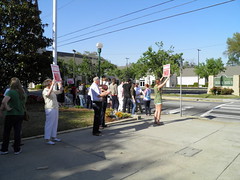
Rumor has it that there’s going to be another demonstration today outside Valdosta City Hall starting at 5PM.

-jsq

VDT says VLCIA illegally made up a document

Today’s editorial in the VDT is Another Industrial Authority misstep refers to the VDT article and editorial of Sunday, and continues:
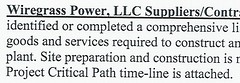
The reporter who conducted the interview with Industrial Authority Project Manager Allen Ricketts has been subsequently repeatedly contacted by Ricketts for what he deems “false reporting.” According to Ricketts, the timeline was never official and was only something the Industrial Authority threw together to appease the Times when given an official Open Records Request. Ricketts is apparently unaware that legally he cannot produce a document that does not exist to comply with said request. If he knowingly did so, as he now claims, that is a clear violation of the Open Records Act.
Presumably that would be the “Project Critical Path time-line is attached” that wasn’t actually attached to documents returned for an open records request of 17 February 2011. Hm, since VLCIA did supply such a document to the VDT, presumably it is now a VLCIA document subject to open records request, even though it was not what VLCIA told VDT it was.

Back to the VDT editorial: Continue reading

Valdostans protest biomass –VSU Spectator

Molly Duet writes in the VSU newspaper today:
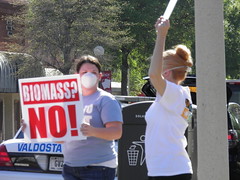
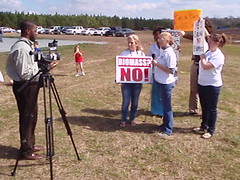
Protestors wearing respirator masks held signs reading “Biomass? No!” in front of the Valdosta City Hall building on Thursday. Members of the Wiregrass Activists for Clean Energy, the VSU student organization Students Against Violating the Environment, and other concerned Valdosta citizens showed up to protest the construction of the Wiregrass Power: Biomass Electric Generating Plant.

“We already have solar power resources in place that we could be using and I feel like money should be directed towards that,” Ivey Roubique, vice-president of the Student Geological Society, said. “It wouldn’t be good for the community and even though I’m in college here it still matters.”

The Spectator article quotes from two speakers for whom LAKE happens to have video, linked below. Continue reading

Why? There’s speculation about money — Stewart Emmett (?) @ VCC 24 March 2011

When public officials ignore objections for long enough, eventually people start speculating as to their motives, in this case about the proposed biomass plant. Here’s the video:


Regular meeting of the Valdosta City Council, 24 February 2011.
Videos by Gretchen Quarterman for LAKE, the Lowndes Area Knowledge Exchange.

-jsq

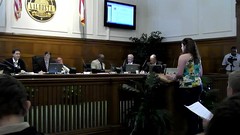
The right of students to breathe clean air –Erin Hurley of SAVE @ VCC 24 March 2011

Erin Hurley provided the very model of how to give a speech:
I’m the president of Students Against Violating the Environment at VSU. I’m here representing 200+ members of SAVE, that consists of students, faculty, community members. We are deeply concerned with environmental issues and we are networking together to make this city a more humane and sustainable community for future generations.

As a student, I feel I have the right to be able to breathe clean air at the college I attend. With this biomass plant possibly being built here, the future for generations to come are in jeopardy, and we want to protect our fellow and future students’ health.

Please take into consideration the future health of this university and its community, and don’t sell grey water to the proposed biomass plant.

Here’s the video:


Erin Hurley, President of SAVE, Students Against Violating the Environment, speaking at
Regular meeting of the Valdosta City Council, 24 March 2011,
Valdosta, Lowndes County, Georgia.

Videos by Gretchen Quarterman for LAKE, the Lowndes Area Knowledge Exchange.

She said who she was, who she represented, how many, what they were for, what they wanted, quickly enough that attention didn’t waver, slowly and loudly enough to be heard, and briefly enough to transcribe, with pathos, logic, and politic. Even the mayor looked up at “As a student….”

-jsq

It’s an opportunity –John S. Quarterman

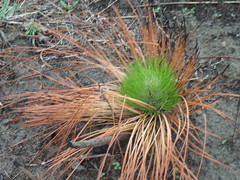
“Like a burned-over longleaf pine, we can come back from this recession greener than ever, if we choose wisely.”

Here is my response to James R. Wright’s questions about jobs and priorities. -jsq

It’s an opportunity for those of us who are not currently searching for our next meal to help those who need jobs, and thereby to help ourselves, so they don’t turn to crime. Like a burned-over longleaf pine, we can come back from this recession greener than ever, if we choose wisely.
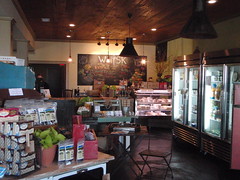
Switchgrass seemed like a good idea five or ten years ago, but there is still no market for it.

Meanwhile, local and organic agriculture is booming, and continued to boom right through the recession.

Not just strictly organic by Georgia’s ridiculously restrictive standards for that, but also less pesticides for healthier foods, pioneered as nearby as Tifton. That’s two markets: one for farmers, stores, and farmers’ markets in growing and distributing healthy food, and one for local banks in financing farmers converting from their overlarge pesticide spraying machinery to plows and cultivators.

Similarly, biomass may have seemed like a good idea years ago, but with Adage backing out of both of its Florida biomass plants just across the state line, having never built any such plant ever, the biomass boom never happened.

Meanwhile, our own Wesley Langdale has demonstrated to the state that

Continue reading

Organic food market booming

What continued to grow right through the recession? Local and organic foods, especially sold through farmers’ markets and traditional supermarkets.

Carol Hazard wrote in the Richmond Times-Dispatch, March 21, 2011, Organic, natural food catching on:

U.S. sales of organic foods and beverages grew from $1 billion in 1990 to $24.8 billion in 2009, according to the Organic Trade Association.

The sector saw double-digit growth — often more than 20 percent — every year over the past decade except 2009, at the tail-end of the recession. Even then, organic sales rose 5.9 percent from the previous year while total food sales increased only 1.6 percent.

The article didn’t link to the study, but here it is: Industry Statistics and Projected Growth.

Further from the Times-Dispatch article:

National grocers are pumping up their organic and natural food selections. Even Wal-Mart and its Sam’s Club warehouse division are paying attention.
Continue reading

Why “jobs, jobs, jobs” isn’t good enough for the public good and the general welfare –John S. Quarterman

Sure, everyone wants jobs for the people right now and jobs so the children don’t have to go somewhere else to find one. But what good is that if those jobs suck up all the water those children need to drink?

This is the problem:

“What I believe the three most important things are, not only for our community, and our state, and our country, but for our country, thats jobs number 1, jobs number 2, and jobs.”


Brad Lofton, Executive Director, Valdosta-Lowndes County Industrial Authority (VLCIA),
speaking at the Lake Park Chamber of Commerce annual dinner,
Lake Park, Lowndes County, Georgia, 28 January 2011.
Video by Gretchen Quarterman for LAKE, the Lowndes Area Knowledge Exchange.

I shook Brad Lofton’s hand after that speech and told him I liked it, because I did: in general it was a positive speech about real accomplishments. I’ve also pointed out I had a few nits with that speech. This one is more than a nit. This one is basic philosophy and policy.

Now one would expect an executive director of an industrial authority to be all about jobs. And that would be OK, if Continue reading

Stopping a ‘done deal’ -Jim Parker

This LTE appeared in the VDT today. -jsq
I’m just an older, working man that lives in our fair city of Valdosta. I have children and grandchildren that live, work and go to school in Lowndes County. After looking at the information available, and doing some research in my limited spare time, I’ve come to the conclusion that this proposed biomass facility that the Industrial Authority is trying to push through is a really bad idea. The pollution that will continuously pour from the plant will create cancers, heart and respiratory disease, as well as seriously aggravating chronic conditions such as asthma. Children are especially at risk, and there are two schools within a mile of the plant site, not to mention all the homes.

As a cancer survivor

Continue reading

Harrisburg, PA loses solvency and trust over incinerator

Michael Cooper wrote in the New York Times on 20 May 2010 about An Incinerator Becomes Harrisburg’s Money Pit:
HARRISBURG, Pa. — Officials here decided seven years ago to borrow $125 million to rebuild and expand the city’s enormous trash incinerator, which the federal government had shut down because of toxic air pollution.

But the incinerator burned through the money faster than the trash, leaving Harrisburg residents feeling like they were living through a sequel to the 1986 movie “The Money Pit.”

There were contractor troubles, delays, cost overruns and squabbles. The city borrowed tens of millions more, shoveling good money after bad into the job.

The Patriot-News Editorial Board wrote on 12 April 2010 about Harrisburg incinerator fiasco deserves an investigation to understand how it happened:
Over nearly a decade, officials at the Harrisburg Authority and City Hall made a series of decisions that sought to get the trash incinerator working and profitable, but which instead brought Pennsylvania’s capital to the brink of bankruptcy.

The 2003 deal that took on $125 million in debt to repair the incinerator neglected to include a performance bond.

Inexperienced firms were hired. Fees were paid for work poorly done. Loans were taken on disastrous terms.

Officials were aided, or rather misled, by the advice of numerous attorneys, bankers and engineers apparently far more interested in collecting handsome fees than they were in protecting the interests of taxpayers.

As a result, there is a deep distrust of the fundamental institutions that created this fiasco.

Something else sounds familiar about this situation:
While some of the seats have changed, many of the same people in government today had their fingerprints on these decisions.
It’s the same old boy network locally as approved Sterling Chemical, and the chair of the county commission at that time is now on the Industrial Authority. And the VLCIA has taken on what is reputed to be a $15 million bond issue.

How big is Harrisburg? 50,000 people, same as Valdosta. What is Harrisburg considering? Bankruptcy. Who profited anyway? Local developers.

What’s the moral?

All of the guarantees proved worthless.

All of the fail-safes failed.

What say we have the investigation now, before the fail-safes fail?

-jsq