Category Archives: Agriculture

Farm bill would reauthorize USDA REAP grants

Sen. Richard Lugar (R-Ind.) and Rep. Marlin Stutzman (R-Ind.) wrote for The Hill 5 March 2012, REFRESH Act: Strengthen rural communities and U.S. energy security
Reauthorize and reform the popular REAP program to demonstrate opportunities for economically viable energy investments and encourage loans rather than grants.
Rep. Sanford Bishop (D-Ga.) has long been working with local farmers and USDA to help with agriculture and rural jobs.

The Indiana Congress members continued:

Real commitment to rural growth requires that we put money where our mouth — or authorization — is. We offer basic mandatory funding that is more than paid for through cutting waste.

Renewable energy production creates jobs. Rural communities see potential for real economic growth in the emerging biofuel sector. Advances in technologies and agricultural techniques could offer economic benefits from coast to coast. Using the REFRESH Act as the basis for the next Farm Bill would help galvanize private investment in the sector, bringing jobs to a ready economy.

Indeed it can.

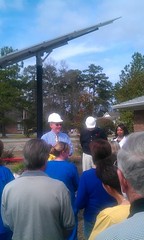
Obviously I like REAP grants, since we got one for Okra Paradise Farms. That 25% REAP grant plus an 35% ARRA NREL plus 35% GEFA credits will add up to 90% covered by grants and tax credits, which is a pretty good deal.

Now that remaining 10% is still a significant amount; like the price of a small car. But in 7-15 years (how long it will take to pay off this system, depending on how you figure it), what would the value of a car be? Much less than when you bought it. Meanwhile, these solar panels will be generating almost as much power as they are now, and they will continue to generate for at least a decade more, probably much more.

The big missing piece is up-front financing. Local banks will do it, but only for collateral. By which they mean real estate. Nope, they won’t take the solar equipment as collateral, even though it would still be operational many years from now.

Local banks or credit unions could see this as an opportunity and start accepting solar equipment as collateral. Beyond that, with a few changes to Georgia law, to deal with the power utility territoriality clause, and maybe to ban boondoggle charges for more dangerous and less job-producing power sources, we could get a commodity market in solar power in this state. You could put up solar panels like this, or more, on your house or business roof, and sell your excess power to somebody in Atlanta with less roof space. That would produce widely distributed energy, reducing need for foreign oil or dirty coal, lowering your electric bills, maybe even producing you a profit, and generating local jobs right here in south Georgia.

Private investment is ready to come in for utility-scale solar projects.

And companies like SolarCity that already do everything from financing to installation could do that in Georgia. Or home-grown companies could do that. Or local banks could finance while local companies installed.

Anyway, we have here on our workshop roof a proof of concept, operational right now, purchased partly via a USDA REAP grant.

-jsq

Blazer Gardens recognized by VDT for promoting healthy food

Healthy food got recognition on the front page of the VDT today.

In today’s capitalistic food market, several people have felt compelled to begin “living organically.” This philosophy has been brought to Valdosta and centralized by a group at Valdosta State University.

Bobbi Hancock, a VSU student, founded Blazer Gardens@VSU in August 2010. The group currently has 14 active members.

“There was reports of a food pantry being implemented on campus and that was implemented because there was students going to the dining hall asking for food,” said Hancock. “I just thought, if we could teach students how to grow food, it would eliminate a lot of the issues we have with campus hunger.”

Blazer Gardens started as nothing but seeds in the yard of Kathryn Grant, an organization member.

“This was an opportunity for me to understand and for me to appreciate how my food is grown,” said Grant.

From their professor:
Dr. Miryam Espinosa-Dulanto, Blazer Gardens faculty advisor and VSU professor of modern classical languages, said she feels compelled to get involved with this organization.

“I think we are what we eat, so I want to be clean and organic and safe,” said Espinosa-Dulanto.

Maybe they can help us all not eat poisons and even stop Monsanto and ConAgra from poisoning our food supply. It’s good health and it’s good business.

-jsq

VLCIA and local counties

In which of these five, seven, eleven, or thirteen counties is Athens, Georgia?

According to Valdosta-Lowndes County Industrial Authority (VLCIA), Regional Hub,

Valdosta is a regional hub for eleven Georgia counties and two Florida counties. Valdosta-Lowndes County acts not only as the regional hub for retail, medical, transportation and entertainment. Our community is also the regional hub for employment for five contiguous, predominantly rural Georgia counties and two Florida counties (as indicated in the chart to the right) and supports a thirteen county region referenced from the 2000 Census (see chart attached below).
The five Georgia counties are (alphabetically) Brooks, Cook, Echols, Lanier, and Lowndes, and the two Florida counties are Hamilton and Madison. In which of those seven counties is Athens, Georgia?

The thirteen counties, barely legible on VLCIA’s webpage, are: Berrien GA, Brooks GA, Clinch GA, Colquitt GA, Columbia FL, Cook GA, Dougherty GA, Duval FL, Echols GA, Fulton GA, Hamilton FL, Lanier GA, and Madison FL. Fulton County, Georgia? OK, that’s odd. Hm, the table is entitled

“Journeys To and From LOWNDES GA (Threshold = 50)”.
It’s about vehicles travelling in and out of Lowndes County. So Fulton makes some sense, due to people travelling between here and Atlanta. Local region, though? Not Fulton. Ditto Duval County, Florida. Jacksonville, local? I think not.

So maybe call it an eleven county region. In which of those eleven or thirteen counties is Athens, Georgia?

-jsq

Why doesn’t VLCIA buy locally?

Col. Ricketts reminded VLCIA board members at their most recent regular meeting (2012 01 17) that he had asked them for input about trees for Miller and Westside Business Parks.
We have identified trees from a nursery, Select Trees, in Athens, Georgia, with a special five year warranty on those trees, that meet our landscape plans for both Miller and Westside Business Park. As we discussed in our last board meeting, there is some cost savings available to us, and the ability for us to select trees now and hold them if we make a deposit.
OK, I commend VLCIA staff and board for trying to save we the taxpayers money.

But isn’t VLCIA supposed to be promoting local business and agriculture? Why is our Industrial Authority outsourcing to a company halfway across the state? Why doesn’t it buy locally, even if it costs a little more?

For that matter, aren’t there plenty of local trees, like sycamores, magnolias, and even longleaf pines that would cost very little to transplant to a local business park? Maybe those are the types of trees they’re buying. We don’t know, because only the board got the list of trees.

For that matter, why didn’t VLCIA put out a public request for bids for the trees?

Here’s the video:


Why doesn’t VLCIA buy locally?
Regular Meeting, Valdosta-Lowndes County Industrial Authority (VLCIA),
Norman Bennett, Tom Call, Roy Copeland chairman, Mary Gooding, Jerry Jennett,
Andrea Schruijer Executive Director, J. Stephen Gupton attorney, Allan Ricketts Project Manager,
Valdosta, Lowndes County, Georgia, 17 January 2012.
Videos by John S. Quarterman for LAKE, the Lowndes Area Knowledge Exchange.

-jsq

Some answers and some remaining questions about the Comprehensive Plan

When I spoke at the Greater Lowndes Planning Commission (GLPC) about the Short Term Work Projects (STWP) document on Monday, November 28th, I had questions about several sections, and many of the deleted or modified items. The next day I met with Lowndes County Planner Jason Davenport to discuss my questions. Some of my questions were answered to my satisfaction, some I still had concerns about, and some are still unanswered because they were not actually in his area of expertise.

The document covers all the cities in Lowndes County as well as the unincorporated area. I did get some questions about Valdosta projects answered by Valdosta City Planner Matt Martin in a telephone conversation.

Questions I had about Conservations of Sensitive Areas were answered in detail. For example: Continue reading

Local state legislative delegation at the Country Club

At the State Legislative Luncheon at the Country Club yesterday, sponsored by the Rotary Club and the Chamber of Commerce, I found it more interesting what the legislators didn’t mention than what they did.

Frequent attendees told me the audience was much larger than in previous years, and one attributed that to the recent school consolidation referendum. Sitting side by side were Chamber Chair Tom Gooding and FVCS President Sam Allen.

Jeff Hanson introduced the legislators. He’s the Chair of the Chamber’s Government Affairs Council (GAC). He said they are seeking more participants. Hm, they have an Energy and Environment Policy Committee that’s chaired by someone from Georgia Power….

Tim Golden announced that the local delegation’s highest priority was to get $32 million for a Health Science Center for VSU. VSU Interim President Dr. Levy was there, as was former president “Dr. Z” as Tim Golden called him.

I was just talking to someone from SGMC in the food line about how it would be nice if the Industrial Authority would promote healthcare industries more. It’s good that the legislators are doing that, although it’s not clear that there are not other things that should be even higher priority.

Tim Golden also wants to remove a sales tax Continue reading

Don’t we still need farmers to feed us? —Gretchen Quarterman @ GLPC 28 November 2011

What was it that the Lowndes County government didn’t want its citizens to see in the draft it didn’t publish and didn’t provide in response to an open records request, and the hearing it didn’t hold about its updates to the Comprehensive Plan? Could it be the many items the county is deleting, having to do with feeding seniors, health care, transportation, work ethics and life skills, environmental impacts, agriculture, wells, wetlands, and many other topics, some of which Gretchen Quarterman detailed to the Greater Lowndes Planning Commission yesterday?

After Valdosta and Hahira City Planner Matt Martin explained how all the local city governments had or were going to have hearings about their Comprehensive Plan Short Term Work Program updates, the GLPC Chairman asked if any citizens wanted to speak on that topic. One citizen did, Gretchen Quarterman. She apologized for missing the September GLPC meeting because she would have raised some of these issues then.

I have an appointment with [Lowndes County Planner] Jason [Davenport] tomorrow to address some of my questions.

But I want to let you know that at the County Commission did not hold a public hearing after the changes. I was at the [Valdosta] City Council meeting, and the City Council did hold a public hearing, but the County Commission did not.

And I believe that is in violation of DCA’s guidelines. They sent a transmission letter that said they followed DCA’s guidelines. DCA’s guidelines say hold a public hearing. It was on the agenda, the public hearing, but no public hearing was held. So I didn’t have an opportunity to see the document, or to comment, before the county sent it.

She said she would provide written comments to Jason the next morning, and asked if GLPC would like to hear some of them. They said they would, so she read some of them. For example:
In Section 1.3 it was struck from the document:
Ensure supporting senior services such as health care,
Continue reading

Baltimore’s place-based model

Growth isn’t everything, and vacant lots can be leveraged to deal with food disparity and obesity, Baltimore is demonstrating.

Vanessa Barrington wrote for Grist 21 November 2011, Baltimore’s can-do approach to food justice

…43 percent of the residents in the city’s predominantly black neighborhoods had little access to healthy foods, compared to 4 percent in predominantly white neighborhoods. Meanwhile, more than two-thirds of the city’s adults and almost 40 percent of high school students are overweight or obese.
That’s the problem.

There are solutions:

Speaking on a panel at the recent Community Food Security Coalition Conference in Oakland, Calif., Abby Cocke, of Baltimore’s Office of Sustainability, and Laura Fox, of the city health department’s Virtual Supermarket Program, outlined two approaches to address the city’s food deserts. Both were presenting programs that have launched since Grist last reported on Baltimore’s efforts to address food justice. And both programs come under the auspices of The Baltimore Food Policy Initiative, a rare intergovernmental collaboration between the city’s Department of Planning, Office of Sustainability, and Health Department. They also show how an active, involved city government and a willingness to try new ideas can change the urban food landscape for the better.

According to Cocke, Baltimore’s Planning Department has a new mindset. She calls it a “place-based” model. “In the past,” she says, “growth was seen as the only way to improve the city, but we’re starting to look at ways to make our neighborhoods stronger, healthier, and more vibrant places at the low density that they’re at now.”

The article outlines the specific solutions, such as: Continue reading

Videos of the Weigh-In at the Hog Show

As the Hog Show Weigh-In yesterday, in addition to still pictures, Gretchen took videos. Don’t miss the piggy kung fu! Here’s a playlist:


Weigh-In at the Hog Show
agriculture, hogs, pigs,
34th Annual Lowndes Area Market Show and Sale, 4H + FFA (Hog Show),
Valdosta, Lowndes County, Georgia, 31 October 2011.
Videos by Gretchen Quarterman for LAKE, the Lowndes Area Knowledge Exchange.

-jsq

Students Compete in the Local Hog Show

Gretchen went to the weigh-in yesterday, and will be at the show today. Pictures and videos to come.

According to Lowndes County Schools 28 October 2011, Students Compete in the Local Hog Show:

One hundred-thirty youngsters from Echols, Lanier, and Lowndes counties are registered to exhibit their hogs in the 34th Annual Lowndes Area Market Show and Sale, to be held on Tuesday, November 1st. These elementary, middle, and high school students are members of either local 4H or FFA organizations.

The Show will be held at the Lowndes County Civic Center, with judging of weight divisions beginning at 5:00 PM. Hogs will be judged according to market standards for providing the best pork possible. Showmanship classes will follow, where the students will be evaluated for their success in exhibiting their animal.

-jsq