Tag Archives: Valdosta

Private prison profits buying more laws to lock people up

Another report about money and private prisons (in addition to the ACLU’s Banking on Bondage), this one Public Campaign and PICO National Network, Unholy Alliance: How the Private Prison Industry is Corrupting Our Democracy and Promoting Mass Incarceration. It establishes that the “kids for cash” scandal, in which two judges accepted kickbacks in exchange for locking up juveniles, was just the tip of the iceberg.
Yet the reality is that private prison lobbyists regularly buy influence with state and federal officials, not only to win lucrative contracts, but also to change or preserve policies that increase the number of people behind bars. Private companies have made huge profits off the mass incarceration of non-violent drug offenders, and are now turning their attention to increasing the detention of Latino immigrants—the newest profit center for the prison industrial complex. Ultimately there is no way to reverse the costly trend toward mass incarceration without reducing the influence of these companies and their money in our democracy.
Here’s another example David Donnelly wrote for Huffpo 17 Nov 2011, Private Prisons Industry: Increasing Incarcerations, Maximizing Profits and Corrupting Our Democracy,
Earlier this year in Louisiana, a plan by Gov. Bobby Jindal (R-LA) to privatize prisons narrowly failed in a legislative committee by a vote of 13 to 12. The 12 members of the House Appropriations Committee who voted to approve the prison privatization plan have received more than three times more money from private prison donors than the 13 members who voted against the plan, according to an analysis of data from the Louisiana Ethics Administration and the National Institute on Money in State Politics. Gov. Jindal himself has taken nearly $30,000 from the private prison industry.
And of course in Georgia there’s HB 87, which isn’t really about excluding immigrants; Continue reading

The private prison game: Banking on Bondage

Rania Khalek wrote for AlterNet 29 November 2011, The Shocking Ways the Corporate Prison Industry Games the System
Just a decade ago, private prisons were a dying industry awash in corruption and mired in lawsuits, particularly Corrections Corporation of America (CCA), the nation’s largest private prison operator. Today, these companies are booming once again, yet the lawsuits and scandals continue to pile up. Meanwhile, more and more evidence shows that compared to publicly run prisons, private jails are filthier, more violent, less accountable, and contrary to what privatization advocates peddle as truth, do not save money. In fact, more recent findings suggest that private prisons could be more costly.

So why are they still in business?

In a recently published report, “Banking on Bondage: Mass Incarceration and Private Prisons,” the American Civil Liberties Union examines the history of prison privatization and finds that private prison companies owe their continued and prosperous existence to skyrocketing immigration detention post September 11 as well as the firm hold they have gained over elected and appointed officials.

We’d already heard from Bloomberg that Continue reading

December LAKE meeting: El búho al Cazador

The owl lights in Valdosta Tuesday evening.
El Cazador, 1600 North Ashley Street, Valdosta, Georgia What: Monthly LAKE Meeting
When: 5:30 PM, Tuesday 6 December 2011
Where: El Cazador
1600 North Ashley Street
Valdosta, GA 31602
(229) 333-0554
That’s the old Margarita’s at the corner of College Street. They’re open until 10PM.

If you follow the LAKE blog, On the LAKE Front, you know what we cover, from elections to gardening, connecting the dots. What else do you want to investigate?

If you’re on Facebook, please Like the LAKE facebook page. You can sign up for the facebook meeting event, Or just come as you are.

jsq

How to read Comprehensive Plan documents

I’m always getting a civics lesson, learning more and more about how our local and state governments work. Most recently, I had the opportunity to have explained two documents related to the Lowndes County Comprehensive Plan: the Short Term Work Projects (STWP) and the Report of Accomplishments (ROA). In the spirit of information exchange, I share what I learned with you.

The state of Georgia requires a Comprehensive Plan and collects and approves them through the Department of Community Affairs (DCA). The current plans for all of Georgia are available at the DCA Planning Site.

The current STWP documents that are being reviewed locally are the projects that the local governments and agencies expect to actively work on in the next five years. The ROA documents report on what was done in the past five years: what was completed, or will no longer be pursued. Many municipalities and counties file separate reports. Locally, because there is significant cooperation among the cities and Lowndes County there is one document with all the projects included and a place that indicates which agency is participating in the project. However, their input documents are filed separately, and LAKE has collected them on the LAKE web pages. Also, each local municipality holds its own public hearings.

Reading the STWP and ROA can be a bit tricky but once I understood the format, the process became much easier. The overall topics are prescribed by the state and are in general categories like “Population”, “Economic Development”, “Housing” and “Land Use”. There are sub-categories in each of the ten major categories, like “Secure High-Wage Jobs” and “Address Workforce Adequacy” in the “Economic Development” major category. Then, under each of these items are one or more specific projects that will be done in the next five years to help achieve each goal.

One reason the draft STWP is complex is that it redlines projects that were performed in the previous five years and are now being removed or modified for a variety of reasons. Many projects were completed, some moved from one stage (investigate) to another (implement or market), and still others simply lacked the staff or funding resources to continue being pursued.

The ROA document is in a similar format but the focus of it is to report the status of the STWP for the previous five years. An Explanation Column gives details on the status of each previous project. For example, it says that the “Feed the Elderly Senior Citizen Nutrition Program” has been discontinued because “Budgetary constraints have limited Lowndes County’s role in this supporting action.”.

The STWP and ROA documents are meant to be read as a pair, giving the reader an understanding of where we have been, where we are going and how we are going to get there as a community.

-gretchen

Jerome Tucker honored at Civic Roundtable

The Civic Roundtable honored Jerome Tucker for some of the many things he has done for Lowndes County and south Georgia. And as usual he hit the nail on the head.

Dawn Castro wrote for the VDT yesterday:

“We do have one of the best communities,” Tucker said. “The toughest part of me standing before you is knowing how much better we could be if all the little groups would work together.”
He also said:
“I am still blessed to have my dad with me,” Tucker began. “He always asks me, ‘Where have you been?’ and ‘Did you do any good?’
Here are a few good things Jerome Tucker has done recently: Continue reading

Marijuana prohibition had nothing to do with smoking it

It had everything to do with the king of yellow journalism newspapers not wanting competition for his yellow paper and the king of the new plastics not wanting competition with them: competition from hemp.

Kathleen Murphy wrote for the Washington Free Press 3 June 2009 about How Marijuana Became Illegal,

As the methods for processing hemp into paper and plastics were becoming more readily available and affordable, business leaders including William Randolph Hearst and DuPont stood to lose fortunes. They did everything in their power to have it outlawed. Luckily for Hearst, he was the owner of a chain of newspapers. DuPont’s chief financial backer Andrew Mellon (also the Secretary of the Treasury during President Hoover) was responsible for appointing Harry J. Anslinger, in 1931 as the head of the Federal Bureau of Narcotics and Dangerous Drugs.
Anslinger and Hearst made up whatever propaganda they thought might scare the public into supporting prohibiting hemp: Continue reading

Video playlist, GLPC 28 November 2011

Here’s a video playlist for the entire Greater Lowndes Planning Commission (GLPC) Regular Session of 28 November 2011. We’ve already blogged a couple of them separately: And we’ll probably blog more of these videos separately. But you don’t have to wait.

Here’s the playlist:


Video playlist, GLPC 28 November 2011
Comprehensive Plan,
Regular Session, Greater Lowndes Planning Commission (GLPC),
Valdosta, Lowndes County, Georgia, 28 November 2011.
Videos by Gretchen Quarterman for LAKE, the Lowndes Area Knowledge Exchange.

-jsq

ZBOA: Zoning Board of Appeals 6 December 2011

According to Valdosta City Planner Matt Martin today:
This is a reminder that your next meeting for the Zoning Board of Appeals (ZBOA) is this coming Tuesday, December 6, 2011 at 2:30pm. Attached is a copy of the meeting agenda and also the draft minutes from both the October and November meetings.

Just like the November meeting, there are again NO public hearing items for December. However, we still need to meet (& have a quorum) to approve the Minutes and also elect officers for 2012.

ZBOA does not explicitly post its agendas, but the above appears to be the entire agenda for next week’s meeting.

Here are backgrounders on Who is ZBOA? and On What Basis Does ZBOA Decide?

-jsq

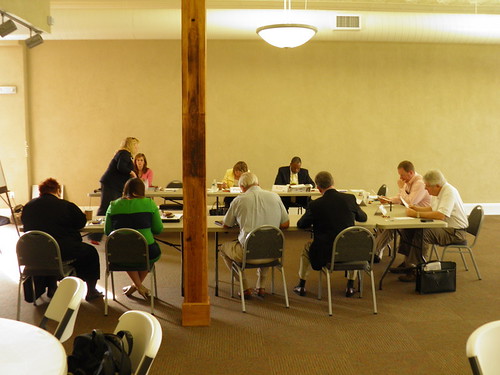
We’re not done working on this —Jason Davenport @ GLPC 28 November 2011

Continuing the Comprehensive Plan Short Term Work Program (STWP) updates, the chairman asked if the board was ready

Lowndes County Planner Jason Davenport responded:

We’re not done working on this. But if you think it’s time to bring it before y’all.
Later, at about 11:40 in, Davenport clarified:
And the only that’s different right now is Lowndes County. Because Lowndes County did not hold a public hearing as required, so we’re on a different timeline. And if Mrs. Quarterman would have given me about until December 13th she would have seen that.

Because our initial resolution was not the same as the other communities. We’re on a little bit of a different timeline because we have to address that issue. That’s one thing; the county in this instance will be handled a little different than some of the smaller cities and Valdosta.

That would be the initial resolution the county did not provide in response to an open records request about the draft the county did not publish as required by the state. If the county had answered questions weeks ago, instead of waiting until they had to do makeup homework, nobody would have had to ask about it at that GLPC meeting….

Anyway, the County Planner has said there will be a public hearing. However, remember it was the County Chairman who said that the public hearing item on the agenda was not really a public hearing. It’s the Chairman, not the Planner, who sets the agendas for the County Commission. We’ll see what’s on the 13th December County Commission Agenda, and whether it really is handled as a public hearing in that meeting.

Then GLPC Board Member John Page expressed his concerns: Continue reading

Saturday: Small business for economic development

Received yesterday. -gretchen
The House Democratic Caucus presents:

Small Business—BIG CHANGE!

Entrepreneurial development is an effective economic development strategy. It can also be used as a vehicle for leveraging existing community strengths and diversifying local economies. In Georgia, small businesses are key to the state’s well-being. They account for a significant share of the state’s economic production and hiring. Small firms make up 97.8% of the state’s employers.

Creating economic security in any community first begins with understanding the impact of fiscal responsibility. Democrats are hosting this series of statewide seminars to build financial literacy for families, help with the information for startups and provide useful intel for existing small businesses.

Goals:

  • Provide information on financial literacy for individuals
  • Encourage financial security and support entrepreneurship.
  • Provide opportunities for entrepreneurs to connect with one another.
  • Provide fledgling businesses with access to support services.
  • Help entrepreneurs’ access capital.
Saturday, December 3 from 9am-2pm, Valdosta, GA
Goodwill Industries
Career Center
1000-E North Saint Augustine Street
Valdosta, GA 31601

Brought to you by:
Georgia House of Representatives Democratic Caucus
Cash Prosperity Campaign
Georgia Pro Bono Project