Tag Archives: ACLU

Big Little River Paddle Race


Blue boat

Today is the last day of the $20 online registration for the
Big Little River Paddle Race, cosponsored by WWALS Watershed Coalition
and Friends of Reed Bingham, to be held Saturday March 23rd
at Reed Bingham State Park.


WWALS blog post
;
event flyer PDF, and much of the flyer text is below.

Continue reading

Internet speeds into jobs

Something good out of Chattanooga?
The city with the fastest metropolitan Internet access
plans to turn that into jobs.

Elizabeth Prann wrote for Fox 26 January 2013,

City turns Internet speeds into jobs
, that Chattanooga


is home to most advanced smart grid in the nation, customers are
enjoying Internet speeds that are almost 100 times faster than the
national average. Most Internet users in the U.S. have access to
about 4.5 megabits of Internet speed.

We wish!
OK, you can get spees that fast here:

with Verizon 4G LTE
,
not too many places via land access.

So what’s Chattanooga got that’s better?

Continue reading

Citizens can video on duty police —Supreme Court

The Supreme Court has declined to review a Seventh Circuit Court of Appeals
decision that struck down an Illinois law prohibiting audio recordings
without permission,
echoing last year’s

First Court decision that you can record police on the job.

Let’s remember it’s not just police:

“Gathering information about government officials in a form that can
readily be disseminated to others serves a cardinal First Amendment
interest in protecting and promoting

‘the free discussion of
governmental affairs.’

That means all elected or appointed or employed government officials, from
County Commissioners and City Councils down through sheriff and
police departments to the Animal Shelter.
Police are employees, not elected or appointed, so these rulings would appear
to apply to other governmental employees.

Radley Balko wrote for Huffpo 27 November 2012,

Supreme Court Inaction Boosts Right To Record Police Officers
,


The Illinois and Massachusetts laws have been used to arrest people
who attempt to record on-duty police officers and other public
officials. In one of the more notorious cases, Chicago resident
Tiawanda Moore was arrested in 2010 when she attempted to use her
cell phone to record officers in a Chicago police station.

Continue reading

Drive Away CCA Today!

Today at 5PM, help Drive Away CCA!


Join the motorcade from the private prison site to honk at Valdosta City Hall
and march at the Industrial Authority office.

I’ll be on Chris Beckham’s show on WVGA 105.9 FM this morning at 7:30 AM
to talk about it.


Update: audio of the interview.

Update 2: Here’s video of the interview.

Here’s
the case against a private prison:

Continue reading

Faith groups urge state governors not to sell prisons to CCA

From

Quakers

to
Catholics
,

“Our
organizations advocate for a criminal justice system that brings
healing for victims of crime, restoration for those who commit
crimes, and to maintain public safety.”

religious groups oppose privatization of prisons.
Here is

the text of a letter

many of them sent to all 50 state governors,

joining the ACLU in opposing

CCA’s recent

offer to 48 states to buy their prisons.


You can help

drive away CCA
, 5PM this Tuesday, March 6th.
Or sign the

petition to the Industrial Authority

to reject the private prison in Lowndes County, Georgia.

-jsq

March 1, 2012

Dear Governor:

We the undersigned faith organizations represent different


traditions from across the religious and political spectrum. Our
organizations advocate for a criminal justice system that brings
healing for victims of crime, restoration for those who commit
crimes, and to maintain public safety.

We write in reference to a letter you recently received from Harley
Lappin, Chief Corrections Officer at Corrections Corporation of
America (CCA), announcing the Corrections Investment Initiative –
the corporation’s plan to spend up to $250 million buying prisons
from state, local, and federal government entities, and then
managing the facilities. The letter from Mr. Lappin states that CCA
is only interested in buying prisons if the state selling the prison
agrees to pay CCA to operate the prison for 20 years — at minimum.
Mr. Lappin further notes that any prison to be sold must have at
least 1,000 beds, and that the state must agree to keep the prison
at least 90% full during the length of the contract.

The undersigned faith organizations urge you to decline this
dangerous and costly invitation. CCA’s initiative would be costly

Continue reading

ACLU and 60 policy and religious groups ask states to reject CCA’s prison privatization offer

What do the American Federation of State, County and Municipal Employees,
The Sentencing Project, the NAACP, and the Southern Poverty Law Center
have in common?
They all want states to reject

CCA’s offer to 48 states to buy prisons.

Right here in Lowndes County, our Industrial Authority wants to go
one better for CCA and help

build a shiny fresh new private prison with our tax dollars.

PR from yesterday,

ACLU Urges States to Reject CCA Offer to Privatize Prisons
,


The American Civil Liberties Union and a broad coalition of 60
policy and religious groups today urged states to reject a recent
offer by the nation’s largest private prison company to buy and
privatize state prisons.

In a letter sent to governors in every state, the ACLU and 26 other
organizations said a recent offer by Corrections Corporation of
America (CCA) to buy prisons currently run by state officials is a
backdoor invitation to take on additional debt while increasing
CCA’s profits and impeding the serious criminal justice reforms
needed to combat the nation’s mass incarceration crisis.

Two similar letters are also being sent today by religious
coalitions to governors. One of the letters, sent by 32 faith groups
including the United Methodist Church General Board of Church and
Society, the United Church of Christ/Justice and Witness Ministries,
the Episcopal Church and the Presbyterian Church (U.S.A.) Office of
Public Witness, says there is a moral imperative in reducing
incarceration through evidence-based alternatives to imprisonment
and re-entry policies that ease the transition of prisoners back
into society. A third letter, from the Presbyterian Criminal Justice
Network, argues that the principles of mercy, forgiveness,
redemption and reconciliation are largely absent from the private
prison industry.

“Selling off prisons to CCA would be a tragic mistake for your
state,” the ACLU’s letter reads. “[CCA’s] proposal is an
invitation to fiscal irresponsibility, prisoner abuse and decreased
public safety. It should be promptly declined.”



You can

help decline CCA’s private prison in Lowndes County.

-jsq

ACLU podcast against private prisons —Alex Friedmann

CCA inadvertently rehabilitated former prisoner Alex Friedmann
and gave him a new career, lobbying against prison privatization.
He says:


In my view, the worst thing
is that they have normalized the notion of incarcerating people for profit.
Basically commodifying people, seeing them
as nothing more than a revenue stream….

If you incarcerate more people and you put more people in
your private prisons you make more money.
Which provides perverse incentives against reforming our justice system.


And increasing the number of people we’re putting in prison,
whether they need to be there or not, just to generate corporate profit.
I think that’s incredibly immoral and unethical,
I think that’s the worst aspect of our private prison industry.

This comes from the ACLU’s

Prison Voices, Episode 1: Private Prisons
:

Continue reading

The private prison game: Banking on Bondage

Rania Khalek wrote for AlterNet 29 November 2011,

The Shocking Ways the Corporate Prison Industry Games the System

Just a decade ago, private prisons were a dying industry awash in
corruption and mired in lawsuits, particularly Corrections Corporation


of America (CCA), the nation’s largest private prison operator. Today,
these companies are booming once again, yet the lawsuits and scandals
continue to pile up. Meanwhile, more and more evidence shows that
compared to publicly run prisons, private jails are filthier, more
violent, less accountable, and contrary to what privatization advocates
peddle as truth, do not save money. In fact, more recent findings
suggest that private prisons could be more costly.

So why are they still in business?

In a recently published report,

“Banking on Bondage: Mass Incarceration and Private Prisons,”

the American Civil Liberties Union examines the
history of prison privatization and finds that private prison companies
owe their continued and prosperous existence to skyrocketing immigration
detention post September 11 as well as the firm hold they have gained
over elected and appointed officials.

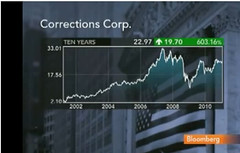
We’d already heard from Bloomberg that

Continue reading

Boston catches up with Atlanta: you can video police

Poilce are public employees, and the public has a right to video them doing their duty; so says a federal appeals court.

Pace Lattin wrote for Technorati,

Federal Courts Rule it is Not Illegal to Film Police

John S. Quarterman


The First Court of Appeals has reached a decision that would allow the
general public to video-tape police officers while they are working. This
decision comes right after several well-known public cases have come to
light involving citizens being arrested for video-taping police.

This specific case in question was Simon Glik vs.The City of Boston
(and several police officers), in which a teenage Simon Gilk was arrested
after videotaping Boston Police abusing a homeless man. While Mr. Gilk was
not interfering with the police, he was arrested on wiretapping charges.

The ACLU had sued on his behalf, even when the charges were dropped,
noting that there was a growing epidemic of citizens in the United States
being arrested by police for videotaping, even when documenting police
brutality and abuse.

The First Court Agreed with the ACLU that this should be legal, and wrote
that: “The filming of government officials engaged in their duties in a
public place, including police officers performing their responsibilities,
fits comfortably within these principles [of protected First Amendment
activity].


The Atlanta Police Department already avoided this problem

by settling a previous case and making a policy that citizens can video police.

This appeals court ruling
now says anybody can, nationwide, because of the First Amendment.

Why has this become an issue lately?

Continue reading

Medical issues at McRae warrant closing CCA private prison —ACLU

Azadeh Shahshahani wrote for Huffpost 18 August 2011,

License to Abuse? Time for Bureau of Prisons to Sever Ties With CCA

Last week, the ACLU of Georgia submitted

comments

to the Bureau of Prisons (BOP) to ask that the agency not renew its
contract with Corrections Corporation of America (CCA) for operation of
the McRae Correctional Facility.


McRae is located in Telfair County, Georgia. The prison is owned by CCA,
which purchased it in 2000. McRae currently houses a population of low
security, adult male, primarily non-citizen prisoners. The contract
between CCA and the BOP is set to expire in November 2012.

Why? Lack of medical treatment for prisoners, among other reasons.
For example:

Continue reading