Category Archives: Georgia Power

Southern Company has 3 biggest CO2 plants in U.S.

David Ibala wrote for the AJC 11 January 2012, Study: Southern Company plants are 3 biggest greenhouse gas emitters
Two Southern Company coal-fired electric generating plants near Atlanta are the biggest contributors to global greenhouse gases in the United States, and a third Southern plant in Alabama is the third-biggest emitter, an analysis of environmental data found Wednesday.

The nation’s No. 1 producer of carbon dioxide — the heat-trapping gas that is held chiefly responsible in models of global warming — is Plant Scherer in Juliette, about 65 miles southeast of downtown Atlanta, according to the Associated Press analysis of data reported to the U.S. Environmental Protection Agency for 2010.

That’s the plant that supplies most of our power in south Georgia, whether you get it through Georgia Power or Colquitt EMC.
The No. 2 producer is Plant Bowen, just west of Cartersville, about 50 miles northwest of central Atlanta, and the third-largest is Plant Miller in Quinton, Ala., about 165 miles west of Atlanta near Birmingham, the AP said.
The story also notes (as a picture caption):
Georgia Power recently installed pollution-control equipment, called baghouses, to curb mercury pollution at Plant Scherer. EPA rules that will regulate mercury likely will lead to the utility to install additional baghouses at other coal-fired plants
Hm, that’s exactly what Southern Company said it was incompetent to do. Apparently it figured out to do what other power companies already knew how to do.

Anyway, pumping out CO2 from coal plants is what Southern Company is doing instead of solar and wind.

-jsq

Farmers and other people own most of Germany’s reneable energy production

Power companies aren’t the only possible owners of solar power farms, and centralized isn’t the only power distribution model. In Germany, most renewable energy production is owned by people, not power companies.

Matthew McDermott wrote for Treehugger 6 January 2011, Over Half of Germany’s Renewable Energy Owned By Citizens & Farmers, Not Utility Companies

Germany’s promotion of renewable energy rightly gets singled out for its effectiveness, most often by me as an example of how to do things well versus the fits and starts method of promotion common in the US. Over at Wind-Works, Paul Gipe points out another interesting facet of the German renewable energy saga: 51% of all renewable energy in Germany is owned by individual citizens or farms, totaling $100 billion worth of private investment in clean energy.

Breaking that down into solar power and wind power, 50% of Germany’s solar PV is owned by individuals and farms, while 54% of its wind power is held by the same groups.

Not only is that more distributed, but it also may be a faster way to get solar deployed:
In total there’s roughly 17 GW of solar PV installed in Germany—versus roughly 3.6 GW in the US (based on SEIA’s figures for new installations though the third quarter of 2011 plus the 2.6 GW installed going into the year).

Remember, Germany now produces slightly over 20% of all its electricity from renewable sources.

Nothing prevents Georgia Power or Colquitt Electric or any of the other power companies operating in Georgia from leading the solar pack. For example, power companies concerned that solar doesn’t produce at night could still deploy solar peak load generation, thus dispensing with natural gas peak load generation.

While the power companies are not leading, private organizations such as Tabby Solar, founded by a pair of doctors, are forging ahead anyway.

-jsq

Solar energy trust to help fund Bulloch County’s budget

This story is very interesting in light of Georgia’s territoriality agreement which (I am not a lawyer) basically says not just anybody can sell electric power to municipalities.

Mary Carr Mayle wrote for SavannahNow 27 September 2011, Solar firm establishes energy trust

Two area doctors, co-owners of the Tabby Power Solar Co. in Bulloch County, have formed the Georgia Energy Trust Fund to direct part of their company’s proceeds to the county.

And, while it will take more than a few generations – some 350 years, in fact – Savannah dermatologist Dr. Sidney P. Smith and Brunswick pathologist Dr. Pat Godbey hope the trust fund will eventually generate enough money to pay all of Bulloch County’s budget and create a prototype other rural Georgia counties can follow.

Initially, the doctors are donating 1.5 percent of the gross receipts from their six-acre solar farm in Pembroke to the trust, which will invest in state bonds for the county. The county will then receive half of the earned interest, with the other half reinvested for the county.

Interesting angle, that: they’re not directly selling the power to the county; they’re using some of their income to buy bonds for the county. And they’re inviting others to do the same:
Other county solar installations, both private and public, will be able to contribute to the fund, he said.
Will Georgia Power (or somebody) sue? We’ll see!

And they didn’t wait for North Carolina or New Jersey to do it first:

Smith believes the Georgia Energy Trust is the first trust fund of its kind in the country.

“It will lead to financial independence in the counties in which it is enacted.”

Sounds like a plan to me!

-jsq

After Fukushima: Fewer nukes most places; More in Georgia

Most countries are not building more nuclear power plants, and some are shutting down some of the ones they have, because Fukushima has confirmed what Chernoby and Three Mile Island already told us: maybe the physics is sound, but the business model leads to unsafe plants. But in the U.S. and Georgia, it’s full speed ahead for new nukes, regardless of the risks of radiation leaks or cost overruns.

Christopher Joyce wrote for NPR today, After Fukushima: A Changing Climate For Nuclear

“We don’t see Fukushima as having a significant impact on the U.S. industry,” says Scott Peterson, vice president of the industry’s Nuclear Energy Institute. “The Nuclear Regulatory Commission was renewing 10 licenses for U.S. plants, extending them 20 years in operation. We were continuing to move forward in examining new reactor designs.”
Nevermind that those extensions mostly go well beyond the design lifespans of the plants extended.
Marc Chupka, who advises electric utilities as an economist with the Brattle Group in Washington, wonders who’s going to pay for them.

“Right now, just the plain economics of nuclear power are underwater,” he says. He notes that over the past decade, construction costs have skyrocketed and natural gas got more plentiful and cheaper.

“Things change significantly over relatively short periods of time,” Chupka says, noting that it takes about a dozen years to plan and build a new nuclear plant. “That makes it an incredibly challenging environment to plan for the long term. And that adds to the risk and it makes investors understandably skittish.”

So we could do what Germany is doing:
Germany says the same: The government will throw its weight and wealth into solar and wind energy to replace nuclear power.
Or we could listen to the same old excuse: Continue reading

Southern Company claims to be incompetent regarding new EPA rules

Why can’t Southern Company do what other power companies can do in implementing the new coal plant pollution control rules EPA is about to promulgate?

Elizabeth Shogren wrote for NPR today, EPA To Unveil Stricter Rules For Power Plants. She described new rules for coal plants EPA is going to release in the next few weeks, including controls on mercury, “arsenic, acid gases and other pollutants.” Southern Company doesn’t like that.

“It’s physically impossible to build the controls, the generation, the transmission and the pipelines needed in three years,” says Anthony Topazi, chief operating officer for Southern Company, which provides electricity to nearly 4 million homes and hundreds of thousands of businesses in the Southeast.

Topazi says electricity rates will go up, putting marginal companies out of business. He says unless his company gets six years, it will not be able to keep the lights on.

“We will experience rolling blackouts or rationing power if we don’t have simply the time to comply,” Topazi says.

Other power companies see no problem: Continue reading

Local state legislative delegation at the Country Club

At the State Legislative Luncheon at the Country Club yesterday, sponsored by the Rotary Club and the Chamber of Commerce, I found it more interesting what the legislators didn’t mention than what they did.

Frequent attendees told me the audience was much larger than in previous years, and one attributed that to the recent school consolidation referendum. Sitting side by side were Chamber Chair Tom Gooding and FVCS President Sam Allen.

Jeff Hanson introduced the legislators. He’s the Chair of the Chamber’s Government Affairs Council (GAC). He said they are seeking more participants. Hm, they have an Energy and Environment Policy Committee that’s chaired by someone from Georgia Power….
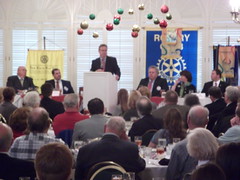
Tim Golden announced that the local delegation’s highest priority was to get $32 million for a Health Science Center for VSU. VSU Interim President Dr. Levy was there, as was former president “Dr. Z” as Tim Golden called him.

I was just talking to someone from SGMC in the food line about how it would be nice if the Industrial Authority would promote healthcare industries more. It’s good that the legislators are doing that, although it’s not clear that there are not other things that should be even higher priority.

Tim Golden also wants to remove a sales tax Continue reading

Who to contact about nuclear vs. solar

Somebody asked who to write about the nuclear costs Georgia Power is passing through to customers. Here’s the contact page for the Georgia Public Service Commission.

PSC Commissioner Lauren McDonald has been the most vocal about wanting Georgia Power to do solar. Commissioner Chuck Eaton and Tim Echols have both said in public they want more solar. PSC staff member Tom Newsome tried to get gapower to accept a better nuclear profit deal.

Don Parsons, chair of the energy committee of the Georgia House of Representatives, wants to write an energy plan for Georgia. A real one; not that bogus one from 2006 that nobody followed anyway.

Doug Stoner, Georgia State Senator, has said that Georgia Power wasn’t building nuclear plants with private money; they were using public money, and that even a public utility is a subsidy. So it appears he gets it.

Scott Holcomb, Georgia State Representative, wants a state energy policy, and has said:

Our lack of an energy policy is an absolute Achilles heel of our national policy.
So we should get on with a real energy strategy for Georgia.

Click on the pictures of each of the legislature members for their contact information. Even better, contact your state representative or senator. Or federal, since I think the new Plant Vogtle construction gets federal subsidies, too. Or write your local newspaper, or your local TV station, or the AJC.

-jsq

Calculate how much Vogtle is costing you —Mandy Hancock

Received yesterday, related to Georgia Power forges ahead with expensive nukes. -jsq
For those of you concerned about nuclear energy, here are some quick, meaningful actions you can take today. Maybe you aren’t concerned about nuclear energy. I bet you ARE concerned about $$$$.

Learn more about how Georgia Power is getting your money at the state and federal level. All US taxpayers all over the US are basically cosigning a loan for $8.3 B for the Vogtle reactors. Simultaneously, Georgia Power is raising your electric rates to fund the pre-construction costs by pulling the same advanced cost recovery scheme as SC and FL. You can learn more about the controversy surrounding the loan guarantees here

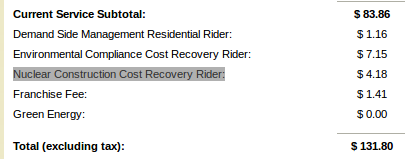
Calculate how much Vogtle is costing you on your monthly bill

(Look for “Nuclear Construction Cost Recovery Rider:”)

-Mandy Hancock

He is in the business of selling energy, not saving it. —Michael G. Noll

Received yesterday on Georgia Power forges ahead with expensive nukes. -jsq
Thanks for posting this John!

Mr. Bowers’ visit and his comments are almost comical, particularly his quote that “the government is stimulating for renewables to give them a running chance but, when you remove them, the question is can they run on their own two feet?”

A good question! Fact is that neither coal nor nuclear would be able to “run on their two own feet” if it wasn’t for the large subsidies both have received for decades. Now these are nicely hidden subsidies so that the average consumer thinks he is getting a bargain, without realizing that it is us, the consumers, who have actually paid for this “inexpensive rate”.

At the same time truly renewable and clean energies

Continue reading

Yes, I do have solar

Here’s my LTE in the VDT today. -jsq
A letter last week asked, “Do you have solar energy yourself?” Why yes, I do. When we installed solar panels on our farm workshop in 2009, the closest certified solar installer was in Marietta. There were only four in the state. Now there are forty. Georgia may yet catch up with North Carolina and even New Jersey!

Hannah Solar had all the paperwork ready when Okra Paradise Farms applied for a USDA REAP grant for more solar panels a few weeks ago. Much to our surprise,

Continue reading