Category Archives: Economy

Solar beats coal

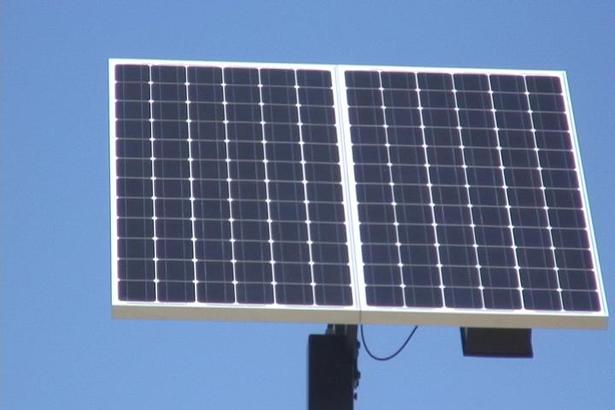
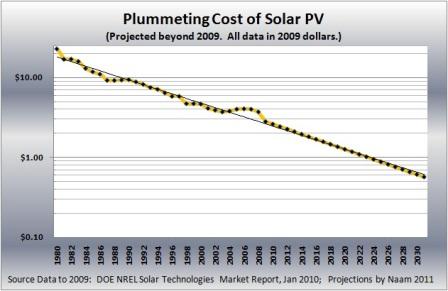
This is what you call a paradigm shift: the energy source that made the industrial revolution take off 200 years ago, coal, is being beaten down in price by the energy source Thomas Edison recommended 80 years ago: the sun.

Sandra Enkhardt wrote for PV Magazine 24 April 2012, Germany: PV makes coal power unprofitable,

“Photovoltaics destroys the economics of coal power plants,” stated MD of the Association of Coal Importers, Erich Schmitz. Given the increasing amounts of green electricity from the wind and sun, it is questionable whether investment in new coal plants by energy companies Eon, RWE, Vattenfall and EnBW will pay off, since the plants must be turned off if there is enough green energy being fed into the grid.

Already back 9 February 2012 Lars Paulsson and Marek Strzelecki wrote for Bloomberg Europe Coal Loses to South Africa on Renewables: Energy Markets,

Germany’s biggest program of solar- and wind-power production has driven European coal prices below South Africa’s for the first time in 10 months….

Coal prices in Europe have fallen 7.5 percent this year as nations increase the amount of energy they get from alternative sources. Germany, the continent’s biggest power market, installed a record 3,000 megawatts of new solar panels in December, the Bonn-based Bundesnetzagentur, the network regulator, said. Coal stockpiles at the biggest storage site in the Netherlands are 6.7 percent above year-ago levels, according to Europees Massagoed-Overslagbedrijf BV, which operates the terminal.

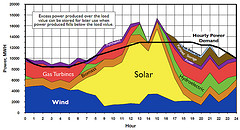
So if solar is beating coal’s price down and Germany installed 3 gigawatts of solar PV in December while installing none of coal, which is the alternative now? Wouldn’t coal be the poor alternative while solar is the main act?

-jsq

PS: Owed to Michael Noll.

SO CEO Fanning: Policy, jobs, and the economy plus fracking

You may have wondered, how was Southern Company (SO) CEO Thomas A. Fanning so ready and able to respond at length to any question at the SO shareholder meeting? Because he’s a class A CEO who does his homework, such as this white paper he wrote dated September 2011: American Energy Policy, Jobs and the Economy, in which he explains what he meant by “the revolution we have seen in the shale gas industry”.

So, natural gas is important, but it’s not a panacea. Here’s why.

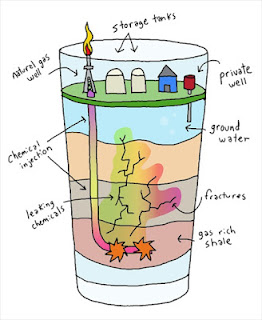
First, the reason prices have dropped so far is because of a new technology called fracking, which releases natural gas from so-called tight rock formations, such as shale gas. Fracking is the injection of chemicals underground, which have the effect of fracturing the rock deposits, thereby releasing the natural gas. There are environmental concerns around the chemicals associated with the fracking process. Those concerns have to be resolved.

Those concerns range from polluted groundwater to earthquakes. It’s great that SO is turning away from coal. I don’t think it’s so great to trade dirty air from coal for dirty water and earthquakes from fracking.

Secondly, many of these shale gas deposits are in places where there is no sufficient pipeline infrastructure necessary to move the gas to the places it’s needed to generate the electricity. Pipelines will have to be built. It will take time. We need to resolve that issue, too.

Meanwhile, rooftop solar Continue reading

Gov. Deal freezes state gas tax

Why is the governor freezing an 8/10 cent gas tax just before voters are expected to decide on a 1 cent transportation tax? Why do we need T-SPLOST when we could use that gas tax instead?

According to the Governor’s own press release:

Friday, June 8, 2012

Gov. Nathan Deal announced today that he will stop an increase in the motor fuel tax scheduled to go into effect on July 1. Using the formula established in state law, the Department of Revenue determined that average gas prices over the past six months call for the motor fuel tax to rise to 12.9 cents per gallon from 12.1 cents per gallon.

With that 0.8 cent gas tax, why would we need the 1 cent T-SPLOST sales tax? That 0.8 cent gas tax would have gone into effect just before the 31 July 2012 primary election, when voters till vote on the T-SPLOST referendum. T-SPLOST, which is a one cent sales tax. And a gasoline tax is paid by people who actually use the roads, not by every pedestrian who buys food.

The governor’s PR also said:

“We’re seeing a slow and steady rebound in Georgia’s economy, with our unemployment rate going down and state revenues heading up, but Georgians are still paying gas prices that are high by historical standards,” Deal said in a statement. “The state should not add to that burden at this juncture.”

But we should increase everyone’s food prices with a T-SPLOST tax? How does that make sense?

The governor’s PR also says:

The governor of Georgia has the power to suspend collection of a tax, but the action requires ratification from the General Assembly.

Oh, but this freeze only lasts until January, and the General Assembly doesn’t meet until then. How convenient!

-jsq

Video Playlist @ VLCIA 2012-05-22

The first 100% VSEB contract, local industry expansion, new prospects, a bank lost a bond, and new Georgia sunshine laws require attention. Here are videos of the entire 22 May 2012 meeting of the Valdosta-Lowndes County Industrial Authority (VLCIA) board. Here’s the agenda.

Guests included a camera crew from VSU, one of whom was Cameron Copeland, Chairman Roy Copeland’s son.

CPA Tom Davis said the county told him revenues were flat, so VLCIA would get about the same amount as last year. Tom Call asked if revenues would catch up over 6 months or 8 months. Call said they would eventually.

Tom Call reported for the budget committee and said expenses were projected to be down for the coming year, plus the budget would be more specific about where revenues were being spent.

Meghan Duke reported they had gotten an article in the newspaper, and they had held an OSHA training meeting at Wiregrass Tech. They plan to hold further courses and will send out a survey about that. She also expected updates to the land-searching Valdosta Prospector website to be ready in a few weeks. She and Andrea Schruijer had selected 3 finalists out of 10 proposals to redo the VLCIA website. Her only stated criterion for picking one was

“I just have to go with my gut.”

Website completion had been scheduled for September, but had been deferred. Roy Copeland wanted to know when. Continue reading

Local grass and 100% VSEB local contractors for landscaping Westside Business Park @ VLCIA 2012-05-22

The very first 100% VSEB contract! In a welcome change of pace, Allan Ricketts announced at the 22 May 2012 Industrial Authority meeting that staff had accepted a proposal to have local conctractors plant native local grasses as part of landscaping Westside Business Park.

VSEB is the Valdosta Small Emerging Business program. He identified the grass as Little Bluefield. Later he said that was the same as Little Bluestem, which is a well known native warm season bunchgrass (Schizachyrium scoparium).

Here’s the video:

Local grass and 100% VSEB local contractors for landscaping Westside Business Park
Regular Meeting, Valdosta-Lowndes County Industrial Authority (VLCIA),
Norman Bennett, Tom Call, Roy Copeland chairman, Mary Gooding, Jerry Jennett,
Andrea Schruijer Executive Director, J. Stephen Gupton attorney, Allan Ricketts Project Manager, Tom Davis, CPA, Lu Williams, Operations Manager, S. Meghan Duke, Public Relations & Marketing Manager,
Valdosta, Lowndes County, Georgia, 22 May 2012.
Video by John S. Quarterman for Lowndes Area Knowledge Exchange (LAKE).

-jsq

Lowndes County budget public hearings are on the calendar @ LCC 2012-06-19

According to the online calendar of the Lowndes County Commission:

Budget Public Hearing (6/19/2012)

The Lowndes County Board of Commissioners will hold a Public Hearing for the purpose of adopting the FY13 Proposed Budget at 8:30 a.m. in the Commission Chambers, located on the 2nd floor of the Administration Building, 327 N. Ashley St. For questions please call County Clerk, Paige Dukes, at 229-671-2400.

Budget Public Hearing (6/26/2012)

The Lowndes County Board of Commissioners will hold a Public Hearing for the purpose of adopting the FY13 Proposed Budget at 5:00 p.m. in the Commission Chambers, located on the 2nd floor of the Administration Building, 327 N. Ashley St. For questions please call County Clerk, Paige Dukes, at 229-671-2400.

-gretchen

REZ-2012-09 Copeland rezoning @ LCC 2012-06-12

How can a man with health care financial troubles make a living with a shop he’s had for decades when some of the neighbors complain about a rezoning that is now required? A controversial case that raised issues ranging from wetlands to public safety to Moody Air Force Base jets flying out of Valdosta Airport made its way through two appointed boards to a Solomonic rezoning decision by the elected Lowndes County Commission. Nobody wanted to deny a man a living, but many people wanted to limit potential commercial uses of the subject property. The Commissioners attempted to take all that into account, yet failed to incorporate two major considerations raised by neighbors, mentioning one of them only to disparage it. Even that isn’t the end of it, since it may head back to the Zoning Board of Appeals for a buffer variance. Here are videos of REZ-2012-09 Copeland at the Lowndes County Commission.

It had been to the Planning Commission for a recommendation on rezoning, it had been to the Zoning Board of Appeals for a buffer variance, Monday morning it had been to the County Commission Work Session at which we learned a bit more, and Tuesday evening it went to the Lowndes County Commission Regular Session for a vote on rezoning.

Monday 11 June 2012 Work Session

At the 8:30 AM Monday Work Session, County Planner Jason Davenport had several updates since Commissioners had received their packets the previous week.

  • An email from a Mr. Bradford in opposition.
  • Some open records requests to be filled after the work session.
  • Some opponents of the rezoning had hired a lawyer. (Those of you who watched Bill Nijem at the Zoning Board of Appeals meeting already would have guessed that. Nijem also spoke the next day at the Regular Session.)
  • Davenport had met with the applicant, Mr. Copeland, who had provided more materials because he believed there were some accusations about lack of continuous operations in the building.

Davenport summarized that he thought there were three camps:

  1. Those not supporting the case.
  2. Those supporting the case,
  3. Those supporting the case with conditions,

He said one possibility would be for he and the county attorney to meet with the opposition attorney to try to work out some conditions.

Tuesday 12 June 2012 Regular Session

The agenda item was

6. Public Hearings – REZ-2012-09 Copeland, 3258 & 3264 Loch Laurel Rd, R-A & R-1 to C-C, well & septic, ~5 acres

Here’s a list of every citizen speaking for, at any of GLPC, ZBOA, or County Commission: John A. Copeland (the applicant), Kevin Copeland (applicant’s son), Nancy Hobby, Charles Miles, Fuller Sorrell, Alan Davis, Robert Roffe, and Norman Bush, plus a petition for.

Here’s a list of every citizen speaking against, at any of GLPC, ZBOA, or County Commission: Bill Nijem (attorney for several neighbors), Jimmy Hiers, Gail Hiers, Greta Vargas, and Patty Haynes.

For the rezoning

Continue reading

Internet speed and access —John S. Quarterman @ LCC 2012-05-08

At a recent Lowndes County Commission meeting, I said:

I was interested to learn two weeks ago that my neighbor Timothy Nessmith was interested in getting DSL on Hambrick Road.

He said you can get it as close to him as Quarterman Road. I can attest to that because I have 3 megabit per second DSL, due to being just close enough to Bellsouth’s DSL box on Cat Creek Road, but most of Quarterman Road can’t get DSL due to distance. There are some other land-line possibilties, involving cables in the ground or wires on poles.

Then there are wireless possibilities, including EVDO, available from Verizon, with 750 kilobit per second (0.75 Mbps) wide area access from cell phone towers.

Verizon’s towers could also be used for WIFI antennas, for up to 8 Mbps Internet access, over a wide scale.

Then there’s metropolitan-area Internet. Chattanooga has the fastest such network, with 1 Gbps (1,000 Mbps). But hundreds of communities around the country have such networks, including (continued after the video)…

Internet speed and access —John S. Quarterman
Regular Session, Lowndes County Commission (LCC),
Valdosta, Lowndes County, Georgia, 8 May 2012.
Video by Gretchen Quarterman for Lowndes Area Knowledge Exchange (LAKE).

…Lafayette, Louisiana, Bowling Green, Kentucky, Lagrange, Georgia, and Thomasville, Georgia. They use it for public safety, education (Wiregrass Tech, VSU), and

It attracts new industry. If you want knowledge-based industry, they’re going to be expecting Internet access not just at work, but at home, whereever they live.

Other uses include Continue reading

Better cities and counties make better watersheds

Want jobs, low taxes, and less flooding? Help maintain our watersheds with good local planning.

What’s a watershed? Kaid Benfield wrote for Atlantic Cities today, The Cost of Sprawl on Clean Water:

Watersheds are topographic areas where all the rain that falls eventually ends up in a namesake steam, river, lake, or estuary.

These are our local watersheds. Purple is the Little River Watershed, blue is the Withlacoochee Watershed, and Valdosta is where the Little River flows south into the Withlacoochee. Green is the Alapaha watershed, and Tifton is where all three meet. Every drop of rain or used well water or wastewater overflow or pesticide runoff or soapy shower water or clearcut mud that runs downhill into one of these rivers is in their (and our) watersheds.

Becoming greener doesn’t just mean a municipality’s adding a pleasant new park here and there, or planting more trees, although both components may be useful parts of a larger effort. How a town is designed and developed is related to how well it functions, how well it functions is related to how sustainable it really is, and how sustainable it is, is directly related to how it affects its local waters and those who use those same waters downstream.

Compact, mixed-use, well-designed in-town growth can take some of the pressure off of its opposite on the outskirts — or beyond the outskirts — of towns and cities. We know that sprawling growth is generally pretty bad for maintaining environmental quality in a region (air pollution from cars that become necessary in such circumstances, displacement of open land, water pollution from new roads and shopping centers that are begot by such growth patterns).

We also know, as UGA Prof. Dorfman told us several years ago,

Local governments must ensure balanced growth, as
sprawling residential growth is a certain ticket to fiscal ruin*
* Or at least big tax increases.

Kaid Benfield explains how town planning is related to watersheds:

Continue reading

Solar Lowndes High?

What does the world see driving north up I-75 past Valdosta? The empty roofs of Lowndes High School. Every south-facing one of which could hold solar panels.


View Larger Map

That would do more to put Lowndes County and Valdosta on the map as supporting solar and thus knowledge-based jobs than any amount of exit beautification.

Run out of roof space? What about those parking lots:


View Larger Map

And it wouldn’t take a Ted Turner to do it. In all but a few states the Lowndes County Board of Education (LCBOE) could let a private company finance and install all those solar panels and then lease the electricity for a fixed rate for 20 years, greatly reducing the school’s electricity bill and promoting our local community, all without any expense to we the taxpayers.

But you can’t do that in Georgia! Because Georgia Power doesn’t want us to. Unless we get some laws changed. Follow the link for how.

-jsq

PS: I haven’t forgotten Valdosta High School. All the economic advantages would apply just as well for the Valdosta Board of Education and Valdosta taxpayers. Even Valwood could do this and profit. If we get Georgia law changed to permit it.