Tag Archives: Power Purchase Agreement

Southern Company and Duke backing solar Florida

Are all the fracking utitilies finally seeing the sunlight?


By Backing solar power
in Florida, are Duke, Southern Company, TECO, and even FPL’s parent NextEra
hedging their bets, or finally realizing where the future is?

Reem Nasr, CNBC, 12 June 2015,

The sleeping giant of the solar industry: Florida
,

Duke Energy Florida told CNBC that it “is a strong supporter of
solar energy and we are committed to helping to grow solar in
Florida.” Last month it announced an additional 500 megawatts of
solar facilities by 2024, among other solar projects.

Meanwhile in May Duke Energy of Charlotte, North Carolina
bought 7.5% of Sabal Trail, along with Spectra Energy of Houston
and NextEra Energy of Juno Beach, Florida.

Southern Co., which owns Florida’s Gulf Power, said the following:

Continue reading

Georgia Power starts selling rooftop solar tomorrow

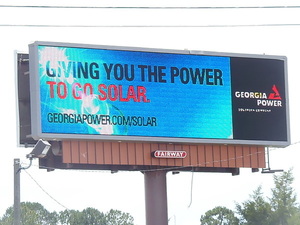
For most of June, Georgia Power has had two ads rotating on the

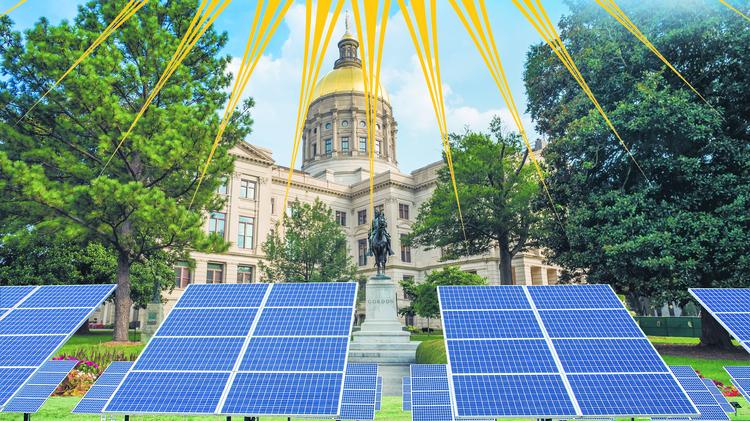
300x225 Sunlight from Georgia Power, in Giving you the power to go solar, by Gretchen Quarterman, 10 June 2015

five LED billboards in Valdosta, saying

Giving you the power to go solar —Georgia Power

When? Tomorrow, July 1st, as

Southern Company CEO Tom Fanning said

at the SO Stockholder meeting 27 May 2015.
Why then?
Because that’s when

HB 57
, aka the Solar Power Free-Market Financing Act of 2015,

goes into effect
.
As Tom Fanning has made his mantra since that meeting:

“If somebody wants to buy distributed generation, I want to sell it to ’em,”

Herman K. Trabish, Utility Dive, 11 June 2015

Inside Georgia Power’s move into the residential solar market:
The utility says it will offer solar through an unregulated business, but installers fear possible anticompetitive impacts
, Continue reading

Solar financing bill HB 57

You won’t have to mortgage the farm to install solar power if this bill passes,


because you’ll be able to get

reasonable financing
.

Update 2015-02-07: HB 57 was favorably reported out of the
House Energy, Utilities & Telecommunications Committee 28 January 2015,
first time such a bill has ever cleared that hurdle.

The actual solar leasing bill in the Georgia House as of 14 January 2015
is

HB 57
“…to provide for financing of solar technology by retail electric customers for the generation of electric energy to be used on and by property owned or occupied by such customers or to be fed back to the electric service provider”, aka the “Solar Power Free-Market Financing Act of 2015.”
It includes the same old generation limits from the 1973 Territorial
Electric Service Act (10 Megawatts per individual and 100 MW per company),
but it blows a huge hole in the prohibition on power purchase agreements (PPAs).

Georgia Power and the Electric Membership Corporations have reportedly

already agreed on this bill
.
If so, it should sail through the legislature.
Still, it won’t hurt to call your Georgia House member and ask them to vote for it,
and maybe become a co-sponsor.

Here’s PDF
of the bill, and
here’s the key provision: Continue reading

Georgia Power claims credit for solar leasing bill

That

antique 1973 law
may finally change to greatly facilitate
solar financing through power purchase agreements (PPAs),
now that Georgia Power has finally realized the good PR it’s
getting for its own solar power deployments.

Walter C. Jones, Jacksonville.com, 13 January 2015,

Solar access for residences, churches, small businesses could become easier under agreement
,


ATLANTA | Homeowners, churches and small businesses would soon have
access to the financing available in two-dozen states for the
installation of solar panels with little upfront costs based on an
agreement announced Tuesday during a legislative hearing.

Coming up with $18,000 or more in cash to install photovoltaic
panels on the average home is difficult for most homeowners. But if
the agreement becomes law, they could lease their roof to companies
that pay them back with free electricity, selling the rest to the
utilities.

Or cities or counties.
Valdosta or Lowndes County, for instance, might save hundreds of
thousands of dollars a year on utility bills if they could finance
solar power through PPAs.

Georgia has the fastest-growing solar Continue reading

Solar is now competitive with … natural gas –Crossborder Energy study

Colorado, California, North Carolina: when will Georgia catch up in solar power?
What will it take to get the Georgia legislature to realize all Georgians
will benefit economically from much more solar power than

GA PSC in July required Georgia Power to buy
?
And why should we permit

a methane gas pipeline to gash through Georgia

to profit executives in Houston and Juno Beach, Florida
when we could be deploying solar everywhere in Georgia
for

local jobs, profit, lower electric bills, and clean air and water
?

Here’s
the study

that showed solar benefits outweigh costs in North Carolina,

The Benefits and Costs
of Solar Generation
for Electric Ratepayers
in North Carolina
,
by R. Thomas Beach and
Patrick G. McGuire for Crossborder Energy, 18 October 2013.

Wholesale solar PPA prices provide perhaps the most dramatic
evidence of the continued decline in solar PV costs. Solar PPA
prices have fallen dramatically over the past several years, to the
point that, in some regions of the U.S., solar is now competitive
with other generation resources, including wind and natural gas.
Xcel Energy in Colorado recently announced that it is proposing to
add 170 MW of utility-scale solar to its system, with its CEO
stating “[f]or the first time ever, we are adding cost
competitive utility scale solar to the system.”33
The
California electric utilities make public each year the average PPA
prices for renewable contracts approved by the CPUC in the prior
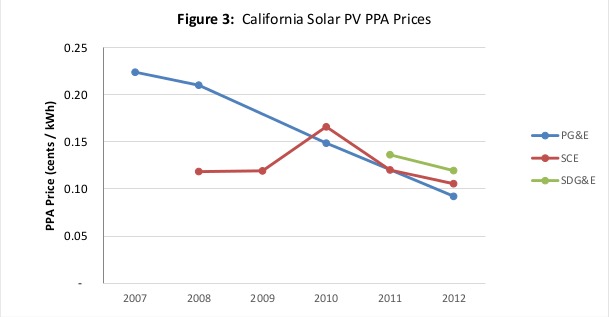
year. Figure 3 shows the trend in the prices for their solar PV
PPAs; CPUC contract approval can occur up to a year or more after
bids are received, so the figure is indicative of prices through
roughly 2011.34
2012 solicitations for solar PPAs in California in
the 3 MW to 20 MW size range through the Renewable Auction Mechanism
(RAM) have yielded market-clearing prices in the
8 to 9 cents
per
kWh range.3


The Lawrence Berkeley National Lab (LBNL) conducts and publishes
regular national surveys of the installed costs of solar PV; these
surveys include Continue reading

Industrial Authority working for solar in south Georgia @ VLCIA 2012-12-18

The

Industrial Authority

is working to find locations for some of the
210 MW Georgia Power got the PSC to shift
from biomass to solar
back in September.
That’s a good next step.

Jason Schaefer wrote for the VDT 23 Dec 2012,

Solar power push has Authority working to establish connections
,

Since the Georgia Public Service Commission (PSC) approved Georgia

Allan Ricketts, Projects and Existing Industry Manager, VLCIA, 2012-12-18

Power Company’s plan Nov. 20 to add 210 megawatts of solar power to
its electrical grid, the Valdosta-Lowndes County Industrial
Authority has been devising strategies to draw solar energy
producers to South Georgia.

Georgia Power will issue a Request for Proposals (RFP) from solar
energy collection and production companies in early 2013, according
to the PSC, and the company will contract with the lowest bidders to
purchase their energy and place it on the Georgia Power electrical
grid for public consumption.

Georgia Power plans to add 90 megawatts to its grid from distributed
generation (small companies producing between 100 kilowatts and 1
megawatt), and 120 megawatts of large utility-scale projects
producing up to 20 megawatts each. The company plans to price the
solar energy at $0.13 per kWh for distributed generation and up to
$0.12 per kWh for utility-scale projects, according to the PSC.

This government-approved commercial push for solar energy could be a
boon to sunny South Georgia as well as the greater Valdosta area
specifically, and the Authority is prepared to accommodate the solar
energy producers they expect.


Andrew Schruijer, Executive Director, VLCIA, 2012-12-18

“I think there’s a very good possibility of solar energy
coming to South Georgia,” Executive Director Andrea Schruijer
said. “Possibly in the near future.”

There’s more in the VDT story.
It’s pretty much what
Col. Ricketts also told me after the VLCIA meeting Tuesday a week ago.
He asked me if I knew what “distributed” meant.
I pointed out Georgia Power’s version of distributed was actually not
very distributed, compared to

Continue reading

VLCIA to sue Sterling Power about biomass site?

I’d heard a rumor that some sort of lawsuit about the biomass site
was the subject of some of the Industrial Authority executive
sessions for real estate discussions.
VLCIA has finally said in public what their position is.

Jason Schaefer wrote for the VDT today,

Authority weighs suit for biomass land:
Slow progress leads to default, contract argument


The Valdosta-Lowndes County Industrial Authority plans to send a
petition to Lowndes County Superior Court to sue Wiregrass Power,
LLC, for a clear title on the land purchased for the development of
a biomass energy plant.

The Authority believes Wiregrass defaulted on a lease agreement to
build the plant, placing ownership of the 22.22-acre tract back in
their hands, but Wiregrass denies the allegations. This denial casts
“a cloud” of suspicion on the Authority that may prevent
it from re-marketing the property, according to the petition,
leading to the suit.

Sounds like they’re publicizing their intent
to try to scare Sterling off without having to sue.
I’m for that.

This may explain

a flurry of special called meetings they had in May and June 2011.

Continue reading

Enabling a commodity market in solar power: Dr. Smith’s electric meters

Dr. Smith’s electric meters enable a commodity market
in solar power, with billing from generators to customers.
And EMCs can take 1% or so for carrying the power,
plus they can get advertising rights that could be
worth more than selling electricity!
If
SB 459
or something like it gets out of committee and into law.


Dr. Sidney Smith explained how the electric meter he’s developed
uses cellular technology to facilitate direct billing from
solar generator and customer.
Gretchen asked him what if they generate more than they use.
Dr. Smith said they wouldn’t.
I asked what if they added more panels.
He said they could, but there are trees in the back.

Here’s

Part 1 of 5:


Enabling a commodity market in solar power: Dr. Smith’s electric meters Part 1 of 5:

South Eastern Pathology Associates,

Selling Power, Lower Rates for Customers LLC (LRCLLC),

Richmond Hill, Bryan County, Georgia, 17 February 2012.

Videos by Gretchen Quarterman for LAKE, the Lowndes Area Knowledge Exchange.


He forgot about

the parking lot out front where the panels
he just connected are located:
no shading there, and plenty of room for more solar panels.

Dr. Smith said the best places for solar are where there is no shade
and near power poles.
Gretchen asked how do you finance?
Dr. Smith answered,

Continue reading

SB 401 revived in SB 459: lets you generate and sell solar power

SB 401 got tabled in the Natural Resources Committee.
46 other states already let people generate solar power and sell it to
a third party.

Yet in only four states — Georgia, Florida, North Carolina and
Kentucky Mdash; are third party power purchase agreements disallowed,
according to the U.S. Department of Energy.

But Georgia Power convinced that committee that it would raise
rates for everybody else.
Which is pretty rich coming from the same gapower that is

already charging customers Construction Work in Progress

for its nuke boondoggle.
So SB 401 sponsor Sen. Buddy Carter found another way.

Mary Landers wrote for the Savannah Morning News Friday,

Solar bill jolted back to life
:

To revive his bill, Carter tacked it onto to one already sent to the


Regulated Industries Committee — SB 459, which would allow
consumers to opt-out of smart meters like the ones Georgia Power is
currently installing in Savannah. The committee held a hearing on
the bill Thursday, ultimately tabling it, and saying they wanted
more information about how power purchase agreements work in other
states.

Carter was elated.

“It’s out there now and people are aware of it,” he
said. It’s getting media attention. I feel good about it.”

Help him feel even better about it.
Contact the committee chair and tell him we want solar cogeneration:

Senator William Ligon

404-656-0045

william.ligon@senate.ga.gov

Oh, regarding the meter opt-out in the main body of the bill,
why let gapower charge people for that?
You can mention to Sen. Ligon that people should be able to opt out for free.

-jsq

PS: Owed to Bob Ingram.
Projects that can actually be built —Jeff Glavan of MP2 Capital


Representing a San Francisco venture capital firm,

MP2 Capital,

Jeff Glavan said he’s looking for
medium to large scale projects that can actually get built,
with partners in each geographic market, since development is very local.

MP2 also does projects with municipalities that can’t take tax credits
because they are tax exempt. MP2 funds instead.

It’s not just all about large systems….
There’s a market for 1 to 5 megawatt systems.

The three things they look at are
credit, commercial terms, and economic terms.
Commercial terms are what hold up most projects.
MP2 likes to be involved in negotiating a
Power Purchase Agreement (PPA)
to avoid terms like host may need to repair roof which could
involve removing the solar system for some undefined amount of time.

MP2 is actively looking for solar partners.

-jsq