Tag Archives: Floridan Aquifer

When contamination gets into the watershed

Fort Gillem groundwater contamination Underground may be out of sight, but it just keeps seeping farther, getting into more wells, poisoning more wetlands, and getting into the air, causing cancer and other diseases.

Katie Leslie and Shannon McCaffrey wrote for the AJC 13 April 2013, 20 years later, Fort Gillem contamination still spreading,

In the early 1990s the U.S. Army discovered hazardous chemicals dumped at Fort Gillem seeping into residential wells in neighboring Forest Park. The finding prompted the military to pass out bottled water and convert many residents to a county water system from their private wells.

But two decades and a base closure later, state officials say the Army still hasn’t done enough to clean up known and suspected carcinogens that are migrating from groundwater into surface water and, potentially, into the air residents breathe.

groundwater contamination  from a waste disposal site

We might want to think about that before importing coal ash; oh, wait, we already did! Maybe at least we should not import any more of it. We already have cancer-causing arsenic in some of our wells; we don’t need more. And what about that Continue reading
South Ga. officials expecting sinkholes after rain while NYTimes plays down the risk

Sinkholes aren’t just for Florida anymore: Albany’s got them. Are sinkholes risky? You may think so if one is under your house. And here above the Floridan Aquifer you probably won’t know that until your foundations starts cracking. Maybe we should do something to prevent the problem, and to help people who are affected by it. Perhaps the Lowndes County government till pay attention when somebody’s house falls into a sinkhole.

Jim Wallace wrote for WALB 9 March 2013, Expect more sinkholes,

Some sinkholes have opened up in South Georgia since the recent heavy rains.

And engineers and public works experts say they expect more sinkholes to develop in the coming weeks. It’s just nature at work, but it can really cause some problems.

Really? Does “nature at work” include sinkholes predictably forming after massive water pumping to sprinkle strawberries during a cold snap?

The WALB story pooh-poohs the possibility of anything like that Sefner sinkhole showing up in south Georgia, and then details two Albany sinkholes:

Continue reading

Suwannee County sinkholes —WCTV

Sinkholes in Seffner, Fort Myers, Tallahassee, and now even closer. Follow the Withlacoochee River south to the Suwannee River, and two counties south of us in Suwannee County, Florida, they’ve got dozens of sinkholes, one of them massive, with another one this month, including apparently a cavern under some yards. This is in the same Floridan Aquifer that underlies Lowndes County, where we had a road drop into a sinkhole three years ago and sinkholes were discovered under a man’s garage and yard last year.

Greg Gullberg 4 March 2013, The Science Behind Sinkholes,

Mikell Cook says he and his neighbors have learned more about Geology than they ever cared to since last summer when Tropical Storm Debby swept through much of Florida leaving Live Oak and surrounding areas peppered with sinkholes.

He and his neighbors live in the town of McAlpin, where

Continue reading

Tallahassee sinkhole

Even closer than Tampa Bay or Fort Myers, Tallahassee has sinkhole problems in our same Floridan Aquifer just across the state line. Will the Lowndes County Commission do anything about our sinkhole problems before people start losing their insurance and get sucked into holes in the ground?

Andy Alcock wrote for WCTV Wednesday, Tallahassee Woman Faces Sinkhole Problem,

Imagine living in a home you can’t insure, no one wants to buy and it may not be safe.

A Tallahassee woman is currently facing that problem.

At first glance, her home in Tallahassee’s Mission Manor neighborhood on the city’s northwest side doesn’t look much different from any of the other homes in the neighborhood.

Then about two years ago, homeowner Vickie Gordon found a problem.

“I started noticing that the doors were getting stuck in the bathroom, couldn’t open them,” said Gordon.

Then the issues became more noticeable.

Cracks started showing up all over the house.

After Gordon contacted her insurance company, investigators found sinkhole activity at her home.

I wish this part was a joke:

Continue reading

Florida sink hole evicts church

More sinkholes in Florida in the same Floridan Aquifer that’s under us, this time evacuating a church. Maybe sinkhole safety should be important here, too.

WCTV carried an AP story today, Suspected Sinkhole Forces Church Move

Pastor Rick Shuck told WBBH in Fort Myers on Monday the sinkhole has caused uneven floors, cracks in the walls and a hole in the ground so large that a landscaper fell into it.

Shuck says they had to end Faith Community Church’s Sunday service early because “it’s just not safe anymore.” He says some cracks in the walls are a half-inch wide and part of the auditorium floor has dropped about 4 1/2 inches.

Geological engineers say it’s definitely a sinkhole. But the church’s insurance company sent engineers who determined there is no problem. So next month the two sides are heading to mediation.

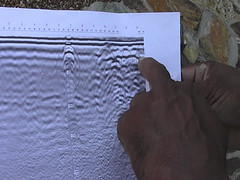
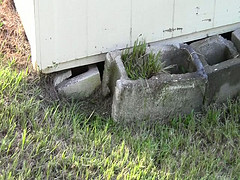
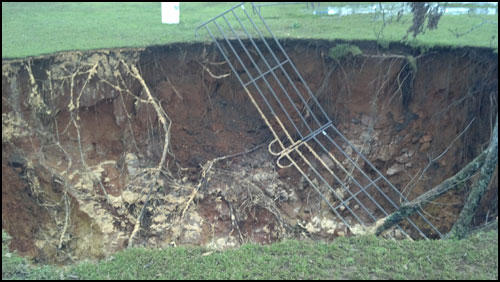
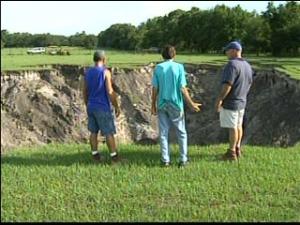
That second picture above was taken in Lowndes County, showing printouts of analysis by a VSU professor of sinkholes under a yard in Lowndes County. And they’re under Michael McCormick’s shed (see picture on the right), and they’re in his garage.

The same Floridan Aquifer is underground here as in Florida. Perhaps something needs to be done about sinkholes right here in Lowndes County?

-jsq

Circular wastewater firing squad continues

The VDT's Sunday front page was covered with wastewater stories, continuing the circular firing squad of the local powers that be. Meanwhile in Dublin, GA, they're breaking ground for solar panels at the local high school, using a bond financing model that we could use here, if local leaders would look up.

In addition to some detail about the city's FEMA application and following up on flooded yards, the VDT followed up on its EPD and EPA scrutiny story with one saying City received help from EPD to keep EPA away. It's good the VDT is covering these issues, but it's still leaving out important parts of the local water story.

Apparently firing back at Thursday's Valdosta City Council session, perhaps especially Robert Yost's very pointed criticisms of the VDT, the VDT concluded its rather rich Sunday editoral:

City leaders, please, no more of the blame game. The citizens of this community are imploring you to just accept responsibility and fix it.

Yet the VDT has spent the last week blaming the city, and has accepted no responsibility for its own role, or that of its editor, Kay Harris, in the recent loss of the SPLOST referendum that would have further funded wastewater work in Valdosta.

Now, I agree with the VDT that Continue reading

Sinkholes in Florida, and in Lowndes County, Georgia

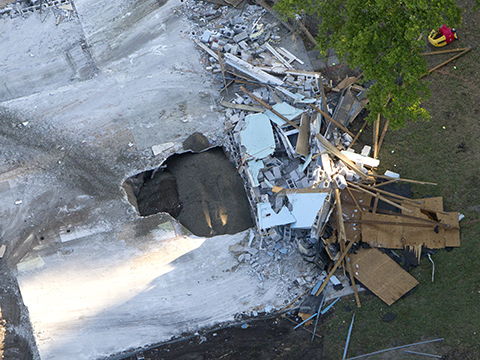
The sinkhole that formed under a man’s bed and pulled him in has made a lot of news in Florida, plus another one a few miles away. But the news seems to neglect why those sinkholes are forming. Could it be the same reason sinkholes are forming in Lowndes County, Georgia? And will the Lowndes County Commission do anything about that before we see news about somebody here falling into a sinkhole?

Will Hobson, Laura C. Morel and Jodie Tillman wrote for the Tampa Bay Times 1 March 2013, Seffner sinkhole 911 call: ‘Bedroom floor just collapsed’,

Jeremy Bush just went to bed when he heard what sounded like a car hitting the house. Then screams from his brother Jeffrey’s bedroom.

“Help me! Help me!”

Someone flipped the lights. Jeremy, 36, threw the door open, revealing a sight that defied belief: The earth had opened beneath his brother’s bedroom and was swallowing everything in it. The tip of Jeffrey’s mattress was the only thing left, and it was sinking into a churning sinkhole.

The Tampa Bay Times has a long series on what happened afterwards, rescue workers who didn’t find him, the demolition of the house, objects found, etc. They never quite get around to saying why the sinkhole was there. They first say (Shelley Rossetter 2 March 2013),

Continue reading

Withlacoochee Wastewater Treatment Plant Fully Operational

Received today. -jsq

FOR IMMEDIATE RELEASE

Release #03-13-02
March 3, 2013

Withlacoochee Wastewater Treatment Plant Fully Operational

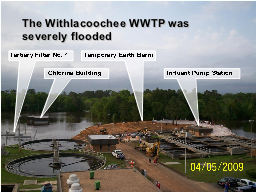
Withlacoochee Wastewater Treatment Plant At approximately 1:30 p.m. today, March 3, the Withlacoochee Wastewater Treatment Plant was brought online and returned to normal operation, after a loss of function for only three days compared to the nine days of complete loss of function experienced in the flood of 2009. Today, the river receded to the point where the temporary by-pass pumps could be connected to the existing valves. The system was turned on, became fully operational and began full treatment capabilities.

Lessons learned from the 2009 flood resulted in proactive measures which include the following:

  • The installation of bypass pumps, pipes and valves to utilize in the event of an emergency or act of God.
  • In 2009, the berm only protected the pump station, which did not prevent flooding of the chemical building, the chlorine contact building, the filters and the belt presses. The plant's electrical system was destroyed in the flooded area and the filters and belt presses were inoperable.
  • In this event, the electric system, chlorine cylinders, de-chlorination system and all flooded areas were turned off to avoid the damage that was experienced in 2009.
  • In this event, the biological, natural occurring bacteria that are used in the treatment process were saved so that the system could treat wastewater immediately when it was turned back on. In 2009, the natural occurring bacteria were washed out of the plant as a result of the continuous pumping during the event.
  • In this event, the plant was fully operational in three days. In 2009, the plant had a complete loss of function for nine days and was not fully operational for over a month.

The city's drinking water supply is in no way

Continue reading

Georgia legislature still trying to suck up Tennessee River water

Because Atlanta can’t get a grip on its water usage, the Georgia legislature is still trying to suck up Tennessee River water. If the legislature is willing to try that, how long before they try sucking up our Floridan Aquifer water for Atlanta?

Prefiled in December to be up early as the Georgia legisture starts meeting today, is a bill to try to move the northern border of Georgia to match an eighteenth century boundary that just happens to include a bit of the Tennessee River in Georgia. HR 4, Georgia and Tennessee; boundary dispute; propose settlement, was filed by Rep. Harry Geisinger, R – Roswell, District 48, and says in part:

WHEREAS, the State of Georgia proposes to the State of Tennessee that the dispute be resolved by the states agreeing that the current boundary between the two states reflecting the flawed 1818 survey be adopted as the legal boundary between the states except for an area described as follows which shall be made a part of the State of Georgia by which Georgia shall be able to exercise its riparian water rights to the Tennessee River at Nickajack:

Georgia is already in a three-decade-long dispute with Alabama and Florida over the Chattahoochee River. Does adding a dispute over the Tennessee River seem like a good idea to you?

And how can we best stop Atlanta from coming for our Floridan Aquifer?

-jsq

2012 Drought more expensive than Hurricane Sandy

You thought Hurricane Sandy was bad? You were right, but economically, the ongoing drought is worse economically. But we already know a much brighter path.

Weather Underground founder Dr. Jeff Masters wrote 16 November 2012, Lessons from 2012: Droughts, not Hurricanes, are the Greater Danger,

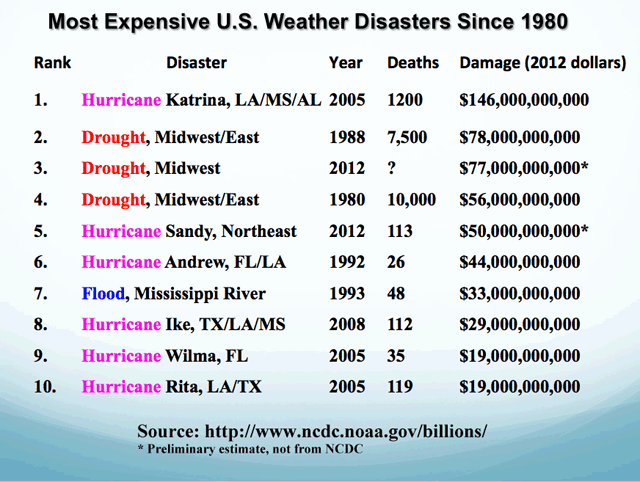
Sandy’s damages of perhaps $50 billion will likely be overshadowed by the huge costs of the great drought of 2012.

By Dr. Masters’ estimate, the 2012 drought will cost more than half again as much as Hurricane Sandy.

Also notice Hurricane Katrina still at the top of that table, with almost three times the economic damage and far more deaths than Hurricane Sandy. We could have gotten the message back in 2005, but hey, those were only poor southern people, so who, in for example New York City, really cared? Yes, I know many of us did and many of you actively helped, but I’m sure you see my point that when greater New York gets the storm, suddenly the country pays attention and a lot more people want to find out how to keep that from happening again.

What’s that drought look like for us here in Georgia at the moment, according to U.S. Drought Monitor?

Continue reading