Tag Archives: Elections

Change the Atomic Energy Act? How about change the Georgia Electric Territorial Act?

In reaction to the NRC denying a nuclear permit for Calvert Cliffs, some nuclear backers suggest changing the Atomic Energy Act of 1954 to permit majority foreign ownership of nuclear reactors. What will they suggest next? Asking Iran to invest in U.S. nukes?

Steve Skutnik wrote for http://theenergycollective.com 5 September 2012, A cost-free way to open up nuclear investment,

If this seems entirely backward in a world of global production and investment, that’s because it is. The current regulation is an artifact of the Atomic Energy Act of 1954, which first authorized private ownership of nuclear facilities. (Prior to this—per the Atomic Energy Act of 1946, all nuclear technology was considered a state secret, during the short time in which the U.S. enjoyed a monopoly on the technology.)

Is there any real compelling reason for restrictions on foreign ownership and investment in nuclear facilities to exist at a time when the U.S. holding a monopoly on the technology has long since passed? Issues of safety here of course are irrelevant—the facilities would be licensed and regulated by the NRC, just as any other nuclear facility is now. About the only salient objection is the political one—i.e., the implications of a foreign entity maintaining controlling ownership in key infrastructure. (Although it’s hard to see anyone getting particularly upset about the reverse—U.S. entities owning a controlling stake in infrastructure in other nations.)

Yeah, sure, strict regulation will deal with that, just like it prevents fracking from setting drinking water on fire, or BP from poisoning the Gulf. The new NRC head is maybe well-meaning, but it’s the same NRC that gave Vogtle 1 a clean bill just before it had to shut down and the same NRC that’s ignoring cancer in Shell Bluff.

Oh, by the way, the article gets to the main point eventually:

Continue reading

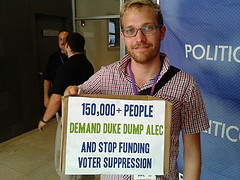
Duke Dump ALEC @ DNC 2012-09-05

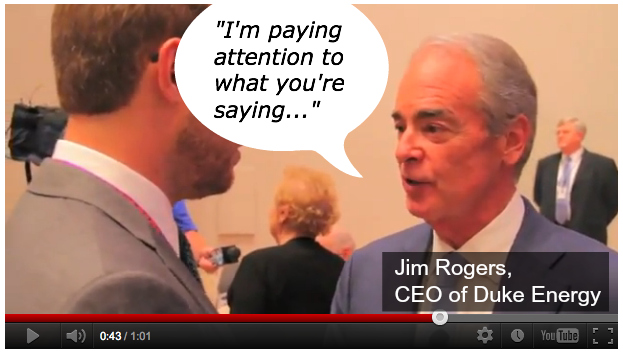
150,000+ People Demand Duke Dump ALEC --Whit Jones Leaving another event, I saw this on the street in Charlotte. Whit Jones said they’d just had a demonstration demanding Duke Energy dump ALEC. Also that he had encountered Duke CEO Jim Rogers and asked him when Duke would dump ALEC. Rogers was uncommittal. Here’s Jones’ blogged account of that encounter:

In short, I asked Duke’s CEO Jim Rogers if he would listen to the over 100,000 people who are calling on him to have Duke Dump ALEC and stop funding voter repression. He responded that “he’d be listening,” and when I pressed him for a commitment to drop ALEC he said “I’m not going to give you [a commitment right now] but you can trust that I’m paying attention to what you’re saying, and you’ll know in due time.”

Here’s video of the event.

Continue reading

NRC rejects nuke permit for EDF in Maryland

French nuclear operator Électricité de France (EDF) was denied a license last week for the proposed Calvert Cliffs nuclear reactor in Maryland, because the Atomic Energy Act of 1954 prohibits majority foreign ownership of nuclear plants. EDF now has 60 days to find a U.S. partner, or give up the project. Who could the possible suitors be? Hint: think southeast.

The handwriting was on the wall two years ago when Constellation Energy pulled out of the project. Jim Polson and Alan Katz wrote for Bloomberg 10 October 2010, Constellation Drops Nuclear Plant, Denting EDF’s U.S. Plans,

Constellation Energy Group Inc. pulled out of negotiations on a $7.5 billion loan guarantee to build a nuclear reactor in Maryland with Electricite de France SA, potentially damaging the French utility’s U.S. expansion plans and the companies’ partnership.

The cost of the U.S. government loan guarantee that the companies’ joint venture, UniStar Nuclear Energy, would need to build the Calvert Cliffs 3 reactor is too high and creates too much risk for Constellation, the Baltimore-based utility said in a statement yesterday. The statement said the next step is up to EDF. Enlarge image U.S. Deputy Energy Secretary Daniel Poneman

In a letter Oct. 8 to Daniel Poneman, deputy secretary of the U.S. Department of Energy, Constellation said it received a government estimate that the venture would have to pay about $880 million to the U.S. Treasury for the loan guarantee, “dramatically out of line with both our own independent assessments and of what the figure should reasonably be.”

Constellation’s decision may make it more likely that the U.S. utility will exercise a put option forcing EDF to buy as much as $2 billion of Constellation’s non-nuclear power plants, said Ingo Becker, head of utilities sector research at Kepler Capital Markets.

“EDF very clearly said if they exercise the put, this thing is over,” Becker said. “Constellation may have just turned around the calendar and pulled out of the new build before exercising the put, anticipating EDF’s reaction.”

In a letter Oct. 8 to Daniel Poneman, deputy secretary of the U.S. Department of Energy, Constellation said it received a government estimate that the venture would have to pay about $880 million to the U.S. Treasury for the loan guarantee, “dramatically out of line with both our own independent assessments and of what the figure should reasonably be.”

Meanwhile, Southern Company is still trying to reduce what it has to pay for its $8.3 billion federal loan guarantee.

Back in Maryland, the news got worse for the nuke last year. EDF asked for the state’s help, but didn’t get the answer it wanted. Scott Dance wrote for Baltimore Business Journal 16 December 2011, EDF: Constellation-Exelon settlement hurts Maryland nuclear industry,

Continue reading

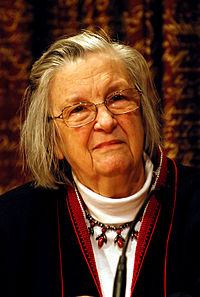
Green from the Grassroots —Elinor Ostrom

On the day she died, Nobel Prize-winning economist Elinor Ostrom published her last article, in Project Syndicate, 12 June 2012, Green from the Grassroots,

This grassroots diversity in “green policymaking” makes economic sense. “Sustainable cities” attract the creative, educated people who want to live in a pollution-free, modern urban environment that suits their lifestyles. This is where future growth lies. Like upgrading a mobile phone, when people see the benefits, they will discard old models in a flash.

Of course, true sustainability goes further than pollution control. City planners must look beyond municipal limits and analyze flows of resources — energy, food, water, and people into and out of their cities.

Worldwide, we are seeing a heterogeneous collection of cities interacting in a way that could have far-reaching influence on how Earth's entire life-support system evolves. These cities are learning from one another, building on good ideas and jettisoning poorer ones. Los Angeles took decades to implement pollution controls, but other cities, like Beijing, converted rapidly when they saw the benefits. In the coming decades, we may see a global system of interconnected sustainable cities emerging. If successful, everyone will want to join the club.

And counties, and regions, and watersheds, of course. As Mayor Julian Castro of San Antonio said, there is a "nexus between sustainability and job creation." We don't have to wait for San Antonio or Los Angeles or Beijing or Atlanta to lead the way: we can get on with it right here where we are.

-jsq

1.5MW solar field near Philadelphia

Far to the north of here, a botanical garden installed more than a megawatt of solar power a year ago. Maybe Georgia Power should ask them how it’s done.

PR of 16 June 2011, LONGWOOD GARDENS COMMISSIONS 10-ACRE SOLAR FIELD: Installation first step of goal to achieve 3 MW of solar energy by 2018

June 16, 2011, Kennett Square, PA — Longwood Gardens today commissioned a new, ground-mounted solar field spanning more than 10 acres at the horticultural showplace in Kennett Square, Pennsylvania.

One of the largest examples of clean emission-free energy in the region, the solar field produces 1.2 MW (megawatts) of power and will produce 1.5 MW when the final panels are installed in the coming weeks. The fixed-tilt, 1.5 MW solar installation will produce enough electricity to offset the usage of approximately 138 average Pennsylvania homes and reduce Longwood’s annual carbon dioxide emissions by 1,367 tons.

“We are always looking for ways to advance our sustainable practices,” said Paul Redman, Longwood Gardens Director. “It is integral to Longwood’s mission to decrease our dependence on fossil fuels.” We want to establish best practices and lead the way in showing communities how to live responsibly,” said Redman.

Imagine if Georgia Power and Southern Company acted responsibly and led the way in solar power!

Continue reading

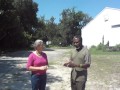
LAKE videoing George videoing Gretchen canvassing @ GretchenForLowndes.com 2012-08-25

Gretchen Quarterman canvassed on Summerlin Street in Valdosta Saturday:

The number one thing we need to do is to make the government accessible and transparent, so that the business of the people goes on in public.

Here’s a video playlist:

LAKE videoing George videoing Gretchen canvassing on Summerlin Street in Valdosta,
Canvassing, Lowndes County Commission (GretchenForLowndes.com),
Videos by John S. Quarterman for Lowndes Area Knowledge Exchange (LAKE),
and by George Boston Rhynes for bostongbr on YouTube,
Valdosta, Lowndes County, Georgia, 25 August 2012.

Gretchen mentioned she’d been going to County Commission meetings for about four years now, and thought it was her turn to serve. George asked why she was canvassing on the west side of Valdosta, and she answered:

The thing that is important for people to know is that every single citizen in the county gets to vote, Whether you live in Valdosta, Hahira, Lake Park, Dasher, Remerton, or the unincorporated areas. Every single person who lives in Lowndes County who is a registered voter gets to vote.

You have until October 8th to register to vote for the November 6th election. You can register at the Board of Elections at 2808 North Oak Street, or there are people going around with forms you can fill in and mail in or they will hand carry down there.

Participatory media! Doing what traditional media could do, George Boston Rhynes interviewed Gretchen Quarterman as she canvassed on Summerlin Street in Valdosta Saturday. Doing what traditional media can’t do, I videoed George videoing Gretchen, and he later videoed me helping Gretchen canvass.

-jsq

LOST Lawsuits Ahead?

Looks like history may repeat itself like last decade, now that LOST negotiations between the cities and the county have failed. Except this time apparently the law has changed so they can’t sue each other directly. Gretchen on LOST Instead next it goes to Superior Court “baseball arbitration”. However, I bet that still involves lawyers at taxpayer expense, not to mention the Court’s time.

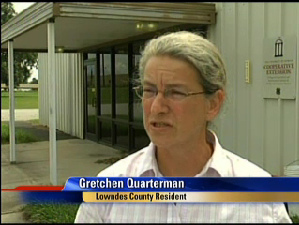
Greg Gullberg reported for WCTV yesterday, Tax Negotiations Hit Another Dead End In Lowndes County, and asked Gretchen down at the County Extension, who said,

It’s sort of sad because it is a waste, if you will, of taxpayer dollars. That the elected officials can’t get together and come to some agreement to say that they all understand how the money has to be divided up Yeah, it’s sad that more money has to go to lawyers insted of being spent on services.

I continue to think the local governments could spend their time together better trying to increase the size of the pie instead of squabbling over slices of it.

-jsq

Distributing information to citizens —George Boston Rhynes

Received yesterday on Valdosta LMIG resurfacing and transparency. -jsq

Thanks you so much for keeping us informed and it is still a disgrace that our elected officials cannot publish their meetings to all citizens. When will our Mayor; Council and County Commissioners start informing all the citizens and not just a select few of conservatives?

When will it all end? The time has come for change to take place in Valdosta for the good of all citizens and visitors. We need and should demand television, radio, internet and other means of distributing information to citizens.

How sad in 2012?

George included a video of his thoughts on elections hereabouts and elsewhere: Words from our YOUTHS….and where are you? Indeed George Rhynes is out there reporting the truth as he sees it, this time along with two VSU students.

-jsq

WSJ misunderstands why T-SPLOST was defeated

Inaccurate labelling is the reason T-SPLOST was defeated, along with Atlanta is not all of Georgia, but the Wall Street Journal doesn’t understand that.

Cameron McWhirter wrote for the Wall Street Journal 1 August 2012, Tea Party Ties Up Tax to Ease Atlanta Traffic

ATLANTA—Money and heavyweight endorsements don’t secure an election — especially when you propose higher taxes in a deeply conservative state with a robust tea-party movement.

A plan for a transportation sales tax was endorsed by Georgia’s Republican governor and the Democratic mayor of the state’s largest city. It was backed by the Metro Atlanta Chamber of Commerce and the area’s top businesses. It was pushed by top political consultants funded by more than $8 million in corporate and other donations.

Those against the plan were a loose coalition of tea-party activists, some environmentalists and a local branch of the NAACP. Their total raised? About $15,000.

But David slew Goliath.

That’s lazy reporting. Those “some environmentalists” included the Georgia Sierra Club, an organization which reportedly has more members than the state Democratic Party. And that’s just in Atlanta.

Opponents in our region included Democrat Ashley Paulk, who was on the T-SPLOST executive committee and is the current Chairman of the Lowndes County Commission, Democrat Gretchen Quarterman, who is the Chairman of the Lowndes County Democratic Party (LCDP) and is running for Chairman of the Lowndes County Commission, as well as Nolen Cox, Chairman of the Lowndes County Republican Party (LCRP), and Roy Taylor, LRCP First Vice Chair and well-known Tea Party activist, along with a wide range of other opponents.

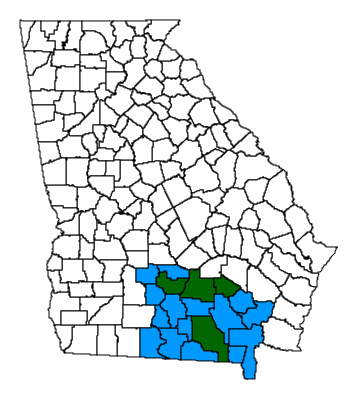
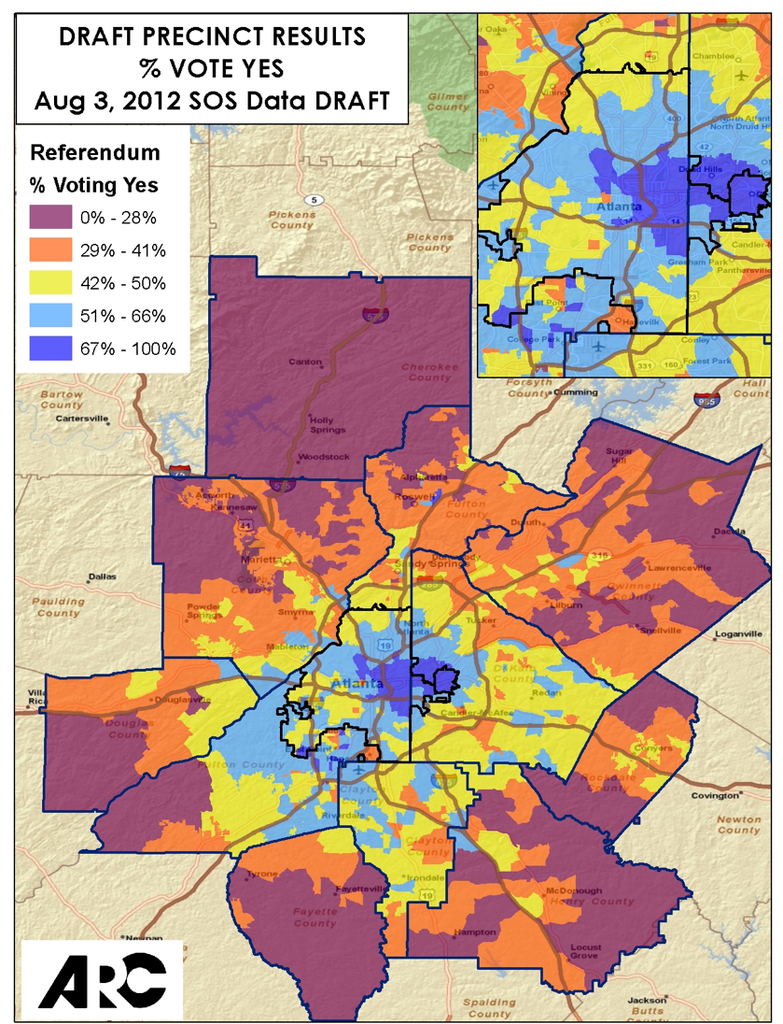
Look at the difference between that Region 11 T-SPLOST vote map and this map of the Atlanta Metro T-SPLOST vote. Atlanta metro is clearly centered around Atlanta. Region 11 isn’t an economic region: the vote was split right down the middle between No on the east and west and Yes in between.

Region 11 throws together three population centers: Lowndes, Tift, and Ware Counties, with their largest cities Valdosta, Tifton, and Waycross. Lowndes and Tift are at least connected by I-75, and they and most of the ones around them voted against (Ben Hill, Turner, Berrien, Cook, Lanier, Echols, and Brooks). Ware County and all the counties east of it (Pierce, Brantley, and Charlton) voted against. In between there’s a complete barrier of counties that voted for T-SPLOST (Irwin, Coffee, Bacon, Atkinson, and Clinch). Those No counties completely separate the eastern Ware County group from the western Lowndes-Tift group.

The perception around here is that T-SPLOST was made up to affect metro Atlanta, and the rest of the regions were Continue reading

PSC rubberstamps Vogtle costs; next day Fitch affirms Southern Company ratings

Need any more proof that Southern Company’s nuclear boondoggle only works with Georgia Power customer and taxpayer subsidy? PSC rubberstamps one day and Fitch affirms ratings the next day. Maybe we should elect Public Service Commissioners who will serve the public.

Georgia Power PR 21 August 2012, Georgia PSC approves Vogtle construction costs

The Georgia Public Service Commission (PSC) today in a 5-0 vote approved Georgia Power’s spending on Plant Vogtle units 3 and 4 for the period including July 1, 2011 through Dec. 31, 2011.

The next day, Fitch PR 23 August 2012, Fitch Affirms Ratings for Southern Company and Subsidiaries,

Continue reading