French nuclear operator Électricité de France (EDF)
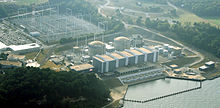
was denied a license last week for the proposed Calvert Cliffs
nuclear reactor in Maryland, because the
Atomic Energy Act of 1954 prohibits majority foreign ownership
of nuclear plants.
EDF now has 60 days to find a U.S. partner, or give up the project.
Who could the possible suitors be?
Hint: think southeast.
The handwriting was on the wall two years ago when
Constellation Energy pulled out of the project.
Jim Polson and Alan Katz wrote for Bloomberg 10 October 2010,
Constellation Drops Nuclear Plant, Denting EDF’s U.S. Plans,
Constellation Energy Group Inc. pulled out of negotiations on a $7.5
billion loan guarantee to build a nuclear reactor in Maryland with
Electricite de France SA, potentially damaging the French utility’s
U.S. expansion plans and the companies’ partnership.The cost of the U.S. government loan guarantee that the companies’
joint venture, UniStar Nuclear Energy, would need to build the
Calvert Cliffs 3 reactor is too high and creates too much risk for
Constellation, the Baltimore-based utility said in a statement
yesterday. The statement said the next step is up to EDF. Enlarge
image U.S. Deputy Energy Secretary Daniel PonemanIn a letter Oct. 8 to Daniel Poneman, deputy secretary of the U.S.
Department of Energy, Constellation said it received a government
estimate that the venture would have to pay about $880 million to
the U.S. Treasury for the loan guarantee, “dramatically out of
line with both our own independent assessments and of what the
figure should reasonably be.”Constellation’s decision may make it more likely that the U.S.
utility will exercise a put option forcing EDF to buy as much as $2
billion of Constellation’s non-nuclear power plants, said Ingo
Becker, head of utilities sector research at Kepler Capital Markets.“EDF very clearly said if they exercise the put, this thing is
over,” Becker said. “Constellation may have just turned
around the calendar and pulled out of the new build before
exercising the put, anticipating EDF’s reaction.”In a letter Oct. 8 to Daniel Poneman, deputy secretary of the U.S.
Department of Energy, Constellation said it received a government
estimate that the venture would have to pay about $880 million to
the U.S. Treasury for the loan guarantee, “dramatically out of
line with both our own independent assessments and of what the
figure should reasonably be.”
Meanwhile, Southern Company
is still trying to reduce what it has to pay for its
$8.3 billion federal loan guarantee.
Back in Maryland, the news got worse for the nuke last year.
EDF
asked for the state’s help,
but didn’t get the answer it wanted.
Scott Dance wrote for Baltimore Business Journal 16 December 2011,
EDF: Constellation-Exelon settlement hurts Maryland nuclear industry,
Constellation Energy Group Inc. nuclear partner EDF Group argues a
settlement over its proposed merger with Exelon Corp. puts the
state’s nuclear industry at risk — and could potentially kill
plans for a new nuclear reactor, according to a report.The French utility challenged Gov. Martin O’Malley for throwing his
support behind the merger after announcing a settlement with Exelon
on Thursday. EDF took issue with the lack of any commitments in the
settlement regarding nuclear power generation in the state. The
settlement meanwhile included requirements that Exelon build up to
300 megawatts of natural gas and renewable power generation in
Maryland.“At this time of economic uncertainty, EDF is surprised that
Governor O’Malley is supporting a transaction that still poses
significant risks to Maryland jobs and to the state’s nuclear
industry,” EDF officials said in a statement. The deal
“threatens hundreds of high-value, high-quality Constellation
Energy Nuclear Group jobs,” the statement said.EDF has argued the deal is a bad one because it would reduce the
autonomy of CENG, a joint venture between EDF and Constellation that
owns five nuclear reactors. Constellation (NYSE: CEG) and
Chicago-based Exelon (NYSE: EXC) have proposed merging in a $7.9
billion all-stock deal.
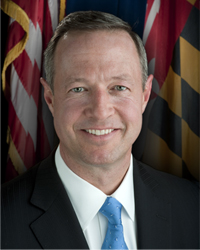
A governor favoring renewable energy over nuclear?
Tsk tsk.
So who could EDF partner with for the Calvert Cliffs nuke?
Not Constellation.
Not Exelon.
Maybe NextEra Energy, parent company of Florida Power and Light (FPL).
Maybe Dominion Resources of Virginia, or American Electric Power (AEP),
or FirstEnergy, or PPL, or any of a number of others.
But Constellation wanted out because the project was too costly
and too long-term.
According to
the Forbes Global 2000, all those companies are smaller than Exelon.
What U.S. electric utility companies are larger than Exelon?
There are only two.
Southern Company (SO), formerly the largest electric utility in the U.S.
and sixth largest in the world.
But the new size champion is Duke Energy of North Carolina,
after its merger with Progress Energy of Florida.
Both Duke and SO have their own nuclear projects, so I would guess
it’s unlikely they’ll take on yet another one.
Especially when that Calvert Cliffs project is in Maryland, which does
not have the kind of utility monopoly regime that SO and Duke enjoy.
This failed EDF nuke project makes it clearer why SO was the first company
to get a nuclear permit in 30 years:
it was the only one big enough and monopolistic enough to pull it off,
and even then it’s such a
bet-the-farm risk
that even SO only dared it with the regulatory capture triple-whammy
of
a stealth tax in the form of a rate hike on Georgia Power customers for
power they won’t get for years if ever,
a captive Public Service Commission
rubber-stamping costs (and soon cost overruns),
and an
$8.33 billion federal loan guarantee.
And what if even one of that three-legged regulatory capture stools legs
went away?
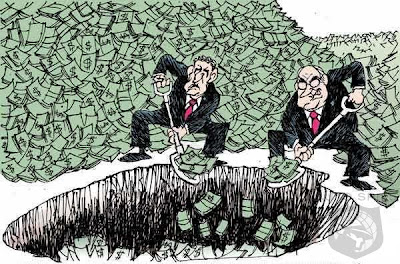
If we elect new Public Service Commissioners and legislators this year,
one or both of the Georgia legs could get revoked.
And if we lobby Congress and the federal government, maybe that
federal loan guarantee, which apparently has never been finalized,
might never get finalized.
Then we could stop
pouring money down that rathole on the Savannah River
and get on with
solar
and
wind power.
PS: Owed to Allison Fisher.
-jsq