Category Archives: Planning

Village Green or Detention Pond?

George Monbiot writes in the Guardian about how We have allowed developers to rob us of our village green:
Build loose suburbs carved up by busy roads and without green spaces and you help to create a population of fat, lonely people plagued by criminals. Build dense, leafy settlements with mixed uses, protected from traffic, and you help to create safe, fit and friendly communities.
Here’s one picture of what a fit, safe and functional community might look like. There’s nothing radical or new about it: similar developments have been built for centuries (and most are now monopolised by the rich). Houses or apartment blocks are built densely around a square of shared green space. It is big enough for playing ball games, but without fixed goalposts, allowing children and adults to define the space for themselves. It could contain trees; perhaps rocks or logs to climb on. There might be a corner of uncut meadow, or flowerbeds or fruit bushes. The space will work best when it is designed and managed by the people who live there.

Most important, the houses face inwards, and no cars are allowed inside the square: the roads serve only the backs of the buildings. The square is overlooked by everyone, which means that children can run in and out of their houses unsupervised, create their own tribes and learn their own rules, without fear of traffic accidents or molesters. They have a place in which to run wild without collecting asbos.

(An asbo is an Anti-Social Behaviour Order, like a citation for disturbing the peace.)

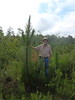
Suppose instead of walling off a detention pond and letting it grow weeds and snakes we made most of it high enough not to flood and let it grow trees, flowers, grass for children to play on, and maybe even vegetables. That wouldn’t cost much more to develop. The detention pond pictured is in the Hamilton Pointe development, where several residents told me they had no place to play football or basketball. If the detention pond was turned into a village green, they would have a place for sports.

-jsq

Valdosta in bottom 10 metro areas for wages

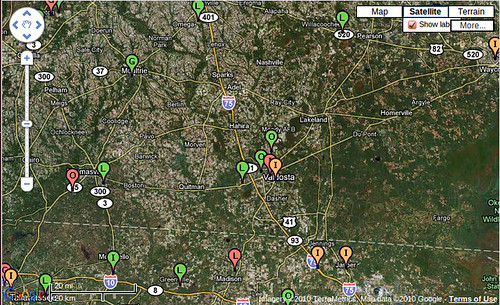
Richard Florida writes about The Geography of High-Paying Jobs, including this map based on Bureau of Labor Staistics (BLS) data:

The Valdosta Metropolitan Statistical Area (MSA) comes in the bottom 10 nationwide. That’s for overall average wages.

It doesn’t look quite as bad for specific classes of jobs (creative, service, and working class), but that’s mostly because there are almost no MSAs in the lowest pay tier. However, for service jobs, Valdosta is not as good as Tallahassee, and makes it into the bottom 10: Continue reading

Local Food for Economic Benefit in Georgia

The UGA Center for Agribusiness and Economic Development has quantified the economic effects of eating local food in Georgia, in this report: The Local Food Impact: What if Georgians Ate Georgia Produce? Prepared by: Sharon P. Kane, Kent Wolfe, Marcia Jones, and John McKissick Center Report: CR-10-03 May 2010
If Georgians produced all of the fruits and vegetables that they consumed, it could provide a way to close this utilization gap (the difference between state-wide production and consumption) of over $780 million per year. Even if this level can’t be achieved, simply closing the gap in one commodity­lettuce, for example­could mean an additional $83.6 million of direct revenue to local producers.

What is the lettuce gap? The Cordele Dispatch explains it: Continue reading

Biomass Town Hall Part 2

This is part 2 about the July 8th town Hall meeting about the biomass plant proposed for Valdosta.

First let’s hear George Rhynes explain that it’s never too late to reregulate our minds:

Here I’ve selected videos of local County Commission candidates: Continue reading

Results of lack of education

Juarez, Mexico, is farther down the road of emphasizing law and order over education and jobs, as Melissa del Bosque reports in the Texas Observer abo ut Mexico’s Lost Generations:
When Juarez’s (soon to be outgoing) Mayor Jose Reyes-Ferriz visited Austin last April something he said stuck with me.

He told the audience that a failure to invest in schools and other public infrastructure had led to the lawlessness in his city. Instead of schools and daycare centers, city leadership only invested in maquila parks and roads. Children were left on the streets to fend for themselves as their parents worked in the maquila factories for meager wages.

Mexican president Calderon, previously consumed by the drug war, finally noticed and did something:
“More than 5,000 residents have received job-training grants or temporary work sprucing up parks and sidewalks and planting trees. Officials added thousands of families to a government insurance program and handed out 6,000 scholarships in a city where few students were receiving such help.”

“It’s not enough to analyze it only in terms of public safety. You have serious gaps in the social and economic [areas] that have to be closed,” said Antonio Vivanco, a Calderon advisor overseeing the development effort.

Todos somos Juarez (We Are All Juarez).

-jsq

Biomass Town Hall, 8 July 2010

On July 8th there was a town Hall meeting about the biomass plant proposed for Valdosta.

Pastor Angela Manning of New Life Ministries sums up why she called this Town Hall meeting:

Speakers included: Continue reading

Foxborough Anti-McDonalds Banner

The VDT writes about Foxborough two days in a row:
Several dozen residents of the Foxborough subdivision came to the Lowndes County Commission meeting Tuesday to again express their dismay at the possibility of having a McDonald’s fast food restaurant located by the neighborhood’s entrance.

Resident Pete Candelaria said he has been living in Foxborough for six years and was speaking on behalf of the residents.

Candelario (I believe that’s the actual spelling of his name) provided a list of suggestions to the Commission, which Chairman Paulk addressed, including: Continue reading

VDT on Foxborough v. McDonalds

It looks like the strategy I recommended to the Foxborough opponents to McDonalds worked: go to the County Commission work session and you may get in the newspaper. Kay Harris writes in the VDT about Issues with development, Neighborhood upset about commercial encroachment:
According to Vince Schneider, the spokesman for the residents, the majority of the neighborhood is opposed to the possibility of a McDonald’s restaurant openin g there. The property is currently listed with Lowndes County as owned by First State Bank, but the county engineer, Mike Fletcher, confirmed Monday at the Lo wndes County Board of Commissioners work session that he has received a plat fo r the proposed development.

Schneider appeared before commissioners at the work session to request they rec onsider the commercial zoning in the area.

Many of the residents only found out aboout the proposed McDonalds from a cryptic mention by Kay Harris in the VDT a few weeks ago. Naturally, the VDT ends the current story on a note of finality: Continue reading

Unkempt Detention Pond

A couple of neighbors mentioned that snakes crawl up out of this detention pond at the end of Abingdon Court, backing up to houses on Hamilton Circle:

I like snakes, but next to many houses with small children may not be the best place. At least it’s not concrete, but some trees would be good, and at least fewer weeeds right next to peoples’ back yards.

There are more pictures in the flickr set. Here’s a video walk-in:

Continue reading

Good Meeting, Foxborough vs. McDonalds

Vince Schneider of Foxborough Avenue sums up the sense of a well-attended meeting (7PM Thursday July 8 2010) at which residents said they don’t want a McDonalds at the entrance to the Foxborough neighborhood. Vince will be speaking at the County Commission meeting Tuesday at 5:30 PM July 13, and also at the work session Monday at 8:30AM July 12.

See you there.

-jsq