Category Archives: Economy

Videos @ VLCIA 2012 02 23

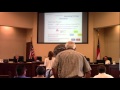
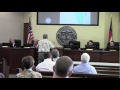
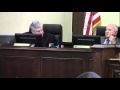
Here are videos of the February 2012 Industrial Authority meeting. Apologies for the poor sound. The room turned out to have very echoey acoustics, and no placement of the camera seemed to alleviate that. Also it’s in three chunks, the first of them quite long. In the interests of moving along and catching up on posting videos of recent meetings, we’re going to leave it like that for now. Here’s the agenda.

Here’s a playlist:


Norman Bennett, Tom Call, Roy Copeland chairman, Mary Gooding, Jerry Jennett,
Andrea Schruijer Executive Director, J. Stephen Gupton attorney, Allan Ricketts Project Manager,
Valdosta, Lowndes County, Georgia, 23 February 2012.
Video by John S. Quarterman for Lowndes Area Knowledge Exchange (LAKE).

-jsq

Net Metering in California: Megawatts and jobs

Net metering of solar energy works fine in California, where it increasingly provides electricity to meet peak demand. Georgia has a 2001 law that requires power utilities to do a version of net metering, but it’s a weak version and there’s a low cap on how much you can sell back to the utility.

The Georgia version, according to GEFA:

Net metering is the process whereby an energy consumer produces energy and then sells some or all of this energy to the “grid”, or major energy producers in the state. Under Georgia’s net metering laws, state residents and businesses can purchase and operate green energy capital, including photovoltaics, wind energy and fuel cells, and use this energy on-site. These residents and businesses may then sell any un-used, additional energy produced on-site to their energy provider. There is a maximum of 10 kilowatts (kW) for residential applications and up to 100 kW for commercial applications.
As you can see by GEFA’s pie chart, solar energy was too small to chart as a source of energy in Georgia as of 2004. With solar, we can burn less coal and uranium.

Solar Energy Industries Association (SEIA) has a report, Solar Net Metering in California,

Protecting Net energy metering (NEM) is the top policy priority of the Solar Energy Industries Association (SEIA) for California in 2012. NEM is a billing arrangement that allows utility customers to offset some or all of their energy use (up to 1 MW) with selfgenerated renewable energy.
The definition sounds the same, except for the cap: 1 megawatt is 1000 kilowatts, so California’s current cap is 100 times the Georgia residential cap and 10 times the Georgia commercial cap, with apparently no distinction between residential and commercial.

The result is this: Continue reading

VLCIA website sort of back: organizational questions

The continuing VLCIA website problems raise some organizational questions.

According to the VDT yesterday,

Website technical difficulties were a chief topic of concern at the Valdosta-Lowndes County Industrial Authority Tuesday evening.

Staff expects the website to go back online in less than 24 hours

Well, let’s see:

Well, sort of. The links in the flash thing at the top do work again, so you can get to detailed pages. Well, some of them: Staff & Board works, but Meeting Schedule does not. This description still applies:

It was also pointed out that meeting agendas and minutes were still available on the crashed website, but were intermixed with coding language.
The latest agenda is available. I thank VLCIA again for that, as I did both in Citizens to Be Heard and after the meeting Tuesday.

Doubtless VLCIA staff are doing what they can.

As an organizational issue, I wonder if the electricity was out for a week at the VLCIA office would the Industrial Authority do this: Continue reading

Luckie Street Solar Project

So whose solar parking lot is that in Atlanta?

According to Atlanta Downtown Improvement District, Luckie Street Solar Project (New Development)

157 Luckie St NW, Atlanta, GA 30303
CATEGORY: Institutional Development
Developer: Turner Enterprises
Solar panels added to a surface parking lot that will produce nearly 200 kilowatt hours of energy, making this the largest solar project installed in Downtown Atlanta
$1 million
Completed 2011

That’s 20 cents per kilowatt hour. Which won’t take many years to pay for itself.

Why did Ted Turner do this? According to Maria Saporta for the Atlanta Business Chronicle, 10 December 1010, Ted Turner builds solar project on parking lot next to his building,

Continue reading

Strategic Plan Update and Personnel Policy @ VLCIA 2012 03 20

The Industrial Authority meets this evening at 5:30 in their usual location. It seems to be mostly about business parks this time, plus these interesting items:

Director’s Report –Andrea Schruijer

  • Strategic Plan response

  • Update on Personal Policy and Procedure Manual

Maybe they’re serious about input from the community for their strategic plan process.

Their website still has sidebar error messages like this:

Deprecated: Function eregi() is deprecated in /home/industri/public_html/modules/jsCookMenu/JSCookMenu.class.php on line 277

But it’s fixed enough that I could retrieve the agenda. This time they do not list what any of the expansion projects or potential projects are. They also still don’t say what the various executive sessions were for; I think real estate or personnel are the usual two reasons allowed by state law.

Valdosta-Lowndes County Industrial Authority
Agenda
Tuesday, March 20, 2012 5:30 p.m.
Industrial Authority Conference Room
2110 N. Patterson Street


Continue reading

Solar projects get community support

What if the Industrial Authority supported industry that had a business model, brought jobs, and had the support of the community? It can happen, and already has!

Citizen Carol wrote for Texas Vox 6 January 2012, Austin Energy drought proofs its energy with new Webberville Solar Project,

Public Citizen says kudos to the City of Austin and Austin Energy for their vision and efforts in completing this project. Given that the State Climatologist is warning us that Texas can expect up to 5 more years of the current drought cycle, this project came just in time to help provide our community with drought–proof electricity during the peak use times — that will come in handy next summer.

Remember we already discovered this right here in Valdosta and Lowndes County? The Wiregrass Solar commissioning was a popular event, with many critics of the Industrial Authority lavishly praising it for the solar plant. Nobody complained about living near a solar installation. How about some more clean industry?

-jsq


Where could we put utility solar in south Georgia?

Where could we find 380 acres for a 30 Megawatt solar plant in south Georgia? Here’s a clue from Texas.

Citizen Carol wrote for Texas Vox 6 January 2012, Austin Energy drought proofs its energy with new Webberville Solar Project

A number of years ago, the City of Austin purchased this land planning to install a new coal-fired power plant. When those plans fell through, a landfill was proposed for the site that now boasts 280 acres of solar panels with a view of downtown Austin along its horizon.
How about on the proposed coal plant site in Ben Hill County?

Of course, it doesn’t have to be that big, or all in one place. How about on top of a landfill? How about on the cotton fields next to Valdosta’s Sallas Mahone Elementary School? Energy to air condition the school instead of drifting pesticides, and profit to the landowner! How about at the airport? At the mall parking lot? On top of the new county palace? On the warehouses in Hahira?

-jsq

Missouri has defeated CWIP: so can Georgia

A veteran of the original No Nukes movement calls Plant Vogtle and CWIP like he sees it.

Harvey Wasserman wrote Friday for EcoWatch, Nuclear Power’s Green Mountain Grassroots Demise,

The accelerating revolution in renewables has allowed solar, wind and other green sources to outstrip atomic reactors in cost, time to build, ecological impact and safety. As billions pour into Solartopian sources, private investment in atomic energy has all but disappeared—except where there are massive taxpayer subsidies.

Even that’s not enough. In 2011, President Obama handed $8.33 billion in federal loan guarantees to the builders of two reactors at Georgia’s Vogtle. But Peach State ratepayers are already being soaked for billions more in pre-payments, and the cost of the project is soaring. A parallel financial disaster looms at the Robinson site in neighboring South Carolina. Though the industry assumes these four reactors will eventually be finished, economic realities may say otherwise.

Cost estimates for new nukes have been soaring even before construction begins. Even with federal money, the builders still demand that state ratepayers foot the bill as the process proceeds, meaning consumers are on the hook for multiple billions even if the reactors never open. Pitched battles over this Construction Work in Progress scam have already been won by consumers in Missouri and are being fought in Iowa and elsewhere. As the years of building drag on, costs will escalate while renewables continue to become cheaper. Sooner or later, construction is likely to stop, as it did at numerous projects in the 1970s and 1980s which were never finished.

We can end CWIP in Georgia. It will benefit Georgia Power and the EMCs as well as all the rest of us when we stop wasting tax and customer dollars on boondoggles like Plant Vogtle or biomass or private prisons and get on with clean, profitable, job-creating renewable energy in Georgia: wind off the coast and sun inland.

-jsq

Industrial Authority still pushing “benefits” of scrapped private prison

The Industrial Authority appears to have learned nothing from the reams of information about the CCA private prison found for them by members of the public. They’re still pushing the “benefits” while saying nothing about the numerous cons (pun intended), the biggest of which is that the state and federal prison population is already decreasing, meaning we don’t need any more prisons, and if we built one here, it would be likely to close. So it’s not just a bad idea, it’s bad business. But here they go again….

Eames Yates wrote for WCTV Friday, Plans For New Prison Scrapped,

Schruijer went on to say “It would have been a huge economic impact. There were about 400 jobs associated with the project with approximately $150 million dollars in capital investment.”

Those four hundred jobs that the prison would have created, on average, would have payed between $40,000 and $50,000 dollars eah.

To people who mostly don’t live here now and mostly wouldn’t want to live here then, while driving away better businesses; she didn’t mention any of that, or the other problems with the whole private prison bad business.

That picture of Ms. Schruijer is hosted on the LAKE website, by the way. The VLCIA website is still broken, a week after I first pointed it out. Is this how the Industrial Authority plans to do PR, still promoting yet another failed Brad Lofton boondoggle while not making anything positive available on their own website?

-jsq

30 Megawatt solar plant opens near Austin

While Georgia Power continues to block solar deployment in Georgia, Austin Energy forges ahead in Texas with a utility-scale solar plant.

Here’s their PR, Austin Energy Activates 30 MW Solar Farm,

AUSTIN, Texas , Jan. 6, 2012 /PRNewswire/ — Austin Energy along with Austin City Mayor Lee Leffingwell , and Village of Webberville Mayor Hector Gonzales today announced the activation of a 30 megawatt (MW) solar power plant located within the Village of Webberville, Texas . The activation of the power plant marks the first utility-scale solar deployment for Austin Energy and helps bring the utility one step closer to achieving a 35% renewable energy mix by 2020. It is the largest active solar project of any public power utility in the country, the largest active project in Texas and among the largest of all operating solar projects in America. The project was activated on December 20, 2011

The key was a PPA:

The utility-scale solar project was made possible through a 25-year solar power purchase agreement in which Austin Energy will purchase the energy at a fixed rate along with the renewable energy credits.
In Georgia, PPAs can be made with municipal governments, universities, companies, or even individuals, if SB 401 passes.

An opportunity for EMCs: Continue reading