Tag Archives: Water

Solar water heaters on Housing Authority building

If they can do this in California, why can’t we do it here?

Sustainable City Network posts, Housing Authority Completes 28-Collector Solar Thermal System:

The City of Alameda, Calif., announced the completion of a solar water-heating system installed at a Housing Authority building on Park Street. Designed and built by SunWater Solar, the system will reduce utility bills by meeting up to 70 percent of the 65-unit building’s hot water load. The system is powered by 28 Heliodyne Gobi 410 collectors. A Heliodyne Delta T Pro monitoring device will provide online access to system performance data.

The Park Street system was recently approved for a $42,785 California Solar Initiative-Thermal rebate that will help cover the system’s $139,000 cost. CSI-Thermal rebates are currently at their highest tier: $12.82 per therm of natural gas offset. SunWater Solar contributed to the development of the CSI-Thermal program and has administered $237,000 in CSI-Thermal rebates on behalf of clients.

-jsq

The politics of climate change denial

Why do some people deny the overwhelming science of climate change in a time when the evidence and analysis is so thorough and so conclusive that no reputable scientific organization in the world doubts any longer that humans are changing the climate of the whole planet for the worse: because it threatens their political and economic beliefs. Naomi Klein: Why Climate Change Is So Threatening to Right-Wing Ideologues:
And the reason is that climate change is now seen as an identity issue on the right. People are defining themselves, like they’re against abortion, they don’t believe in climate change. It’s part of who they are.
It’s like denying the earth goes around the sun. Why would they identify with such a silly thing? Because of what actually dealing with climate change would mean: Continue reading

Uncontrolled growth and water problems

Daniel Mayer, November 2006
Maybe growth, growth, growth alone isn’t any better than jobs, jobs jobs alone, and water remains one of the main issues. Kay Harris wrote in the VDT 17 Feb 2011 that Aging infrastructure, growth, and other issues contribute to city’s sewer woes:
Valdosta Utilities Director Henry … Hicks addressed the sewage spills, saying they are caused by excess rain which overloads the Withlacoochee River Water Pollution Control Plant. He said growth along the river and throughout the regional watershed area has contributed to the amount of excess water running into the river.

“When you have all this growth and you create more impervious surface area (through paving and development), more and more water is running into the Withlacoochee. On average, the plant handles six million gallons a day and is equipped to accommodate twice that, but in recent rain events, we’ve gotten upwards of 15 million gallons extra in stormwater runoff and the system can’t handle that,” Hicks said.

Some of the comments on the VDT page are also interesting. Guest remarked: Continue reading

The mentality that exploits and destroys the natural environment –Wendell Berry

And now a word from Wendell Berry:
The mentality that exploits and destroys the natural environment is the same that abuses racial and economic minorities…. The mentality that destroys a watershed and then panics at the threat of flood is the same mentality that gives institutionalized insult to black people and then panics at the prospect of race riots.
Source: “Think Little” in A Continuous Harmony: Essays Cultural and Agricultural, by Wendell Berry, 1972. Forty years later, that mentality is still a problem.

-jsq

Environmental apartheid and envieronmental racism –Leigh Touchton, VCC, 10 Feb 2011

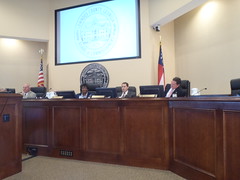
NAACP reiterates charges of environmental racism, despite claims from Brad Lofton, Executive Director of the Valdosta-Lowndes County Industrial Authority, that “all of a sudden we haven’t heard anymore about environmental racism.” Leigh Touchton, president of the local NAACP chapter, presents to the Valdosta City Council research published by Robert D. Bullard about environmental apartheid.


Regular meeting of the Valdosta City Council, 10 February 2011.
Video by Gretchen Quarterman for LAKE, the Lowndes Area Knowledge Exchange.
She posted the appended as a comment on the previous LAKE post about Robert D. Bullard’s report.

-jsq

Dear Mr. Quarterman:
Continue reading

Why “jobs, jobs, jobs” isn’t good enough for the public good and the general welfare –John S. Quarterman

Sure, everyone wants jobs for the people right now and jobs so the children don’t have to go somewhere else to find one. But what good is that if those jobs suck up all the water those children need to drink?

This is the problem:

“What I believe the three most important things are, not only for our community, and our state, and our country, but for our country, thats jobs number 1, jobs number 2, and jobs.”


Brad Lofton, Executive Director, Valdosta-Lowndes County Industrial Authority (VLCIA),
speaking at the Lake Park Chamber of Commerce annual dinner,
Lake Park, Lowndes County, Georgia, 28 January 2011.
Video by Gretchen Quarterman for LAKE, the Lowndes Area Knowledge Exchange.

I shook Brad Lofton’s hand after that speech and told him I liked it, because I did: in general it was a positive speech about real accomplishments. I’ve also pointed out I had a few nits with that speech. This one is more than a nit. This one is basic philosophy and policy.

Now one would expect an executive director of an industrial authority to be all about jobs. And that would be OK, if Continue reading

Biomass water usage as a problem. –Ben Copeland

Ben Copeland, who is on the Suwannee-Satilla regional water council, has learned something about rivers:
“One of the things that keeps some of these rivers going is the treated effluent that goes into them.

Now Brad Lofton wants to use some of that up in a biomass plant. We have a problem there.”

It’s at the end of this video:


Video of Ben Copeland, Past Chairman of the Board, Wiregrass Technical College,
speaking at the Lake Park Chamber of Commerce annual dinner,
Lake Park, Lowndes County, Georgia, 28 January 2011.
by Gretchen Quarterman for LAKE, the Lowndes Area Knowledge Exchange.

Matthew Richard brought up a similar point in his LTE in the VDT of yesterday: Continue reading

Dead fish in Cherry Creek

David Rodock wrote in the VDT on Sunday, Fish found dead following waste water discharge:
When the 27,000 gallons of untreated waste water was discharged at 4036 Bemiss Road on Tuesday, Jan. 20, local resident Dan Davis began to notice dead shiners over the next few days in the nearby Cherry Creek and Lake Cleve waters.

According to Davis, approximately fifty to sixty shiners — a small, silver-colored fish commonly used for bait by fishermen — were found dead in Cherry Creek over the last week. In addition to the fish, Davis also spotted a dead gray egret washed up underneath the bridge.

There’s more in the VDT.

-jsq

Taking water for granted? –Matthew Richard

This LTE appeared in the VDT today. -jsq
In the aftermath of Valdosta’s recent water calamity, it might be a good time to ask whether residents of Lowndes County are taking things like plentiful water for granted? Apparently, the Valdosta City Council is already thinking ahead, for on the agenda of their January 20, 2011 meeting, was a “Consideration of an Ordinance to establish standards for outdoor watering for the City of Valdosta.” One wonders if they’re worried about people watering their lawns in the summer? If that’s the case, it’s good that they acknowledge that the South is in the midst of a long-term drought.

Or perhaps I’m giving Council credit where it’s not due?

Continue reading

Ben Copeland on water and growth in south Georgia

Ben Copeland asked the big question: “How much growth do we want?” He related it to regional water in the aquifer, rivers, growth, and planning, speaking at the Lake Park Chamber of Commerce annual dinner, 28 January 2011.

Copeland is Past Chairman of the Board, Wiregrass Technical College. He serves on the regional water planning council. He said those councils were started due to worries about Atlanta not having a reliable water supply. He said the councils were planning for water and wastewater to 2050. The local regional council is the Suwannee-Satilla regional water council. He described the extent of the water planning region (see map). He expects finalization of the water plan by May. He talked about the Floridian aquifer, and how he’s worried not so much about Atlanta taking our water as about Orlando, Jacksonville, and Tallahassee. “Because they all have their straws in that same aquifer.”

Finally, Ben Copeland asked the big question: “How much growth do we want?”

“Do we want to be Jacksonville? Do we want to be Tallahassee? Do we want to be a large metropolitan region?

Folks are going to move to south Georgia, I can tell you that, because of all the resources that we have. I’m a great believer in the free enterprise system. How much do we try to limit that?

Continue reading