Tag Archives: Law

Carbon tax soon in China


If China can tax CO2, so can the U.S.

Hou Qiang wrote for Xinhua 19 February 2013,

China to introduce carbon tax: official

China will proactively introduce a set of new taxation policies


designed to preserve the environment, including a tax on carbon
dioxide emissions, according to a senior official with the Ministry
of Finance (MOF).

The government will collect the environmental protection tax instead
of pollutant discharge fees, as well as levy a tax on carbon dioxide
emissions, Jia Chen, head of the ministry’s tax policy division,
wrote in an article published on the MOF’s website.

-jsq

Georgia Recreational Use Statute


Suppose you owned land next to a river.
You might have concerns about liability for people getting out of
canoes or kayaks onto your land.
But you’re in luck!
Georgia state law says you’re not liable for most things that could happen.

The Georgia Recreational Use Statute is in

O.C.G.A. §51-3-20 through §51-3-26.

Here are a few excerpts.

§51-3-20. Purpose of article

The purpose of this article is to encourage owners of land to make
land and water areas available to the public for recreational
purposes by limiting the owners’ liability toward persons entering
thereon for recreational purposes.

Does that include boating?

Continue reading

ALEC again: GA HB 176 for higher cell towers with less local government oversight


After
massive public opposition

just fought off

a subdivision near Moody’s gate
,
do we want telephone cell towers popping up in Moody’s flight lines?

Trying to outlaw municipal broadband
isn’t the only thing telecom
companies and ALEC are up to in the Georgia legislature:
they’re also pushing a bill for higher cell towers with less
local government control over height or siting.
Do you want one next to you without even an opportunity for a local government hearing?

Here’s what ACCG says about

HB 176
,
renamed from ‘Advanced Broadband Collocation Act’ to
‘Mobile Broadband Infrastructure Leads to Development (BILD) Act’:


Cell Tower Siting Preemption Legislation Progresses

HB 176 passed a House Energy, Utilities and Telecommunications
Sub-Committee on Thursday. Representatives from ACCG, Cobb County,
Gwinnett County, GMA and several cities expressed concerns on the
impact this legislation will have on local cell tower siting
ordinances. This bill significantly preempts local governments in
reviewing and approving applications for both the modification of
existing cell towers and structures (collocation) and the
construction of new cell towers and structures local communities. As
HB 176 is the top priority of the wireless industry this session and
is being backed by many other influential groups including the
Americans for Prosperity and the Georgia Chamber of Commerce, it has
very strong momentum. Please have your county staff review the bill
and inform your House members of any negative implications it has on
your local zoning, land use or tower/equipment application review
processes. This legislation will likely be heard on the House floor
soon.

Guess who’s chair of the

Energy, Utilities & Telecommunications SubCommittee
?

Continue reading

Want to finance solar? Call GA Sen. Jack Murphy today about SB 51


A Georgia Senate committee needs to take it up
a bill that would greatly ease financing
solar power for your housetop or business roof.
Sen. Jack Murphy is the chair, and you can contact him today.

GA SB 51,

The Georgia Cogeneration and Distributed Generation Act
,
was read to the Senate 16 January 2013
and referred to the Committee on

Regulated Industries and Utilities
.
Here’s contact information for the Chair of that Committee:

Continue reading

National attention on GA HB 282 against muni broadband: needs GA leg. to vote it down

Another bad idea from ALEC already passed in SC and NC and is now in the GA
legislature, getting coverage in several national technical
and political blogs:

HB 282
, which would effectively forbid
municipal broadband if any commercial carrier offers 1.5Mbps.
It's up for a hearing this week: time to call your state rep.

Timothy B. Lee wrote for ArsTechnica 14 Feb 2013,

Bill would ban muni broadband if one home in census tract gets 1.5Mbps:
Approach could leave some Georgia residents without a viable broadband option.


Incumbent broadband providers are pushing legislation that would
restrict Georgia towns from building municipal broadband networks.
Under the proposal, if a single home in a census tract has Internet
access at speeds of 1.5Mbps or above, the town would be prohibited
from offering broadband service to anyone in that tract.

State-level restrictions on municipal broadband networks are

Continue reading

Why cant we keep and restore something that is very important to a community of people? —April Huntley

Received Friday. April Huntley also sent it to the Lowndes County Commissioners.
I have added a few links and pictures. -jsq

Dear Editor,


I’m not sure if people know or care that there is

another Dollar
General about to pop-up
in Lowndes County. This time it will be in
Naylor. I’m not sure if this will be an improvement or not.

Something I am also aware of and hold an opinion about is the

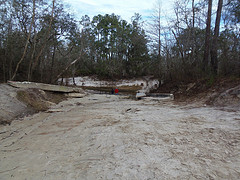
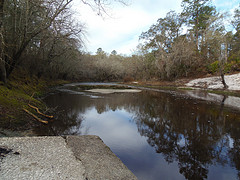
proposal to abandon a road in Naylor that leads to the Alapaha
River
. This is

the only public access to the Alapaha in Lowndes
County
. It is a place of history, recreation and fun for many
people.

The spot where County Road 16, Old State Rd., dead ends at the
Alapaha River is an area of rich history for Naylor and

Continue reading

Thank you for helping the community —April Huntley

Received Wednesday from April Huntley to Joyce Evans. -jsq

Good morning, Commissioner Evans!

Thank you very much for helping the community get the public hearing


for the closure of Old State Rd. tabled until next meeting! I hope
we will all be able to work together to find a lasting solution that
will enable the residents of Lowndes County and surrounding areas to
continue to enjoy this beautiful spot on the Alapaha River. I hope
you agree that this is not a standard road abandonment since it
affects a body of water. I hope you have a great day, and I look
forward to speaking with you soon!

Thank you again!

April Huntley

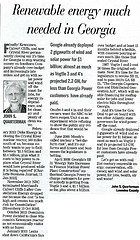
Renewable energy much needed in Georgia —John S. Quarterman

My op-ed in the VDT today; I’ve added links, plus some more after the op-ed.


Finally! Kewaunee, Calvert Cliffs, and now Crystal River
permanently closing say it’s time for Georgia to stop wasting money
on Southern Company’s already over-budget and increasingly-late
nukes and get on with solar power and wind off the coast: for
jobs, for energy independence, and for clean air and plenty of
clean water.

February 2013:

Duke Energy is closing
the Crystal River nuclear
reactor

(Tampa Bay Times, 6 Feb 2013)
,
160 miles south of us, because

nobody wants to pay to fix it
:
between “$1.5 billion and $3.4 billion,
plus what it costs to buy power to replace
what Crystal River would have produced while it is
being repaired”

[Charlotte Business Journal, 11 Jan 2013]
.
November 2012:

NRC terminated
Maryland’s Calvert Cliffs 3

(NRC 1 Nov 2012)

after

Constellation Energy dropped out
because the cost “is too high
and creates too much risk for Constellation”

[Bloomberg 10 Oct 2010]
.

Continue reading

As went Maine Yankee, so goes San Onofre: another reactor will close


San Onofre 4 will stay down
,
if opponents can stop the hidden experiment shell game.
Maine Yankee was down for about a year, and never started up again.

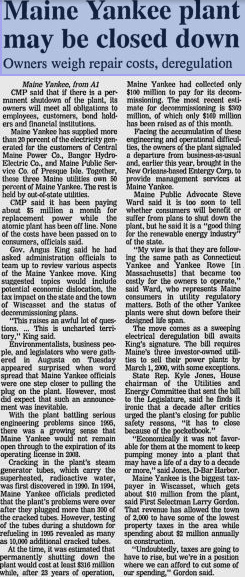
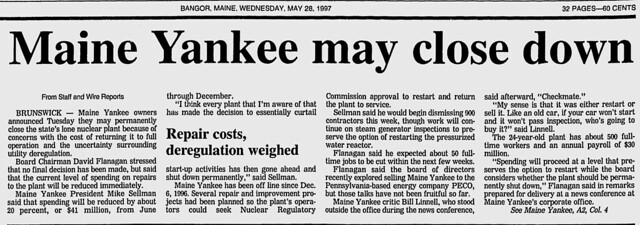
Front page of the Bangor Daily News 28 May 1997,

Maine Yankee plant may be closed down: Owners weigh repair costs, deregulation
,


Page 1A Bangor Daily News 28 May 1997

Maine Yankee President Mike Sellman said that spending
will be reduced by about 20 percent, or $41 million, from
June through December.

“I think every plant that I’m aware of that has made the decision
to essentially curtail start-up activities has then gone ahead
shut down permanently,” said Sellman.

Maine Yankee has been off line since Dec. 6, 1966.
Several repair and improvement projects had been planned so the plant’s
operators could seek Nuclear Regulatory Commission approval to
restart and return the plant to service.

See also
“It has to close because of the pocketbook.” —Kyle Jones on Maine Yankee nuclear power plant
.

-jsq

“It has to close because of the pocketbook.” —Kyle Jones on Maine Yankee nuclear power plant

Instead of demonstrating to influence legislators, sometimes it's better
to get elected and legislate: that's what Kyle Jones did in Maine,
and he closed the Maine Yankee nuke,
de-monopolized the state's electrical utilities,
and instituted a 30% renewable energy goal.
All this was helped by the nuclear industry's own incompetence.

Bangor Daily News, Page A2, 28 May 1997,

Maine Yankee plant may be closed down: Owners weigh repair costs, deregulation
,


Page 2A Bangor Daily News 28 May 1997

Cracking in the plant's steam generator tubes, which carry the superheated,
radioactive water, was first discovered in 1990.
In 1994, Main Yankee officials predicted that the plant's problems
were over after they plugged more than 300 of the cracked tubes.
However, testing of the tubes during a shutdown for refueling in 1995
revealed as many as 10,000 additional cracked tubes.

Sounds a lot like

San Onofre.

At the time, it was estimated that permanently shutting down
the plant would cost at least $316 million while,
after 23 years of operation, Maine Yankee had collected only
$100 million to pay for its decommissioning. The most recent
estimate for decommissioning is $369 million, of which
only $169 million has been raised as of this month.

Facing the accumulation of these engineering and operational difficulties,
the owners of the plant signaled a departure from business-as-usual
and, earlier this year, brought in the New Orleans-based Entergy Corp.
to provide management services at Maine Yankee.

Oh, my!
The same Entergy that's now

likely to close Vermont Yankee.

And Vermont Yankee wasn’t the first to follow this financial path to closure:

Continue reading