Category Archives: Georgia Power

Poor Southern Company: losing money on Kemper Coal in Mississippi

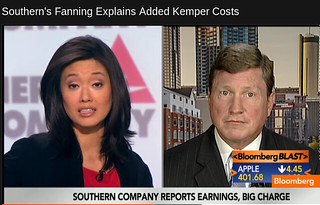
Apparently $1.88 billion wasn’t enough for Southern Company to charge the ratepayers of Mississippi Power enough for their “clean coal” plant. “Escalating costs”: kind of like SO’s new nukes at Plant Vogtle? Southern Company CEO Fanning says “I know people will try and link those, but they are not at all even similar.” What do you think?

Kristi Swartz wrote for the AJC 24 April 2103, Miss. power plant costs hurt Southern Co. profit,

Continue reading

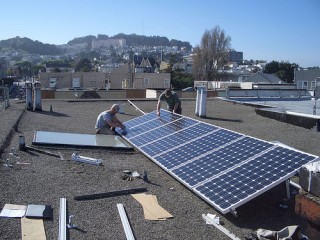
How can we get Georgia to move ahead in solar power?

If we can’t expect Georgia Power or Southern Company to change their tune about solar power, what can we do? Legislate and raise public pressure, while getting on with installing what solar power we can.

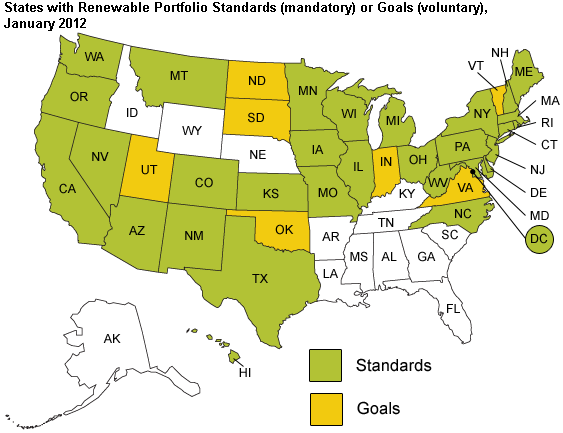
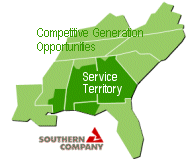
Maybe it’s time to pass something like HB 267 that would limit Georgia Power’s profits on that 19-month-late and $1 billion over budget nuclear boondoggle at Plant Vogtle. Instead of pouring more money down that broken concrete pit on the Savannah River, we need something like GA SB 51, The Georgia Cogeneration and Distributed Generation Act, to fix Georgia’s special solar financing problem, the antique 1973 Territorial Electric Service Act. That’s the 40-year-old antiquated law that SO CEO Thomas A. Fanning says “we need to protect”. Maybe SO does, for Fanning’s huge raises in compensation. Georgia Power and SO are not only defending that antique law, they’re preventing a Georgia Renewable Portfolio Standard (REPS) by stopping passage of bills like HB 503. Georgia Power, SO, and super-lobby ALEC systematically oppose renewable energy standards. They do this so successfully there are no REPS in Southern Company (SO)’s service territory, nor in most of SO’s surrounding “Competitive Generation Opportunities” states. One of the few exceptions is North Carolina, and a bill was introduced there to eliminate NC’s REPS.

Maybe it’s even time to do something about Georgia Power’s 11% guaranteed profit. Isn’t Georgia Power supposed to be a utility operating for the good of Georgians? Why does it get a guaranteed profit to pass on to Southern Company shareholder dividends and SO executive bonuses?

Georgia Power and even Southern Company could suddenly flip for solar power like Austin Energy did in 2003 and Cobb EMC did in 2012. But that probably won’t happen without a lot of public pressure, legal requirements by the Georgia legislature or PSC, or a shareholder revolt. So let’s start with the public pressure….

-jsq

Solar shakeout

Solar companies are shaking out just like car and computer companies before them. Dozens of automobile manufacturers shook out to a handful of major ones; Tesla is the first new one in decades. So many computer hardware and software companies went under or were bought by bigger ones that it would take a very long blog post to list them all; I could name a dozen or two off the top of my head. There’s a shakeout going on right now among mobile phone manufacturers: even mighty Nokia is sinking. The solar industry is going through that same normal shakeout phase. Will electric utilities be next?

Stephen Lacey wrote for greentechsolar 23 April 2013, Four Must-See Charts on the Future of the Global Solar Market: Who will be left standing when the dust settles?

In 2009, after Spain’s market collapsed and the world faced a crippling financial crisis, GTM Research predicted a shake-out in the manufacturing sector. But unexpected growth in global demand, particularly in European markets, helped keep many producers afloat.

Then, in 2010 and 2011, we saw a surge of new manufacturing capacity — much of it driven by China — that created the structural oversupply faced by the industry today. As illustrated by the growing list of deceased solar companies and acquisitions, the delayed shake-out in the industry is now well underway.

This morning at the GTM Solar Summit, Shayle Kann, vice president of research, shared his outlook on consolidation, module prices, and the shifting global demand through 2016. Here are four charts from his presentation that provide a glimpse of what the world may look like in the next three years.

In 2010, when the period of irrational growth began in solar manufacturing, there were 357 active module producers.

By the end of this year, that number will be down to 145. And in 2016, it will drop below 100. (So if you’re at a conference talking to a person involved in manufacturing, there’s a good chance he or she might be out of a job or working for a different firm the next time you see them.)

He then predicts that solar PV panel prices may actually rise briefly due to fewer manufacturers. However, as he notes, demand will keep going up. And demand combined with economies of scale may make prices continue down with Moore’s Law. I think his installed capacity graph is way too conservative, because he doesn’t go back far enough, which would reveal that 2010 growth is not an anomaly, it’s a steady continuation of the previous decade (well, except in Georgia). We shall see what happens in the next few years.

One thing’s for certain: a few bankruptcies are not a problem for the world’s fastest-growing industry. They are merely a symptom of any industry growing that fast. Solar panels will continue to spread, ever-faster, and electric utilities need to adapt or soon their big utility shakeout will start, too. The utility shakeout may look more like an increase in companies, as many solar installers and vendors move in to handle distributed solar power if the incumbents won’t do it. That’s my speculation, and again we’ll see.

-jsq
Dragging Georgia behind in solar power: Georgia Power and Southern Company

As long as we leave it to Georgia Power and Southern Company, Georgia will remain far behind in solar power jobs, profits, and energy independence. Hear Southern Company CEO Thomas A. Fanning say:

We remain very bullish on solar. When we think about renewables, I think renewables are exceedingly important to this nation’s future. My sense is until we see significant technology innovation, my sense is that that will probably very late in this decade or beyond that, we still are gonna get by far the lion’s share of electricity from central stations.

SO’s “bullish on solar” means nuclear, “clean coal”, and natural gas big baseload power stations, and forget about solar or wind. That’s why Georgia Power has raised customer rates to pay for gas and nuclear plants while complaining about solar. Here’s Georgia Power CEO Paul Bowers:

“Renewable (energy sources are) going to have a sliver,” Bowers said of fuels to create electricity. “Is it going to be 2 or 4 percent? That’s yet to be determined. Economics will drive that. But you always remember (that renewable energy is) an intermittent resource. It’s not one you can depend on 100 percent of the time.”

What is to be done?

-jsq

Georgia behind Maryland and Massachusetts in solar power

California and Texas ahead of Georgia in solar power, sure, but Maryland and Massachusetts, small and far to the north with less sun? Does that seem right to you?

According to the Solar Energy Industries Association (SEIA), Georgia should be number 5. Georgia should be moving up the rankings as fast as any state except maybe Arizona or Colorado, according to an Arizona State University study of two years ago that said Georgia was third among state that would benefit from solar deployment through generating and exporting energy to other states. The U.S. as a whole keeps installing far more solar power each year, but Georgia Power and Southern Company keep holding Georgia back.

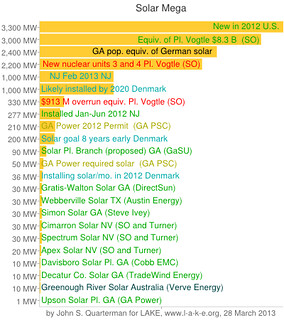
It’s great that Valdosta will soon get 2 more megawatts of local solar power. But while we’re waiting for Georgia Power to slowly get around to doling out 277 megawatts over several years, New Jersey has 1,000 megawatts already installed. Georgia is #22, behind #21 Connecticut. Why do we let that continue?

-jsq

Videos: audit, solar, office, and more @ VLCIA 2013-04-16

Interesting stuff (audit and internal controls, many meetings, 2 megawatts of solar power, searching for and finances of a new office from a mysterious seller) in the items missing from the posted agenda yet presented anyway, while two staff were elsewhere.

Here’s the agenda with a few notes and some links to the videos. * marks items that were not in the posted agenda.

Valdosta-Lowndes County Industrial Authority
Agenda
Tuesday, April 16, 2013 5:30 p.m.
Industrial Authority Conference Room
2110 N. Patterson Street
Continue reading

Two more megawatts of local solar power! @ VLCIA 2013-04-16

One megawatt at DuPont and one megawatt at Valdosta’s Mud Creek Wastewater Treatment Plant: that’s two more megawatts of solar power coming to Valdosta and Lowndes County! This was revealed at the 16 April 2013 Board Meeting of the Valdosta-Lowndes County Industrial Authority.

Project Director Allan Ricketts was on a speaker phone, so Executive Director Andrea Schruijer gave the Existing Industry and Project Report. She thinks maybe three existing industry expansions in second and third quarter 2013. They’ve continued working with a pharmaceutical company about locating here; more on that later. Continued work with three renewable and sustainable energy companies, and Georgia Power is cooperating.

We did receive notification that two of those advanced solar initiatives have been approved by Georgia Power Company.

One of them is a megawatt solar expansion at DuPont. The other is a megawatt solar expansion at the City of Valdosta’s Mud Creek Wastewater Plant.

She didn’t mention that in most states such projects wouldn’t have to be approved for doled-out quotas by a power company.

Schruijer also talked about Continue reading

A grid with a million solar rooftops

Bill McKibben wrote for Rolling Stone 11 April 2013, The Fossil Fuel Resistance,

A grid with a million solar rooftops feels more like the Internet than ConEd; it’s a farmers market in electrons, with the local control that it implies.

Distributed solar power is exactly what electric utilities fear. There’s a reason why Southern Company CEO Thomas A. Fanning consistently ranks “renewables” as his second-to-last power source; the only thing worse for big baseload utilities is his last one: efficiency, which could remove all demand for additional electrical supply in Georgia.

How big of an opportunity for the rest of us is this threat to the cozy business model of big baseload utilities? Continue reading

Southern Company Stockholder Meeting @ SO 2013-05-22

Spring means soon time for the Southern Company Stockholder meeting! See what one of the biggest electric utilities in the world is up to, and maybe make a few suggestions.

Here are videos of what you missed last year, and here is the official SO notice for this year (I got a link to it because I’m a shareholder): Notice of Annual Meeting of Stockholders of The Southern Company

DATE: Wednesday, May 22, 2013
TIME: 10:00 a.m., ET
PLACE: The Lodge Conference Center at Callaway Gardens
Highway 18
Pine Mountain, Georgia 3182

It includes a list of Items of Business, which doesn’t mention that stockholders are usually allowed to ask questions. Those questions are usually answered by Thomas A. fanning, Chairman, President, and Chief Executive Officer, who included a letter (text below) in which he recites his usual list of energy sources, in his usual order: Continue reading

IKEA biggest solar in Georgia

The biggest solar rooftop installation in Georgia? Not by mighty Georgia Power, not by an EMC, not even by GaSU: it’s IKEA’s distribution center in Chatham County. Chatham is also trailing only Atlanta in solar installations in general.

Mary Landers wrote for Savannahnow.com 7 January 2013, New solar adds to Chatham’s growing inventory,

Just in time for the new year, and for a tax break for the old one, Consolidated Utilities began producing electricity from solar panels at its water treatment plant in west Chatham County on the afternoon of New Year’s Eve.

“When I left on Monday the meter was receiving power,” said Tony Abbott, president of Consolidated Utilities, a private local water company.

The 416-panel, 100-kilowatt system is big enough to power about 10 average homes for 25 years, said Julian Smith, of SolarSmith, which installed the system. At the water treatment site, however, solar will instead power the blowers that keep the sewage ponds aerated. The panels occupy previously useless property in a flood zone, Smith noted.

OK, the Wiregrass Solar installation at Valdosta’s Mud Creek Wastewater Treatment Plant is larger, and the Valdosta City Council recently voted to expand it further. Go Valdosta!

But what about IKEA?

It’s not the largest solar installation in the county. That honor still goes to the IKEA distribution center, which in October plugged in its 1,460-kilowatt solar array on the roof of its distribution center. That IKEA installation is in fact the largest in the state.

Back in July I mentioned that IKEA was going to build that array, and IKEA was building almost as much solar as all of Georgia Power’s parent Southern Company. BusinessWire reported 9 Oct 2012 IKEA Plugs-In Georgia’s Largest Private Solar Rooftop Array on Savannah Distribution Center: Surpasses 75% U.S. Solar Presence.

This installation represents the 34th completed solar project for IKEA in the U.S., with five more locations underway, making the eventual U.S. solar presence of IKEA nearly 89% of its U.S. locations, generating with a total 38 MW. IKEA owns and operates each of its solar PV energy systems atop its buildings — as opposed to a solar lease or PPA (power purchase agreement) — and globally has allocated €590 million to invest in renewable energy, focusing on solar and wind during the coming three years. This investment reinforces the long-term commitment of IKEA to sustainability and confidence in photovoltaic (PV) technology. More than 250,000 solar panels have been installed on IKEA stores and buildings across the world. The company also owns and/or operates approximately 110 wind turbines in Europe.

The Savannahnow article mentions something happening in Chatham County but not so much yet in Lowndes County:

“What’s really going on in Chatham is that lots of homeowners put solar on their rooftops,” Arora said. “The excitement exists in Chatham for solar.”

-jsq