Category Archives: Georgia Power

Utilities levy an absurd tax upon the rest of their fellow-citizens –Adam Smith

What’s next door to Georgia Power, also a Southern Company, and raising rates on customers who are using less electricity? Alabama Power.

Rebecca Smith wrote for WSJ 21 March 2013, Return Rates for Utilities Get Harder Look

Households getting electricity from Alabama Power Co. are using 6% less than five years ago. But their monthly power bills still have increased by an average of 8%, partly because of a lucrative rate agreement that the utility brokered with state regulators 30 years ago.

“an absurd tax upon the rest of their fellow-citizens”
—Adam Smith

The deal allows Alabama Power, the state’s largest electric utility, to adjust its rates annually to maintain a return on equity, a measure of profit, of 13% to 14.5%. Now it is coming under fire from consumer advocates and one state utility commissioner, who argue that the utility’s profit levels are too high.

Continue reading

NJ 1 GW Solar: GA #22

While Georgia failed to reform its antique Territorial Electric Service Act and toyed with a solar monopoly, New Jersey, far to the north with far less sun, finished installing a gigawatt (1,000 megawatts) of solar power. The rest of the U.S. installed 3.3 MW total, slightly higher than projections of 3.2 MW, but Georgia lagged behind. When will the legislature and the Public Service Commission, and perhaps more importantly, Georgia Power and Southern Company, stop stop wasting our money on that three-legged nuclear regulatory-capture boondoggle at Plant Vogtle and get on with solar in Georgia for jobs, for profit, and for clean air and water?

Pete Danko wrote for Earth Techling and Huffpo 20 March 2013, New Jersey Solar Capacity Hits 1 Gigawatt,

Continue reading

Even the smallest amount of tritium can have negative health impacts, and most nukes leak tritium.

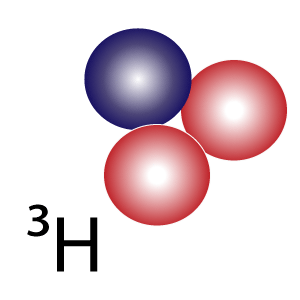
Received yesterday on Nuclear Plant Hatch radioactive leaks. Tritium (3H, a radioactive isotope of hydrogen) is the stuff nuclear Plant Hatch is letting leak into our groundwater. NRC lists 44 leaking sites out of 65 active reactor locations. No solar or wind plants leak tritium. -jsq

In case you haven’t seen this yet: TRITIUM: HEALTH CONSEQUENCES. Excerpt:

Most studies indicate that tritium in living creatures can produce

Continue reading

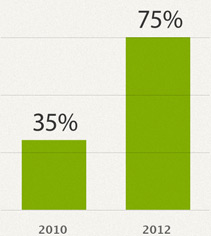
Apple: from 35% to 75% renewable energy in two years

All it takes is the will to get it done, and Apple is doing it: from 35% renewable energy in 2010 to 75% in 2012, and 100% at all Apple data centers. Cost? They’ll save more than they spent. Time for Georgia Power and Southern Company to stop dragging their feet and help us get on with it in Georgia.

Peter Burrows wrote for Bloomberg Thursday that Apple got nudged:

Continue reading

Nuclear Plant Hatch radioactive leaks

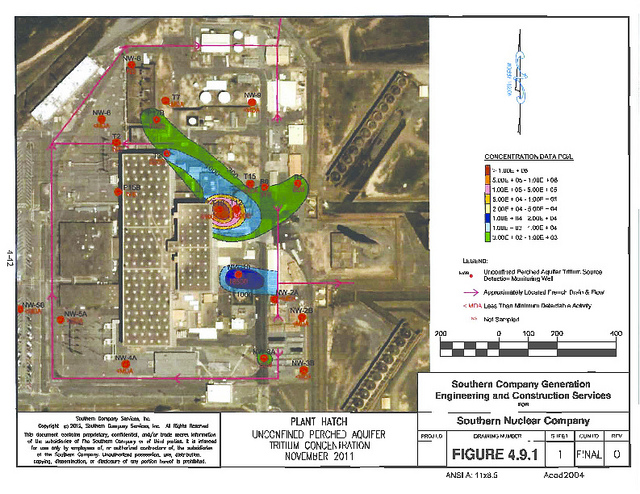
The NRC publishes annual Radioactive Effluent and Environmental Reports for every operating nuclear power reactor. The reports for Plant Hatch 1 & 2 say radioactive tritium has repeatedly leaked into the soil and groundwater, but the internal swamp is getting less radioactive. Reports like this are not needed for wind or solar plants.

Plant Hatch Unconfined Perched Aquifer Tritium Concentration November 2011
Annual Radiological Environmental Operating Reports for 2011

According to a 2007 Industry Groundwater Protection Initiative Voluntary Data Collection Questionnaire,

Continue reading

Renewable Portfolio Standards: GA, NC, and ALEC

Renewable Energy Portfolio Standards (RPS) are being proposed in Georgia and ALEC is trying to do away with them in North Carolina. If ALEC doesn’t like them, there must be something good about RPS. Let’s get on with real renewable energy in Georgia.

In Georgia, HB 503, sponsored by Karla Drenner, Carol Fullerton, Debbie Buckner, Scott Holcomb, Spencer Frye, and Earnest Smith, would create a Renewable Energy Credits Trading program as part of renewable portfolio standards, as Kyle wrote for Spencer Frye’s blog 10 March 2013, Let the Sunshine In. Unfortunately, HB 503 includes biomass as a renewable energy source. Maybe they just mean landfill gas, which I consider a special case since it’s being produced anyway, and since methane is worse as a greenhouse gas than CO2, burning landfill gas makes some sense. Nope, in the actual bill, 46-3-71 (1):

‘Biomass material’ means organic matter, excluding fossil fuels and black liquor, including agricultural crops, plants, trees, wood, wood wastes and residues, sawmill waste, sawdust, wood chips, bark chips, and forest thinning, harvesting, or clearing residues; wood waste from pallets or other wood demolition debris; peanut shells; cotton plants; corn stalks; and plant matter, including aquatic plants, grasses, stalks, vegetation, and residues, including hulls, shells, or cellulose containing fibers

The barn door in there is “harvesting”, which can mean whole trees, but the rest isn’t much better. We don’t need to be burning things that increase atmospheric CO2 and end up stripping our forests. In North Carolina they staretd with just tops and limbs and then tried to escalate to whole trees. We already fought off the biomass boondoggle here in south Georgia; let’s not have it encouraged statewide. Especially when we have better solutions: solar and wind power. HB 503 isn’t going to get passed this year, since it didn’t make crossover day, so maybe its sponsors can clean up that biomass mess before they submit it again.

Speaking of North Carolina, Continue reading

$1.88 billion and more on Kemper Coal to be charged to Mississippi Power customers

Risks at Southern Company’s Kemper Coal plant in Mississippi? Push those costs onto the public, of course! Southern Company and its subsidiary Mississippi Power got the MS Public Service Commissioners to approve super-CWIP (Construction Work in Progress) for Kemper Coal: automatic rate increases for MS Power customers for years. Just like Southern Company and its biggest subsidiary Georgia Power got the Georgia legislature to approve Super-CWIP for the new nukes at Plant Vogtle back in 2009. And both CWIP projects are already over budget. How about we cancel those boondoggles and build solar and wind instead?

AP reported 13 December 2012, After spending $1.88 billion, Southern Co. still faces risks on plant in Kemper County,

Continue reading

David defeats Goliath: Calvert Cliffs 3 nuke license denied, first ever by NRC

David (tiny five-person activist group NIRS with no lawyer) defeated Goliath (the world’s biggest nuclear reactor manufacturer, Areva, and operator, EDF). Previously a committee terminated the licensing process but the proposed operator wanted NRC review for the Calvert Cliffs 3 nuclear reactor. For the first time ever, the Nuclear Regulatory Commission denied a nuclear license, closing the book on Calvert Cliffs 3 for good, and probably taking down with it half a dozen or more other proposed reactors.

ENENEWS posted a roundup 12 March 2013, NIRS: Victory! License denied for U.S. nuclear reactor — First time in history NRC has upheld denial

Who is this proposed nuclear operator? The NIRS press release explains:

Continue reading

Videos: Solar Dublin High School groundbreaking @ DHS Solar 2013-03-11

Breaking ground Groundbreaking for solar power to save Dublin High 40%, thus reducing teacher furloughs, financed by municipal bonds, made possible by cooperation among a wide range of government officials, private companies, and individuals: that was the groundbreaking story in Dublin, Laurens County, yesterday, videod by Gretchen Quarterman for LAKE.

Dublin City Schools are willing to try something new, and that’s why they were groundbreaking, said Chuck Ledbetter, Superintendent, yesterday. He recognized members present of the Dublin City Council, the Laurens County Commission, the Dublin-Laurens Development Authority, and state representative Matt Hatchett, and Public Service Commissioner Bubba McDonald. Ledbetter’s theme,

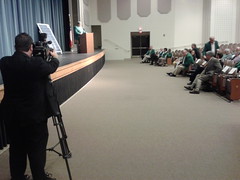
News camera and speaker Everybody worked together to make this happen.

was echoed over and over by many other speakers. What they worked for was economic help for Dublin City Schools through solar power, financed by municipal bonds.

The Mayor of Dublin, Phil Best added to the list Continue reading

Solar Dublin High School groundbreaking tomorrow

Dublin gets the jump on the rest of Georgia again: Dublin High School will get a megawatt of solar electricity through a lease agreement with a private company using local government bonds to get around Georgia’s special financing problem.

Kenny Burgamy reported for for 13wmaz.com Thursday, Solar Plant To Be Located at Dublin High,

Dublin High School of Dublin City Schools will soon implement 1 megawatt of solar energy.

The 4,000 panel solar power plant will be the largest in Central Georgia and is expected to save the school 40 percent in energy costs.

Dublin City Schools Superintendent Chuck Ledbetter told 13WMAZ, “The facility will be built and owned by private business and the school system will lease the solar power plant, saving us money in energy costs.”

The original plan was developed more than 15-months ago by German based MAGE SOLAR, which has a plant located in Laurens County.

The story has been carried by GPB by Athens Banner-Herald via AP.

This installation is similar to but slightly different from Continue reading