Category Archives: Economy

Valdosta in bottom 10 metro areas for wages

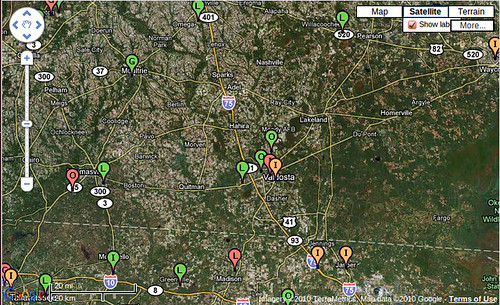
Richard Florida writes about The Geography of High-Paying Jobs, including this map based on Bureau of Labor Staistics (BLS) data:

The Valdosta Metropolitan Statistical Area (MSA) comes in the bottom 10 nationwide. That’s for overall average wages.

It doesn’t look quite as bad for specific classes of jobs (creative, service, and working class), but that’s mostly because there are almost no MSAs in the lowest pay tier. However, for service jobs, Valdosta is not as good as Tallahassee, and makes it into the bottom 10: Continue reading

Georgia Power Away from Coal?

Walter Jones writes about how Georgia Power aims to rely less on coal:
For years, solar and wind were described as unsuited for the South’s weather conditions and geography, although Georgia Power is now taking another look at them in this year’s version of it’s integrated-resource plan, a document it updates every three years.
I suppose late is better than never. However, Georgia Power is turning more to nuclear and natural gas.

But why is it turning away from coal at all?

Stricter environmental regulations are also changing the economics of coal. Even without a “carbon tax” or “cap and trade” passing in Congress, the federal government is stepping up its existing authority over power plants. And an ongoing court case related to a proposed power plant owned by an independent company, Longleaf, could open the door in Georgia to regulation of carbon dioxide emissions. Any combination of those factors could lead regulators to force Georgia Power to shut down more of its older coal plants.

“The financial outlook for coal is grim,” Thompson said.

People are finally wising up that coal is bad for us, and the company sees that affecting its bottom line.

-jsq

Biomass Town Hall Part 2

This is part 2 about the July 8th town Hall meeting about the biomass plant proposed for Valdosta.

First let’s hear George Rhynes explain that it’s never too late to reregulate our minds:

Here I’ve selected videos of local County Commission candidates: Continue reading

Results of lack of education

Juarez, Mexico, is farther down the road of emphasizing law and order over education and jobs, as Melissa del Bosque reports in the Texas Observer abo ut Mexico’s Lost Generations:
When Juarez’s (soon to be outgoing) Mayor Jose Reyes-Ferriz visited Austin last April something he said stuck with me.

He told the audience that a failure to invest in schools and other public infrastructure had led to the lawlessness in his city. Instead of schools and daycare centers, city leadership only invested in maquila parks and roads. Children were left on the streets to fend for themselves as their parents worked in the maquila factories for meager wages.

Mexican president Calderon, previously consumed by the drug war, finally noticed and did something:
“More than 5,000 residents have received job-training grants or temporary work sprucing up parks and sidewalks and planting trees. Officials added thousands of families to a government insurance program and handed out 6,000 scholarships in a city where few students were receiving such help.”

“It’s not enough to analyze it only in terms of public safety. You have serious gaps in the social and economic [areas] that have to be closed,” said Antonio Vivanco, a Calderon advisor overseeing the development effort.

Todos somos Juarez (We Are All Juarez).

-jsq

$100 million for large-scale solar projects

James Cartledge writes in BrighterEnergy.org:
Investment firm PowerFin Partners LLC is offering to finance more than $100 million worth of commercial and utility-scale solar projects in the US and Canada.

The company based in Austin, Texas, is looking for projects above 2 megawatts in size (DC), for which permitting is nearly complete.

Projects must be a minimum of 300,000 square feet across as many as four sites.

Hm, where could we find something like that locally?

-jsq

Solar Power and Georgia Power

As we’ve seen, the Center of Innovation – Energy defines solar as a southwestern energy source (see slide 9). That slide uses a version of this map:

I found that map on Georgia Power’s web pages. Meanwhile, here are Georgia Power Solar Projects. Hm, “a rooftop solar demonstration program”, “plans to install solar panels at schools in each of the company’s regions”, “showcase its technology”. Where’s the actual rapid deployment?

Meanwhile, Texas almost doubled its renewable energy generation between 2004 and 2006 and hasn’t stopped since. Continue reading

Center of Innovation – Energy

Where’s Waldo? And where’s the state renewable energy strategy for Georgia, or for the southeast, or for just south Georgia? Valdosta-Lowndes County Industrial Authority (VLCIA) Project Manager Allan Ricketts found another candidate.
“Forests Dominate Georgia’s Land Use”
That’s the title of slide 10 of 21 in Center of Innovation – Energy (CIE) by Jill Stuckey, Director. Actually, massively pesticided planted pines dominate south Georgia’s land use; not the same as actual forests with species diversity and diverse ages of trees. The same CIE slide equates
Georgia Forestry = Biomass Energy
That is what the state government seems to want it to be.

Back on slide 9, solar is defined as a southwestern regional energy source; nevermind that the solar map on that page shows Georgia with the same insolation as most of Texas (more on that later). And wind is defined as a central U.S. regional strength, nevermind that even Georgia Power has started exploring the possibility of wind off the Georgia coast.

I get it that Georgia has trees and forestry is a big industry in Georgia. I’m a tree farmer myself. I’d love to be convinced that biomass from trees is one good way to go. But at what costs? And compared to what? Continue reading

State Energy Strategy of Georgia

Among the questions local citizens asked the Valdosta-Lowndes County Industrial Authority (VLCIA) was where is the south Georgia, state, or southeast U.S. renewable energy strategy? VLCIA Project Manager Allan Ricketts looked, and he couldn’t find it, either. He did find this list of “renewable energy strategy” hits from a GEFA search. At least one of those links points us to http://www.georgiaenergyplan.org/, which now gets us
Are you interested in buying this domain name?
The state has apparently abandoned that domain. Is that an indication of how seriously Georgia takes renewable energy?

Here’s something that looks promising: State Energy Strategy for Georgia (SESG), December 14, 2006, Governor’s Energy Policy Council, GEFA. It says it’s an energy strategy, but it’s mostly about transportation of existing fuels such as natural gas. Towards the end of the document in Figure 2 (shown above) the SESG illustrates the pit we’re in: about a third of Georgia’s energy comes from coal, another third from petroleum, a sixth from natural gas, and so little from renewable sources they apparently weren’t worth putting on the pie chart.

The SESG does contain this: Continue reading

Glen Laurel Against

Here Coy Brightwell asks for a show of hands for those against rezoning for the Glen Laurel subdivision on Old Pine Road. Many hands went up throughout the packed room. Even more to the point, not one neighbor spoke for the rezoning.

He ends with an additional disclaimer that he’s not against development; he’s against the density of this development in this place. VDT quoted him as saying:

“We are not against progress. We are not against the development of Lowndes County … The part that we do have a problem with is the density of this proposal. We’re just not in agreement with the drastic changes that will take place in our community (and) we are here for a compromise.”

Another view of the show of hands: Continue reading

Nix on biomass plant in Traverse City, Michigan

Looking farther afield in Cadillac, Michigan than schools and realtors, there are some people who aren’t completely pleased with the local biomass plant:
Complaints are more frequent along Mary Street, a short stretch a few hundred yards south of the plant. Residents there deal with more intense noise and odors.

Craig Walworth’s home is among the closest to the plant. He walked up to his Jeep — a vehicle he cleaned the day before — and dragged his finger through a layer of film on the hood.

“Every morning, you have that to look forward to,” he said. “I clean my screens three times a year during the summer because they clog up.”

Nonetheless he didn’t say it affected his property values. However, that’s not the only issue.

Meanwhile, about an hour north on the edge of Lake Michigan, in Traverse City local activism caused cancellation of a proposed biomass plant: Continue reading