Tag Archives: Transparency

New Clayton County Commissioners fire County Manager, fund forensic audit

A few new Commissioners on a five-member board is producing significant changes in Clayton County. What changes will the new Lowndes County Commissioners make?

Tammy Joyner write for the AJC Election results usher in period of change for Clayton,

The new County Commission set the tone this week by ushering in a raft of changes aimed at creating better accountability in Clayton’s finances while putting greater control in the hands of the new chairman. The board removed County Manager Wade Starr, a long-time kingmaker in Clayton politics, and will bring in a chief financial officer to manage county finances.

The balance of power clearly has swung to newly elected Commissioners Jeff Turner and Shana Rooks. Turner, who replaces Eldrin Bell as chairman, and Rooks, who defeated Wole Ralph, teamed with returning Commissioner Michael Edmondson to create a new voting bloc on the five-member board, and they appear intent on taking swift action.

“They hit the ground running,” said Carl Swensson, chairman of the Clayton County Citizens Oversight Committee. “The former power triumvirate has been absolutely shattered. We’re going to have good people in position where they can do the most good for this county. You’re going to find a more receptive ear in the new structure.”

Naturally the remaining old guard took issue:

Continue reading

New Commission meets Monday morning and Tuesday evening @ LCC 2013-01-07

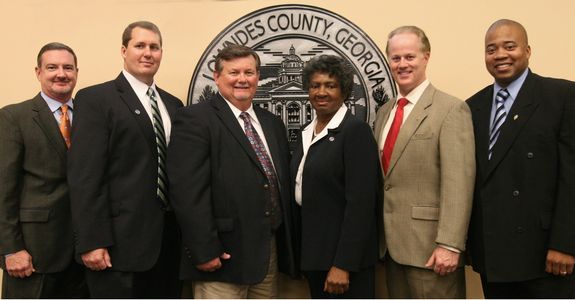
Pictured: newly elected Commissioners Page, Evans (re-elected), Slaughter, and Marshall

The Industrial Authority wants to buy some unspecified property public defender needs renewing, plus 4-H agent and school bus activity. Also workers’ compensation, and the Commission needs to approve its own schedule, since it’s a new Commission now, with two more voting members than last year, and a new Chairman.

Here’s a list of the current Commission members:

  • Bill Slaughter, Chairman, At-Large
  • Joyce E. Evans, Commissioner, District 1
  • Richard Raines, Commissioner, District 2
  • Crawford Powell, Commissioner, District 3
  • Demarcus Marshall, Commissioner, District 4
  • John Page, Commissioner, District 5

Their Commission web page still has at the top this mission statement:

“To provide an efficient, effective and responsive local government to all citizens of Lowndes County while maintaining the financial strength to meet any contingency”

The county government has apparently been pretty good about that last thing (although that $8.9 million discrepency could make some wonder). On responsiveness, not so much, considering the trash non-solution railroaded through at the last meeting of the previous Commission. Maybe this new Commission will be different.

Here’s the agenda.

-jsq

LOWNDES COUNTY BOARD OF COMMISSIONERS
PROPOSED AGENDA
WORK SESSION, MONDAY, JANUARY 7, 2013, 8:30 a.m.
REGULAR SESSION, TUESDAY, JANUARY 8, 2013, 5:30 p.m.
327 N. Ashley Street — 2nd Floor
Continue reading

Substandard fire protection at nuclear Plant Hatch?

Does Hatch nuclear Unit 1 have substandard fire protection, like many reactors built before 1975? Protection against fires that the NRC says cause about half the core damage risk, such as at Fukushima, which is the same design as Hatch?

According to Simplyfy.org 2 Jan 2012, Fire Risk At Older Japan Reactors Shows Potential Worldwide Problem,

The [Japanese Nuclear Regulatory Authority] NRA announced recently that reactors built before 1975 likely have sub standard fire protection designs. This includes having important cables coated in fire resistant insulation, isolating and protecting cables and creating barriers to prevent fires from spreading to other areas of critical equipment.

Source: The Mainichi, 1 Jan 2013, Over 10 nuclear plants in Japan have flawed fire-prevention equipment: sources.

What else was built before 1975? Plant Hatch Unit 1 “Operating License: Issued – 10/13/1974”, according to the U.S. NRC. 100 miles from here, and the same design as Fukushima.

DOE also instituted upgrades and changes to their reactor facilities which included facility modifications as a result of Browns Ferry fire. Private sector nuclear power reactors in the US are not all fully up to the newer rules. The NRC has issued a number of exemptions that watchdog groups have criticized as being unsafe. Browns Ferry still does not meet the NRC fire rules for cables. 47 of 52 reactors in the US still do not comply with the 1980 fire regulations.

Plant Hatch is privately owned and operated. Has it been upgraded? Continue reading

Industrial Authority working for solar in south Georgia @ VLCIA 2012-12-18

The Industrial Authority is working to find locations for some of the 210 MW Georgia Power got the PSC to shift from biomass to solar back in September. That’s a good next step.

Jason Schaefer wrote for the VDT 23 Dec 2012, Solar power push has Authority working to establish connections,

Since the Georgia Public Service Commission (PSC) approved Georgia Allan Ricketts, Projects and Existing Industry Manager, VLCIA, 2012-12-18 Power Company’s plan Nov. 20 to add 210 megawatts of solar power to its electrical grid, the Valdosta-Lowndes County Industrial Authority has been devising strategies to draw solar energy producers to South Georgia.

Georgia Power will issue a Request for Proposals (RFP) from solar energy collection and production companies in early 2013, according to the PSC, and the company will contract with the lowest bidders to purchase their energy and place it on the Georgia Power electrical grid for public consumption.

Georgia Power plans to add 90 megawatts to its grid from distributed generation (small companies producing between 100 kilowatts and 1 megawatt), and 120 megawatts of large utility-scale projects producing up to 20 megawatts each. The company plans to price the solar energy at $0.13 per kWh for distributed generation and up to $0.12 per kWh for utility-scale projects, according to the PSC.

This government-approved commercial push for solar energy could be a boon to sunny South Georgia as well as the greater Valdosta area specifically, and the Authority is prepared to accommodate the solar energy producers they expect.

Andrew Schruijer, Executive Director, VLCIA, 2012-12-18 “I think there’s a very good possibility of solar energy coming to South Georgia,” Executive Director Andrea Schruijer said. “Possibly in the near future.”

There’s more in the VDT story. It’s pretty much what Col. Ricketts also told me after the VLCIA meeting Tuesday a week ago. He asked me if I knew what “distributed” meant. I pointed out Georgia Power’s version of distributed was actually not very distributed, compared to Continue reading

Fracking: coming soon to a state near you?

Lest you think fracking is something that happens only in faraway places like Alberta or Pennsylvania, look at this map of North American shale gas basins, extending right through the Appalachians from Pennsylvania through West Virginia, Virginia, Tennessee, and North Carolina into Georgia, Alabama, and Mississippi.

Source: Canada fracking creates ‘test tube‘ residents in B.C., Alberta,
by Lynn Herrmann for Digital Journal 5 January 2012.

How long before Georgia Power or Southern Company decide natural gas would be even cheaper if they fracked in Georgia or Alabama or Mississippi? How long until unavoidable human error starts fracking polluting our local groundwater and rivers? For that matter, isn’t it bad enough already that other people’s water is fracked for cheap gas in Georgia?

We could just get on with solar power, which doesn’t spill.

-jsq

NRC says it’s “never been a practice” to show licensee documents to the public

After Kendra Ulrich of Friends of the Earth asked about some licensee documents related to last week’s NRC hearing in faraway Maryland on restarting California’s San Onofre nuclear reactor, NRC’s David Beaulieu expanded on NRC’s refusal to divulge the documents.

Here’s the video:

Video by Myla Reson at NRC, Maryland, 18 December 2012.

You can hear him say it’s “never been a practice” to let the public see licensee documents. But if they’re being used in making a license decision, why doesn’t that make them public documents accessible by the public? Oh, right “it’s very complex” but “it’s a yes or no question” and “I will assess”, he says. It’s good to be king!

I wonder if the public had some assurance of transparency maybe the NRC wouldn’t get so many FOIA requests?

Remember, this is the same NRC that gave 100-mile-from-here same-design-as-Fukushima Plant Hatch a 20 year license extension, and the same NRC that gave Plant Vogtle a clean bill of health at a public meeting two days before Unit 1 shut down, and the same NRC that could stop the new nukes there even if the GA PSC won’t.

What if we deployed solar power instead, on budget and on time?

-jsq

Frack human error

What do you get in a solar spill? A sunny day. What do you get in a fracking spill? Polluted groundwater and drinking water. When do you get it? Whenever somebody makes a mistake, which turns out to be frequently.

Alberta Finds Mismanagement of Errors Causes Fracking Water Contamination,

“There is no amount of regulation that can overcome human error,” said Alberta’s Energy Resources Conservation Board (ERCB) spokesman Darin Barter. ERCB released an investigation report that cites inadequate management of risks as one of the main causes of a September 2011 accident that contaminated groundwater with toxic hydraulic fracturing chemicals, including the cancer causing agent known as BTEX (benzene, toulene, ethylbenzene, and xylene).

At least the company involved in this particular incident did something about it:

Personnel from Crew Energy told the Calgary Herald the company is “embarrassed” about the accident. Rob Morgan, chief operating officer for Crew said, “there’s no question of our appreciation of the severity of this,” adding, “pretty much all of the personnel who were involved in this particular circumstance are no longer with the company.”

But the groundwater is still contaminated. And where will they find replacement personnel who will never make mistakes?

Meanwhile, a solar spill is called a nice day.

-jsq


Kewaunee nuke is shutting down; why are we building more at Vogtle?

Dominion Power is shutting down a nuke because it can’t compete economically. Why are we letting Georgia Power charge us up front and load us up with debt to build a nuke we already know can’t compete economically? After all, if it could, it wouldn’t need three-legged nuclear regulatory-capture stool that we the rate-payers and taxpayers are already paying on, instead of getting on with solar and wind power.

According to 22 October 2012 PR from Dominion Power:

Dominion (NYSE: D) today said it plans to close and decommission its Kewaunee Power Station in Carlton, Wis., after the company was unable to find a buyer for the 556-megawatt nuclear facility.

According to Dominion:

Kewaunee, Dominion’s fourth nuclear station, generates 556 megawatts of electricity from its single unit. That’s enough to meet the needs of 140,000 homes.

The station began commercial operation in 1974…

1974? That’s the same year as Plant Hatch Unit 1, on the Altamaha River 100 miles from here. (Hatch Unit 2 came online in 1978.) But the Hatch reactors were relicensed in 2002 extending their lifetimes 20 years out to 2034 and 2038, so they won’t be closing, right?

Well, maybe they could. Howard A. Learner wrote for JSOnline 30 October 2012, Market has spoken in Kewaunee shutdown,

Continue reading

First ALEC, now Heartland Institute: losing sponsors

Heartland Institute, one of only two organizations to field a speaker for continuing Plant Vogtle delays and cost overruns at this week's GA PSC hearing, has been dropped by every pharmaceutical company. When you're down to Heartland Institute and renewable-energy-opposing and astroturf-funding super-lobby group ALEC, itself rapidly losing members (so bad even Bank of America has dumped ALEC); and when your public hearing speakers are 40 to 1 against continuing with Southern Company and Georgia Power's nuclear boondoggle, maybe it's time to end it.

Brad Johnson wrote for thinkprogress 19 December 2012, Heeding Public Outrage, Pfizer Drops Climate Denial And Tobacco Front Group Heartland Institute,

The pharmaceutical giant Pfizer (PFE) has confirmed that it will no longer support the Heartland Institute, a political advocacy group that questions the science of climate change and tobacco smoking. Forecast the Facts, which is leading the campaign calling on corporations to drop Heartland, was informed of the decision by Pfizer's Corporate Secretary Matthew Lepore. Pfizer was a major donor to Heartland, giving $45,000 in 2012 alone.

Pfizer's decision means that there are no longer any pharmaceutical companies known to support the Heartland Institute.

Pfizer's last contribution to Heartland was in 2012. Pfizer's decision follows a groundswell of public outrage over the corporate support for the Heartland Institute's toxic behavior, including a billboard campaign that equated believers in climate change with serial killers such as the Unabomber. Over 150,000 people have signed petitions to corporate leaders to drop Heartland. Pfizer is the 21st company to end its support for Joseph Bast's organization, joining its competitors Amgen (AMGN), Eli Lilly (LLY), Bayer (BAYRY), and GlaxoSmithKline (GSK), as well as major companies like General Motors (GM), State Farm, and PepsiCo (PEP).

That’s the best you’ve got for support, PSC, and you’re pretending continuing to let Southern Company and Georgia Power run up a bill of $billions is in the best interests of the people of Georgia?

-jsq

NRC doesn’t publish nuclear licensing documents

Kendra Ulrich of FOE at NRC Did you know the U.S. Nuclear Regulatory Commission doesn’t publish nuclear licensee documents? Hear them say it on this video of Tuesday’s NRC “public meeting” in Maryland about restarting the San Onofre reactor in California. This is the same NRC that gave Plant Vogtle a clean bill of health at a public meeting two days before Unit 1 shut down, and the same NRC that could stop the new nukes there even if the GA PSC won’t. Plant Hatch This same NRC recertified Plant Hatch on the Altamaha in Georgia, extending the original 40 year design lifespan of Unit 1 from 2014 to 2034 and of Unit 2 from 2018 to 2038. But don’t worry; if you’re farther than 10 miles from Hatch, you’re outside the evacuation zone, so you must be safe, right? Just study the licensing documents to see; oh, wait!

Kendra Ulrich of Friends of the Earth asked the NRC some simple questions that stumped the Commissioners and staff. She wondered when the public could expect to see a a 50-59 analysis California Edison had done about restarting San Onofre. Dave Beaulieu, NRC Generic Communications Branch, said it was a “licensee document, licensee documents are not made public.” He did say NRC would release its own inspection results. She asked again, and Rick Daniel, NRC meeting facilitator suggested she submit written questions. Beauleiu summarized:

“At the end of the day, licensee documents are not made public; that’s the answer.”

So what would be the point of her submitting questions when she was just told they won’t make the answers public?

Ulrich continued by asking why NRC was considering going ahead on the basis of experimental data that has never been used before and that has not been made public. Remember this is about a nuclear reactor that was shut down because it was leaking. That question sure caused some passing of the buck and pretending not to understand the question by everybody in the room who should have been able to answer the question.

Here’s the video:

Video by Myla Reson, 18 December 2012, Maryland.

Continue reading