Tag Archives: prison

Prison slave labor

You, too, can end up as a 21st century slave in the U.S.A.!
For drugs, or debt, or especially for being black.

Rania Khalek wrote for AlterNet 21 July 2011,

21st-Century Slaves: How Corporations Exploit Prison Labor:
In the eyes of the corporation, inmate labor is a brilliant strategy in the eternal quest to maximize profit.


There is one group of American workers so disenfranchised that
corporations are able to get away with paying them wages that rival
those of third-world sweatshops. These laborers have been legally
stripped of their political, economic and social rights and ultimately
relegated to second-class citizens. They are banned from unionizing,
violently silenced from speaking out and forced to work for little to
no wages. This marginalization renders them practically invisible, as
they are kept hidden from society with no available recourse to improve
their circumstances or change their plight.

They are the 2.3 million American prisoners locked behind bars where
we cannot see or hear them. And they are modern-day slaves of the 21st
century.

And who are these prison slaves?

Continue reading

Interview with an architect of Portugal’s successful drug decriminalization

One of the architects of Portugal’s successful drug decriminalization policy
says,
“to make
demands of addicts who are enslaved by their addiction is senseless.”
Well, it makes sense to those who profit by it, such as private prison
companies.
And Georgia is now proposing

to make field slaves
out of them,
for

failing a drug test.

Inês Subtil wrote for communidad segura 11 May 2009,

Portugal: Success in harm reduction
:


In 1999, Portugal broke new ground by enacting legislation that
decriminalized all drug use. Ten years later, the results are there
for all to see, results of a change that João Goulão, president of
the do Instituto da Droga e Toxicodependência (The Drugs and Chemical
Addiction Institute) IDT, believes show the law has been instrumental in
solving the problem of drug abuse, and crucial for bringing legislation
into harmony with practices and people.

A family doctor, Goulão was condecorated by the president of the
Portuguese Republic, but he says he is always ready for to roll up
his sleeves and get out in the field. At 55, he is a candidate for the
Presidency of the European Drugs Observatory, but that has not clowded
his sobriety about the work at hand.

In an exclusive interview to Comunidad Segura, Goulão discusses the
workings and the structure of the institution that he presides over, that
has set a world-wide example of success. For him, drug use is closely
associated to self-esteem. “If we could restore drug addicts their
human dignity, we would be able to demand something in return. But to make
demands of addicts who are enslaved by their addiction is senseless,”
he said.

Now that makes a lot of sense.
And Portugal demonstrates that it works.

He has more sensible things to say in the interview, including this:

Continue reading

“a conflict of interest at its core” —church group on private prisons

Another Sunday, another church group against private prisons.
This time, it includes ex-prisoners, and it went to the lion’s den:
a CCA shareholder meeting.

Marian Wright Edelman wrote 13 December 2010,

Strength to Love: A Challenge to the Private Prison Industry
:


A few months ago a group of earnest and determined stockholders traveled
together by bus from Washington, D.C., to Nashville, Tennessee, to
attend a shareholders’ meeting for the Corrections Corporation of
America (CCA), the largest private prison company in the country. The
group included ex-offenders who now each hold one share of stock in the
same prison company that once held them captive, and they attended the
meeting in the hopes of sharing their perspective on how the privatized
prison industry can better serve society by rehabilitating inmates,
rather than just serving its own profits by perpetuating the prison cycle.

The group, part of Washington, D.C.’s Church of the Saviour, is named
Strength to Love, after the title of one of Dr. Martin Luther King,
Jr.’s sermon collections. Members explain their mission this way:

Continue reading

1 in 13 Georgia adults in the prison system —Pew Center on the States


Georgia is number 1 in something: locking people up,
1 in 13 of adults,

according to the Pew Center on the States.


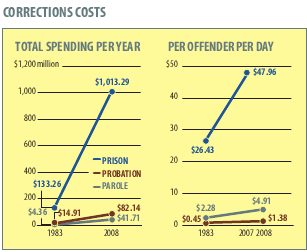
That costs us more than a billion dollars a year in tax money,
5.9% of the state budget.
That’s up from $133.26 million in 1983, increased by more than a factor of seven.


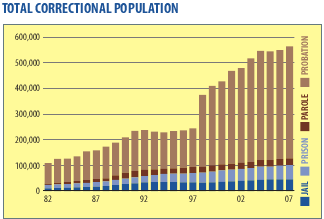
Meanwhile, the correctional population swelled from around 100,000 in 1982 to more
than 550,000 in 2007.
And while other states have started decreasing their prison populations,
Georgia’s continues to increase.
The state is even coming up with new ways to lock people up,
such as kicking them out of mental institutions.
We seem headed back towards

plantation slave labor

and

prison road gangs

in for minor drug infractions.

How about we reverse this trend?

Continue reading

Coalition against private prisons in Shelby County, Tennessee

In at least one southern county, church groups are working together with
other groups to prevent private prisons.
Why not here, too?

The Mid-South Peace and Justice Center is organizing

a broad coalition against private prisons in Shelby County, Tennessee:


No Private Prisons

The Shelby County Commission is in the process of trying to privatize
our criminal justice system. Private prisons have a well-documented
history of inefficient security, poorly trained and underpaid workers,
high turnover rates, scant benefits and unprofessional and unsupervised
treatment of inmates.

The Coalition Against Private Prisons has been created to fight this
privatization plan. So far this coalition involves Grassroots Leadership,
the Mid-South Peace and Justice Center, the AFSCME local 1733, Shelby
County Corrections Officers, Women’s Action Coalition, Mid-South
Interfaith Network, educators, faith leaders, artists, and activists.

To address this we are working with our coalition partners and other
community organizations to educate Memphians about the dangers of
privatization, and to mobilize Memphians around the issue.

They’ve got a report,

Progress or Profit? Positive Alternatives To Privatization and Incarceration in Shelby County, Tennessee.

Continue reading

Private prisons spend millions lobbying to lock people up —Justice Policy Institute

Andrea Nill Sanchez wrote 23 June 2011 in ThinkProgress,

Private Prisons Spend Millions On Lobbying To Put More People In Jail
:


Yesterday, the Justice Policy Institute (JPI) released

a report

chronicling the political strategies of private prison companies
“working to make money through harsh policies and longer sentences.”
The report’s authors note that while the total number of people in
prison increased less than 16 percent, the number of people held in
private federal and state facilities increased by 120 and 33 percent,
correspondingly. Government spending on corrections has soared since
1997 by 72 percent, up to $74 billion in 2007. And the private prison
industry has raked in tremendous profits. Last year the two largest
private prison companies — Corrections Corporation of America (CCA)
and GEO Group — made over $2.9 billion in revenue.

JPI claims the private industry hasn’t merely responded to the
nation’s incarceration woes, it has actively sought to create the
market conditions (ie. more prisoners) necessary to expand its business.

We already knew that, but JPI has quantified it:

Continue reading

Many rural farmers are taking notice of HB 87 —Patrick Davis

Patrick Davis points out from Macon that HB 87 is producing
Lowndes County farm employment problems, and maybe local farmers
should take that into account when they vote.

Patrick Davis wrote,

Rural Republicans in Georgia can’t have it both ways on immigration reform


With the law passed and ready for implementation, many rural
farmers—especially in Central and South Georgia—are taking notice to
the exodus of migrant workers and immigrants which has left some farmers
without workers to pick crops.

Many of these same farmers that are hurting economically and losing
crops in these rural counties had voted Republican for years.


Valdosta’s Ellis Black who represents parts of Lowndes County as a
state representative helped to pass Gov. Nathan Deal’s conservative
and punitive agenda and consequently it has contributed to drive an
increasing number of migrant workers out of the Peach State.


Black has continued to justify his HB-87 vote and attempt to support
Gov. Deal’s ridiculous assertion in regard to the use of probationers
as a solution.

That last link is to

Parolees to replace migrants?
Gov. Deal says put probationers in fields

by David Rodock in the VDT 15 June 2011, which included:

Continue reading

Trend towards drug legalization

Has anyone else noticed that even sitting big name
politicians are saying things only one step short of just legalize it?

The most famous politician in the world said a few months
ago:

‘Drug legalization is an “entirely legitimate topic for debate,”‘

which is a big change from 2009 when Obama laughed
off the question.

Newly elected GA gov. Nathan Deal said

we can’t afford to lock up non-violent drug offenders.

In April Gov. Deal
signed a bill to create a panel to overhaul sentencing laws.


Public opinion

is almost to the majority nationwide
for legalization,
according to the Pew Research Center.

Private prisons have no business plan, because the majority of their
“customers” are in danger of not getting locked up.
We don’t need a private prison in Lowndes County, Georgia.
Spend that tax money on rehabilitation and education instead.

-jsq

Protests about “trillion dollar incarceration machine” crash White House web site

W.E. Messamore wrote for caivn.org 18 June 2011,

Internet activists crash White House phone lines calling for an end to the War on Drugs
:


On Friday June 17th, exactly 40 years after President Richard Nixon
declared a “War on Drugs,” Internet activists organizing from the social
news and activism website, Reddit.com, called the White House en masse
to demand an end to the War on Drugs, calling it a “trillion dollar
incarceration machine” with a measurable failure to reduce drug use,
or harm from drug use.

The

original post included this:

This is also the last vestige of Nixon’s fight against the civil rights and anti-war movements: And if you look at US incarceration rates, it’s been incredibly effective. . .

  • 4,919 Black males per 100,000 population
  • 1,717 Latino males per 100,000 of population
  • 717 White males per 100,000 of population.
  • South Africa under Apartheid (1993) – 851 Black males per 100,000

That’s right, almost six times as many black males per capita
get locked up in the U.S. than in South Africa under apartheid.
The numbers are even worse for young people and especially young black males,
leading to this summary:

This isn’t a War on Drugs: It’s a Race War; It’s a War on the youth,
likely to protest controversial policies (a war that conveniently takes
away those groups voting rights). It’s a war on the American People,
paid for by the American people, for the American people’s own good.

Yep.
Except a majority of the American people don’t want the “war on drugs”
any more.
It’s time for the laws to change.

Back to the

main article:

Continue reading

Call Off the Global Drug War —Jimmy Carter

Jimmy Carter in the New York Times 16 June 2011,

Call Off the Global Drug War

said the

Global Commission on Drug Policy
:


… has made some courageous and profoundly
important recommendations in a report on how to bring more effective
control over the illicit drug trade. The commission includes the former
presidents or prime ministers of five countries, a former secretary
general of the United Nations, human rights leaders, and business and
government leaders, including Richard Branson, George P. Shultz and Paul
A. Volcker.

The report describes the total failure of the present global antidrug
effort, and in particular America’s “war on drugs,” which was
declared 40 years ago today. It notes that the global consumption of
opiates has increased 34.5 percent, cocaine 27 percent and cannabis 8.5
percent from 1998 to 2008. Its primary recommendations are to substitute
treatment for imprisonment for people who use drugs but do no harm
to others, and to concentrate more coordinated international effort
on combating violent criminal organizations rather than nonviolent,
low-level offenders.

These recommendations are compatible with United States drug policy from
three decades ago. In a message to Congress in 1977, I said the country
should decriminalize the possession of less than an ounce of marijuana,
with a full program of treatment for addicts. I also cautioned against
filling our prisons with young people who were no threat to society, and
summarized by saying: “Penalties against possession of a drug should
not be more damaging to an individual than the use of the drug itself.”

Imagine that!
A drug policy meant to address the problem.

How did we go wrong?

Continue reading