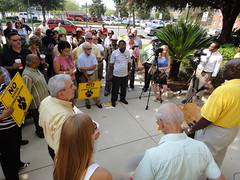
SanAntonio has a solar Goal to reach by 2020. New Jersey also has such a goal to reach by a similar date. We can move forward with just such a comittment from the city to attain a reasonable goal.-Karen Noll
Tag Archives: Lowndes County
Harrisburg prepares to file bankruptcy
Laura Vecsey wrote in Pennlive 16 June 2011, Harrisburg City Council looks to introduce resolution that would allow bankruptcy paperwork to be prepared:
It seems Harrisburg applied for Act 47, which is apparently a state bankruptcy protection plan last October, but now: Continue readingHarrisburg City Council member Brad Koplinski is seeking to introduce a resolution that will allow the council to prepare paper work that might become necessary should a majority of the council decide to file for Chapter 9 bankruptcy.
Koplinski said the urgency of being prepared escalated Thursday when state Sen. Jeffrey Piccola introduced legislation that called for a state takeover of Harrisburg should the distressed city fail to adopt the Act 47 plan it was presented Monday.
The Atlantic dissects Georgia’s anti-immigrant law
Megan McArdle wrote in the Atlantic 21 June 2011, Georgia’s Harsh Immigration Law Costs Millions in Unharvested Crops. She started by quoting Jay Bookman, who quoted the VDT. She then goes into the economics:
Yes, that would be the problem. A law that benefits private prison company CCA at the expense of Georgia taxpayers while putting Georgia farmers out of business.The economics here aren’t particularly complicated, and I’m sure they won’t be new to the sophisticated readers of the Atlantic, but they are useful to look at and consider explicitly when thinking about issues like this.
It goes like this. If you’re not going to let illegal immigrants do the jobs they are currently being hired to do, then farmers will have to raise wages to replace them. Since farmers are taking a risk in hiring immigrant workers, you can bet they were getting a significant deal on wage costs relative to “market wages”. I put market wages here in quotations, because it’s quite possible that the wages required to get workers to do the job are so high that it’s no longer profitable for farmers to plant the crops in the first place.
She concludes: Continue reading
GA HB 87 ridiculed in Atlanta; VDT cited
“Maybe this should have been prepared for, with farmers’ input. Maybe the state should have discussed the ramifications with those directly affected. Maybe the immigration issue is not as easy as &lquo;send them home,&rquo; but is a far more complex one in that maybe Georgia needs them, relies on them, and cannot successfully support the state’s No. 1 economic engine without them.”Except of course HB 87 doesn’t just send them home: it also locks up as many as it can catch, to the profit of private prison company CCA, at the expense of we the taxpayers.
That’s as quoted by Jay Bookman in the AJC 17 June 2011, Ga’s farm-labor crisis playing out as planned:
Continue readingAfter enacting House Bill 87, a law designed to drive illegal immigrants out of Georgia, state officials appear shocked to discover that HB 87 is, well, driving a lot of illegal immigrants out of Georgia.
It might be funny if it wasn’t so sad.
Coalition against private prisons in Shelby County, Tennessee
The Mid-South Peace and Justice Center is organizing a broad coalition against private prisons in Shelby County, Tennessee:
They’ve got a report, Progress or Profit? Positive Alternatives To Privatization and Incarceration in Shelby County, Tennessee. Continue reading![]()
No Private Prisons The Shelby County Commission is in the process of trying to privatize our criminal justice system. Private prisons have a well-documented history of inefficient security, poorly trained and underpaid workers, high turnover rates, scant benefits and unprofessional and unsupervised treatment of inmates.The Coalition Against Private Prisons has been created to fight this privatization plan. So far this coalition involves Grassroots Leadership, the Mid-South Peace and Justice Center, the AFSCME local 1733, Shelby County Corrections Officers, Women’s Action Coalition, Mid-South Interfaith Network, educators, faith leaders, artists, and activists.
To address this we are working with our coalition partners and other community organizations to educate Memphians about the dangers of privatization, and to mobilize Memphians around the issue.
$7.5 million T-SPLOST for a bus system
What would be the benefits?…including the creation and maintainance of a Public Transit System in the City of Valdosta and Greater Valdosta-Lowndes County.
This project will provide mobility options for all travelers; improve access to employment; and help mitigate congestion and maximize the use of existing infrastructure by promoting high-occupancy travel.And that’s the entire description for this project. Nothing about promoting sprawl. Would actually promote dense close-in development. Can’t be very important, then, right?
Not when the sprawl plans for Val Del Road and Cat Creek Road add up to $6 million, or almost enough for the entire bus system.
Last time the transit system was being considered by the county,
I was asked by a prominent local politican, “would you ride it?”
Not every day.
But more often than I would drive on the $10 million five lane New Bethel Road.
If you’re interested in a potential bus system, here is a lot more information about it.
Here’s what Lowndes County submitted for T-SPLOST funding, extracted from the 171 page PDF.
Project Sheet
Transparency is key —Steve Kalland of NCSC
Kalland said transparency is key.
Other speakers had said you could have too much transparency, but Kalland pointed out that it was only through a hearing that North Carolina found out a major power company was going to use up its solar energy credits years ahead of schedule, and without transparency there couldn’t be real competition because the customers wouldn’t know who had which prices.
What else does it take to make a state competitive in solar? Kalland discussed this table (reformatted here from the copy of his presentation he gave me):
He said a lot more, but that’s a very interesting table to consider not only for a state, but for a region, like south Georgia, or a small metro area, like Valdosta MSA.Foundational Steps to Focus on Solar
Installed Capacity Manufacturing Interconnection Standards
Base Resources (economic or voices)
Early Adopters
Military or Large Federal
High Tech Firms
Corporate GreensUniversity Partnership Opportunities
Existing presence of businesses in multiple fields (diversification)
I know some people will react with: “but VSU is not a research university!” Nope, but this could be a way to add some research capacity to VSU.
-jsq
Incinerator forces Harrisburg to sell off parking lots
William Alden wrote in huffpo 15 June 2011, Harrisburg’s ‘Bad Deal’: City Forced To Pursue Parking System Lease Despite Fears:
The finances of Harrisburg, Pa., are so desperate that local officials are considering a deal they fear will ultimately make the city more miserable.
A state-appointed panel, charged with crafting a financial recovery plan for the city, announced this week that Harrisburg must pursue the sale of public assets to help resolve its fiscal crisis. The nearly-bankrupt state capital, weighed down by debt more than four times the size of its budget, “is not in control of its own destiny,” the state team said in a report.
Three years ago, confronted with a similar budget shortfall, the city considered leasing parking garages and meters in exchange for quick infusion of cash, but that deal was never approved. Last month, the offer resurfaced when New York-based developer LambdaStar expressed renewed interest. Some city leaders harbor a growing fear that Harrisburg will be forced into a deal that will bleed its coffers over the course of decades, after it surrenders valuable assets to a profit-driven company with the power to raise rates on a captive base of customers.
But those misgivings may not matter, as a budget crisis chokes Harrisburg into submission.
“This is a situation where Wall Street will get paid, and the little guys on Main Street, taxpayers, are going to get stuck holding the bag,” Harrisburg City Council Member Brad Koplinski said.
Couldn’t happen here, right? Our local governments would never hastily approve bonds that could force raising taxes or default, would they? Oh, right: they already did.
-jsq
Private prisons spend millions lobbying to lock people up —Justice Policy Institute
We already knew that, but JPI has quantified it: Continue readingYesterday, the Justice Policy Institute (JPI) released a report chronicling the political strategies of private prison companies “working to make money through harsh policies and longer sentences.” The report’s authors note that while the total number of people in prison increased less than 16 percent, the number of people held in private federal and state facilities increased by 120 and 33 percent, correspondingly. Government spending on corrections has soared since 1997 by 72 percent, up to $74 billion in 2007. And the private prison industry has raked in tremendous profits. Last year the two largest private prison companies — Corrections Corporation of America (CCA) and GEO Group — made over $2.9 billion in revenue.
JPI claims the private industry hasn’t merely responded to the nation’s incarceration woes, it has actively sought to create the market conditions (ie. more prisoners) necessary to expand its business.
$3 million T-SPLOST for sprawl on Cat Creek Road
In amongst the boilerplate and the red herrings (“potentially reducing the incidence of crashes”, “mitigating congestion”) is the real purpose of this project:
There’s a more long-term reason, too, which is hinted at with this further unnecessary work: Continue readingAlso as a part of the project, protected left turn lanes will be added at various intersections along Cat Creek Road. The proposed intersections include Pine Grove Road, Radar Site Road, New Bethel Road, and Hambrick Road.


…including the creation and maintainance of a Public Transit System in the City
of Valdosta and Greater Valdosta-Lowndes County.