Tag Archives: Georgia

For the children —Matt Flumerfelt @ VLCIA 14 June 2011

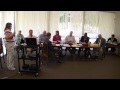
Matt Flumerfelt put down his trumpet to speak for the biomass protesters. He recommended responsibility on behalf of the children and grandchildren. He also said he looks forward to the new VLCIA executive director, since her background in hotel marketing fits with his vision of the area as a retirement community.

Here’s the video:


For the children —Matt Flumerfelt
Irregular Meeting, Valdosta-Lowndes County Industrial Authority (VLCIA),
Norman Bennett, Roy Copeland, Tom Call, Mary Gooding, Jerry Jennett chairman,
J. Stephen Gupton attorney, Allan Ricketts Acting Executive Director,
Valdosta, Lowndes County, Georgia, 14 June 2011.
Videos by John S. Quarterman for LAKE, the Lowndes Area Knowledge Exchange.

-jsq

Nominated VLCIA Officers for FYE 2012

Chairman Jerry Jennett asked Tom Call for a report from the officer nominating committee, which was that the nominated officers for FYE 2012 are: Roy Copeland Chairman, Mary Gooding Vice-Chairman, and Norman Bennett Secretary/Treasurer.

Roy Copeland pulled a very sour face at the news. Mary Gooding asked Roy Copeland if he was willing to do it, and he said,

I’ll let you know next meeting.

They clarified that they elect officers next meeting. I don’t know when the next meeting is, but since their fiscal year ends 30 June 2011, presumably some time before then. Given that nobody else seems to want especially the hot potato of the Chairman’s job, it seems a safe bet that Roy Copeland is it. Continue reading

Georgia moving people out of mental hospitals

The state of Georgia is stopping admitting to state mental hospitals people with developmental disabilities and is starting to move many people with severe and persistent mental illness out of state hospitals into the communities.

According to DBHDD Summary of October 2010 Settlement by Georgia Department of Behavioral Health & Developmental Disabilities, Frank E. Shelp, M.D., M.P.H., Commissioner:

By July 1, 2011, Georgia will stop admitting to its state hospitals people for whom the reason for admission would be a primary diagnosis of a developmental disability, including Temporary and Immediate Care (TIC).

Enhanced community services will be provided for people whose primary diagnosis is a developmental disability and who are either currently hospitalized in state hospitals or who are at risk of hospitalization in state hospitals. Those with forensic status may be included in the target population if the relevant court finds community placement appropriate.

In all cases, the individuals served will be able to make an informed choice about where they’d like to live. Unless they choose otherwise, everyone in the target population will be served in their own homes or the homes of their families and none will be served in a host home, congregate living setting, skilled nursing facility, intermediate care facility, or assisted living facility. All of the waiver participants will receive support coordination.

And a larger group of people: Continue reading

Musical protesters @ VLCIA 14 June 2011

When I got there at 5:30 the biomass protesters were breaking up so some of them could go inside and speak. Matt Flumerfelt is visible heading in the door with his trumpet. Videos of his and other remarks to the board will follow.

Here’s the video:


Musical protesters @ VLCIA 14 June 2011
Irregular Meeting, Valdosta-Lowndes County Industrial Authority (VLCIA),
Norman Bennett, Roy Copeland, Tom Call, Mary Gooding, Jerry Jennett chairman,
J. Stephen Gupton attorney, Allan Ricketts Acting Executive Director,
Valdosta, Lowndes County, Georgia, 14 June 2011.
Videos by John S. Quarterman for LAKE, the Lowndes Area Knowledge Exchange.

-jsq

Transparency and leadership for the local good —John S. Quarterman @ VLCIA 14 June 2011

Noting that I was there on behalf of the Lowndes Area Knowledge Exchange (LAKE), which takes these videos and puts them on the web, I recommended to the Industrial Authority board that they put their agendas on the web, since they give those away at the door and they don’t contain any of the details that they’re concerned about revealing to competitors.

Recalling that I had previously had the audacity to read their own charter to them, or at least the parts about the general good and welfare of the community, I reminded them that some areas that had successfully attracted industry, such as Raleigh, NC, Austin, TX, and Portland, OR had said what kinds of industry they wanted. Expanding on the example of Austin, TX, I noted that they emphasized clean industry, music, and arts, and that helped attract the kinds of knowledge-based workers that our local Chamber of Commerce wants for knowledge-based jobs.

Then I noted that I had complimented Mayor Fretti Continue reading

Why all those VLCIA special meetings?

Here’s the VlCIA board approving minutes for some of those recent meetings, although you can’t tell what they were for, since they were listed on the agenda like this:
Minutes
  • Special Called Meeting, May 17, 2011
  • Executive Session, May 17, 2011
  • Regular Meeting, May 17, 2011
  • Special Called Meeting, May 20, 2011
  • Executive Session, May 20, 2011
  • Special Called Meeting, May 21, 2011
  • Executive Session, May 21, 2011
  • Special Called Meeting, June 7, 2011
  • Executive Session, June 7, 2011
That’s right: no indication of what the meetings were for.

I was told outside afterwards by one board member that the special meetings were for Continue reading

VLCIA land accounting

Chairman Jerry Jennett is asking for an accounting of the land VLCIA has bought using their $3 million a year in dedicated 1 mil property tax and $15 million in bonds that Lowndes County guaranteed for them. And it seems that much of it is in lots too small to be useful.

While the VLCIA board was approving minutes for their 17 May 2011 regular meeting, Chairman Jennett said this:

On the last page, where we’re talking about the industrial park acreage, this is real good the way you’ve presented this, it shows Azalea West 17 acres Lake Park 10, Hahira 10, [?] 165, Miller 220, West Side 155.

Let me ask you that in future you do one more thing. That you tell me how many 100 acre sites you have, how many 50 acre sites you have, and how many 25 acre sites you have,

[Col. Ricketts made some response.]

Then I’m going to assume that everything else is ones, fives, and tens. And my point would be that we track those, and that when someone comes with a project that and they need 200 acres, we can’t do it. But I think there might be room for at least one and maybe two 100s. I think that’s important when we think about people….

It’s good Chairman Jennett is having Col. Ricketts keep track of all this land VLCIA has acquired. He started on this project at Brad Lofton’s last board meeting, when he asked Lofton about lot sizes. I look forward to the results.

Incidentally, while that list Chairman Jennett read does add up Continue reading

Videos from VLCIA board meeting of 17 May 2011

For anyone who wants to review what the Industrial Authority did in its last regularly scheduled meeting, which was 17 May 2011, before going to today’s irregularly scheduled meeting, here is a playlist.


Operating at a slower pace VLCIA 17 May 2011 Part 2 of 2:
Regular Meeting, Valdosta-Lowndes County Industrial Authority (VLCIA),
Norman Bennett, Roy Copeland, Tom Call, Mary Gooding, Jerry Jennett chairman,
J. Stephen Gupton attorney, Allan Ricketts Acting Executive Director,
Valdosta, Lowndes County, Georgia, 17 May 2011.
Videos by John S. Quarterman for LAKE, the Lowndes Area Knowledge Exchange.

-jsq

Treating an “epidemic of mass incarceration” —Physicians in NJEM

Everybody from Serpico to Richard Branson and even the U.S. Senate says the War on Drugs has failed and we should stop locking up so many people. Now physicians weigh in.

ScienceDaily, 1 June 2011, U.S. Physicians Call for New Approach to Address National ‘Epidemic of Mass Incarceration’

With 2.3 million people behind bars and an estimated 10 million Americans cycling in and out of correctional facilities each year, the United States is in the midst of an “epidemic of mass incarceration,” say researchers from the Center for Prisoner Health and Human Rights, a collaboration of The Miriam Hospital and Brown University.

In a Perspective article to appear in the June 2 issue of the New England Journal of Medicine (NEJM), the authors argue that much of this epidemic is due to inadequate treatment of addiction and mental illness in the community, which they say can be linked to policy changes over the last 30 years, such as severe punishment for drug users as a result of the nation’s “War on Drugs.”

“More than half of all inmates have a history of substance use and dependence or mental illness, yet they are often released to the community without health insurance or access to appropriate medical care and treatment,” says Josiah D. Rich, M.D., M.P.H., director of the Center for Prisoner Health and Human Rights, which is based at The Miriam Hospital.

“Sadly, without these linkages to transitional care in the community, the majority of these individuals will re-enter the revolving door of the criminal justice system, which already costs our county $50 billion annually,” he adds.

What is to be done? Continue reading

The other immigration reaction

Probably everybody has heard that Alabama followed Georgia down the Arizona lock-’em-up anti-immigration path.

According to Albor Ruiz in the New York Daily News, 12 June 2011,

Washington’s inaction on the immigration crisis is no longer sprouting only hostile and inhumane local laws. But there is growing evidence an increasing number of local and state officials have tired of playing an abusive and costly anti-immigration game they don’t believe in.

Two weeks ago, Gov. Cuomo pulled New York State from the Secure Communities federal deportation program, following Illinois Gov. Pat Quinn who had done the same weeks before. And days after Cuomo’s decision Massachusetts Gov. Deval Patrick took the same courageous step. All three governors are Democrats and strong allies of President Obama.

They had plenty of reasons to quit the controversial Department of Homeland Security program. Promoted as a tool to deport undocumented immigrants convicted of serious crimes, in reality Secure Communities targets mostly low-level offenders or those never convicted of any crime at all.

And who benefits by arresting such people? Private prison companies, which hold the new prisoners.

It’s not just northeast state, either. Here’s a city and state on the frontline of immigration, Los Angeles, California: Continue reading