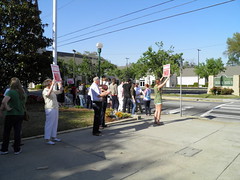
When public officials ignore objections for long enough, eventually
people start speculating as to their motives, in this case about the proposed biomass plant.
Here’s
the video:
Regular meeting of the Valdosta City Council, 24 February 2011.
Videos by Gretchen Quarterman for LAKE, the Lowndes Area Knowledge Exchange.
Erin Hurley provided the very model of how to give a speech:
I’m the president of
Students Against Violating the Environment at VSU.
I’m here representing
200+ members of SAVE, that consists of students, faculty, community members.
We are deeply concerned with environmental issues and
we are networking together to make this city a more humane and
sustainable community
for future generations.
As a student, I feel I have the right to be able to breathe clean air
at the college I attend.
With this biomass plant possibly being built here,
the future for generations to come are in jeopardy, and we want to protect our fellow and future students’ health.
Please take into consideration the future health of this university
and its community,
and don’t sell grey water to the proposed biomass plant.
Erin Hurley, President of
SAVE, Students Against Violating the Environment, speaking at
Regular meeting of the Valdosta City Council, 24 March 2011,
Valdosta, Lowndes County, Georgia.
Videos by Gretchen Quarterman for LAKE, the Lowndes Area Knowledge Exchange.
She said who she was, who she represented, how many, what they were for, what they wanted, quickly enough that attention didn’t waver, slowly and loudly enough to be heard, and briefly enough to transcribe, with pathos, logic, and politic. Even the mayor looked up at “As a student….”
The center “will educate a person to work in an advanced manufacturing
plant,” Gilley says, just the kind of plants that are coming to Troup
County over the next year or so. Using industry-standard equipment,
students will be educated to meet the manufacturing community’s
workforce needs.
In fact, the manufacturing community already is calling on the
center. DaeLim, a supplier to Kia and Hyundai (the latter has a plant
nearby in Alabama), expressed interest in students doing prototyping of
plastic parts once the center, which opened June 1, is up and running.
“We’ve left a good platform on which to build. We have good faculty,
good staff. I think we have good community relations,” Gilley says of
his time at West Georgia. Then he looks to the future and what he’ll
miss most about his job. “We offer programs that allow people to get
better paying jobs. I’ll miss having the power to make decisions that
change people’s lives.”
Hm, so the locals think the technical college has more to do with
industry than the K-12 schools.
It seemed like a good idea at the time when the west Texas farming
town of Littlefield borrowed $10 million and built the Bill Clayton
Detention Center in a cotton field south of town in 2000. The charmless
steel-and-cement-block buildings ringed with razor wire would provide
jobs to keep young people from moving to Lubbock or Dallas.
For eight years, the prison was a good employer. Idaho and Wyoming paid
for prisoners to serve time there. But two years ago, Idaho pulled out
all of its contract inmates because of a budget crunch at home. There
was also a scandal surrounding the suicide of an inmate.
Shortly afterward, the for-profit operator, GEO Group, gave notice that
it was leaving, too. One hundred prison jobs disappeared. The facility
has been empty ever since.
It’s an opportunity for those of us who are not currently
searching for our next meal to help those who need jobs,
and thereby to help ourselves, so they don’t turn to crime.
Like a burned-over longleaf pine, we can come back from this recession
greener than ever, if we choose wisely.
Switchgrass seemed like a good idea five or ten years ago,
but there is still no market for it.
Not just strictly organic by Georgia’s ridiculously
restrictive standards for that, but also less pesticides
for healthier foods, pioneered as nearby as Tifton.
That’s two markets: one for farmers, stores, and farmers’ markets
in growing and distributing healthy food, and one for local
banks in financing farmers converting from their overlarge
pesticide spraying machinery to plows and cultivators.
Similarly, biomass may have seemed like a good idea years ago,
but with Adage backing out of both of its Florida biomass plants
just across the state line, having never built any such plant ever,
the biomass boom never happened.
Meanwhile, our own Wesley Langdale has demonstrated to the state
that
Here’s
an interview with Mayor Drew Ferguson IV of West Point, Georgia
by Larry Copeland in USA TODAY, 25 March 2010,
Kia breathes life into old Georgia textile mill town.
Nope, no mention of schools, education, or unification.
Nice picture of the mayor with a Kia, though.
Karen Kennedy published
a lengthy article about the Kia plant
in GeorgiaTrend in August 2008,
LaGrange/Troupe County: The Kia Effect,
in which the first mention of schools is for the period after
the Kia plant opened:
The biggest need Mayor Ferg-uson sees in West Point right now is public
education. “We have a wonderful elementary school.” But there is
no middle or high school in the city limits. “The current formula for
education funding is not working,” he says of the state’s approach,
which bases money on students who are already in the system, not on
students who will be coming through the system in the near future. “If
you don’t have great education opportunities people will live far away
and drive [to work]. Schools should be looked at as an economic driver.”
They are a way to help recruit good strong families to an area, he adds.
That’s right, after the Kia plant, there are big problems
with the schools, and there’s not even any mention of unification.
The only example in Georgia that
CUEE claimed of good effects
of school unification was Troup County, Georgia, where a few people
are convinced that
the Kia plant
would not have come to town
if the schools hadn’t unified.
That’s one county out of 159.
And it’s hearsay anecdotal evidence.
So let’s look for any actual evidence.
Even if that anecdotal connection between school unification and
the Kia plant had some evidence behind it, that’s not an example of
improved education!
Wiregrass Technical College wants to expand onto some land owned
by the Industrial Authority, using
SPLOST funds.
Chairman Jerry Jennett:
The point is they’re landlocked.
And so what you want to do is you want to take what your tract is now
and have the ability to expand your building in the future.
You want to move your training facility now and….
Regular monthly meeting, Valdosta-Lowndes County Industrial Authority, VLCIA,
Norman Bennett, Roy Copeland, Tom Call, Mary Gooding, Jerry Jennett chairman,
J. Stephen Gupton attorney, Brad Lofton Executive Director,
Allan Ricketts Program Manager, 15 March 2011.
Videos by John S. Quarterman for LAKE, the Lowndes Area Knowledge Exchange.
If you go to lowndescounty.com, pull down Government at the top,
select Board of Elections, then
Election Results, you can select a format for displaying
election results.
And the results at 8:50 PM 15 March 2010 are:
If you’re not yet convinced to get out and vote today to continue
the 1% ESPLOST local sales tax that pays for school buildings, books,
band instruments, and sports equipment for the Valdosta and Lowndes County, Georgia school systems,
here are two Facebook pages:
And
where you can vote.
And here’s
lots of detail on where the money goes.
The two school boards are setting a standard for local government transparency in posting a detailed notice in the newspaper five times,
holding information sessions, going to other people’s meetings and speaking,
handing out flyers, etc.