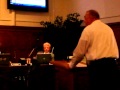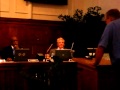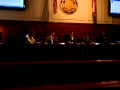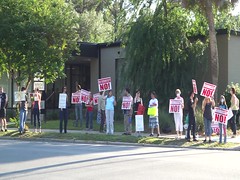
So what’s the evidence that these
biomass opponents are many, as the VDT says?
We could review letters to the editors in the VDT,
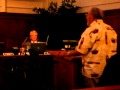
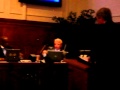
but let’s look at the visual evidence LAKE has recorded.
With no pro-biomass demonstrators anywhere to be seen.
Sure, a few people show up at government meetings to speak for the
biomass plant, but by my tally they are indeed very few,
and most of them are either former employees or board members
of the Industrial Authority.
Yes, LAKE has posted videos of
them, as well:
Ken Garren,
Nolen Cox.
Crawford Powell.
Or watch the people at the microphones during the
6 December 2011 VLCIA biomass “forum”
and see what you think the ratio is.
“THUMBS DOWN: To area officials who continue to refer
to the opponents of the biomass plant as a “fringe” group.
Far more citizens are concerned about the plant
than officials would like for the
public to believe. Thankfully, the city council allowed them to speak
at Thursday’s meeting, but the issue is not going away until their
health concerns are addressed.”
A year ago the VDT was solidly in the pro biomass camp.
Guess they didn’t like being fed misinformation,
any more than the rest of us did.
And that was before the VDT said
VLCIA illegally made up a document.
The big winner in the crackdown on the illegal immiggration
has been the private prison industry.
As Bloomberg Business Week reports in its latest issue,
companies such as Corrections Corporation of America
are making millions.
In fact, CCA makes more money from detaining immigrants
than it does from any single U.S. state.
She goes on to mention CCA’s stock price has gone up by
a factor of ten since 9/11.
Bloomberg’s Betty Liu reports, 18 March 2011. (Source: Bloomberg)
The source of the money CCA and its investors and executives are making?
Our tax dollars!
What about county voters, and what about the combined budget?
Q: “What is the county’s view on consolidation?”
A: CUEE Chairman Leroy Butler answered:
“We did no poll of individuals in the county,
so we don’t have any; anything we say would be speculation.”
Remember,
only one of CUEE’s board is from the county outside the City of Valdosta,
and nobody outside Valdosta gets to vote in the referendum.
They don’t know what the county thinks, and they don’t care,
because legally they don’t have to:
if Valdosta votes to give up their school system, the Lowndes County
school board has no choice but to pick up the pieces.
Kick-off meeting, Community Unification for Educational Excellence, Inc., CUEE.
They’re for consolidation of the Valdosta and Lowndes County School Systems.
Videos by John S. Quarterman for LAKE, the Lowndes Area Knowledge Exchange.
http://lake.typepad.com/on-the-lake-front/cuee/
Jerome Tucker explained that there are jobs to be developed
in south Georgia for solar power, in
distribution, installation, and related industry.
First Jerome explained how he heard of MAGE SOLAR, and
it’s pronounced Mah gay.
He toured their facility and saw that they manufacture the panels
in Dublin, Georgia,
and this was impressive to him, who still has his kerosene lamp.
He was especially impressed with MAGE SOLAR’s academy,
which can train everybody from mom and pop operations
to mega installers.
And with this industry there’s opportunity for engineers,
there’s opportunity for electricians,
there’s opportunity for plumbers,
truck drivers,
across the board.
MAGE SOLAR at Lowndes High School, 29 March 2011.
Videos by Gretchen Quarterman for LAKE, the Lowndes Area Knowledge Exchange.
T-SPLOST is a ten-year one-cent sales tax,
organized in twelve regional taxing districts,
through committees composed of county chairs and city mayors,
plus an executive committee with some of them plus 3 people from the
legislature, which funnels transportation funding requests to GDOT,
which picks, and then sends to a referendum in 2012.
Got all that?
No?
Well, Corey explains it much better than I do.
The Georgia legislature passed what was then known as House bill 277
called
Transportation Investment Act of 2010….
It created or proposed a one percent sales tax for transportation purposes
throughout the state of Georgia.
It creates
twelve special transportation taxing districts
that are based on the boundaries of the regional commissions.
And that is where the connection with the regional commission stops.
They are not the same body….
“We are like tenant farmers chopping down the fence around our house for
fuel when we should be using Nature’s inexhaustible sources of energy —
sun, wind and tide. … I’d put my money on the sun and solar energy. What
a source of power! I hope we don’t have to wait until oil and coal run
out before we tackle that.”
— Thomas Alva Edison talking to Henry Ford and Harvey Firestone in 1931
The reporter who conducted the interview with Industrial Authority Project
Manager Allen Ricketts has been subsequently repeatedly contacted by
Ricketts for what he deems “false reporting.” According to Ricketts,
the timeline was never official and was only something the Industrial
Authority threw together to appease the Times when given an official Open
Records Request. Ricketts is apparently unaware that legally he cannot
produce a document that does not exist to comply with said request. If
he knowingly did so, as he now claims, that is a clear violation of the
Open Records Act.
Presumably that would be the “Project Critical Path time-line is attached”
that wasn’t actually attached to
documents returned for an open records request of 17 February 2011.
Hm, since VLCIA did supply such a document to the VDT,
presumably it is now a VLCIA document subject to open records request,
even though it was not what VLCIA told VDT it was.