6.a) Four F-650 Trucks for Public Works, some from SPLOST @ VCC 7 April 2011
Regular monthly meeting of the Valdosta City Council (VCC),
Valdosta, Lowndes County, Georgia, 7 April 2011,
Videos by Gretchen Quarterman for LAKE, the Lowndes Area Knowledge Exchange.
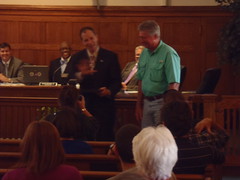
Mayor Fretti presented a check for $200 to Randall Jones,
who gets his name inscribed on a plaque inside
the front door of City Hall.
Jones is a maintenance supervisor at the water plant.
The mayor said he identified that the
January water outage
involved damage to switch gear and dealt with the problem.
Here’s
the video.
Regular Meeting, Lowndes County Commission, Lowndes County, Georgia, 12 April 2011
Videos by Gretchen Quarterman for LAKE, the Lowndes Area Knowledge Exchange.
Stewart Brand of Whole Earth Catalog fame is a long-time environmentalist
who in recent years decided nuclear was necessary.
(He also decided
no-till was necessary, which was enough
to convince me he’s gone barmy.)
Here
at TED
he debates Mark Z. Jacobson,
whose new study says we can
power the world with wind, water, and sun.
I think Jacobson should reconsider including building more hydroelectric dams,
but his study does demonstrate that we don’t need nuclear or biomass.
But watch it and see what you think:
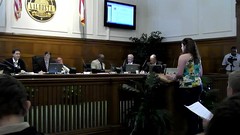
Erin Hurley provided the very model of how to give a speech:
I’m the president of
Students Against Violating the Environment at VSU.
I’m here representing
200+ members of SAVE, that consists of students, faculty, community members.
We are deeply concerned with environmental issues and
we are networking together to make this city a more humane and
sustainable community
for future generations.
As a student, I feel I have the right to be able to breathe clean air
at the college I attend.
With this biomass plant possibly being built here,
the future for generations to come are in jeopardy, and we want to protect our fellow and future students’ health.
Please take into consideration the future health of this university
and its community,
and don’t sell grey water to the proposed biomass plant.
Erin Hurley, President of
SAVE, Students Against Violating the Environment, speaking at
Regular meeting of the Valdosta City Council, 24 March 2011,
Valdosta, Lowndes County, Georgia.
Videos by Gretchen Quarterman for LAKE, the Lowndes Area Knowledge Exchange.
She said who she was, who she represented, how many, what they were for, what they wanted, quickly enough that attention didn’t waver, slowly and loudly enough to be heard, and briefly enough to transcribe, with pathos, logic, and politic. Even the mayor looked up at “As a student….”
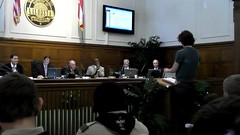
Karen Noll of WACE, Wiregrass Activists for Clean Energy,
asked the Valdosta City Council not to sell wastewater
to the proposed Wiregrass Power LLC biomass plant.
She presented
“500+ signatures from community members and organizations”
asking for that.
She also said
“…furthermore a response to our request each
member of the council is expected before the next council meeting.”
WACE, Wiregrass Activists for Clean Energy, at
Regular meeting of the Valdosta City Council, 24 March 2011,
Valdosta, Lowndes County, Georgia.
Videos by Gretchen Quarterman for LAKE, the Lowndes Area Knowledge Exchange.
…a
new study just published in the journal Energy Policy
states that the
world can provide for all of its energy needs, including electric power,
transportation, heating/cooling, etc using only wind, water, and solar
(WWS) energy by the year 2030.
By water the study authors,
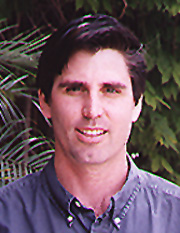
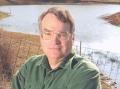
Mark Z. Jacobson (pictured)
Mark A. Delucch,
mostly mean hydroelectric power,
which would involve building
more dams, with all their environmental problems.
Still, it’s an interesting study demonstrating that true renewable
energy could power the world: no coal, no oil, no nuclear.
According to the U.S. Department of Energy, here are the
current costs of coal, natural gas, nuclear, wind (onshore and offshore),
solar (electrical and hot water), geothermal, biomass, and hydroelectric:
Coal is not the cheapest: natural gas is.
Onshore wind actually costs about the same as coal, and less than nuclear.
Offshore wind is currently about 2.5 times more expensive.
Solar photovoltaic (PV) currently costs a bit more than twice as much as coal,
and already less than offshore wind.
The table does not take into account the environmental costs
of the various power sources, or obviously coal would fare far worse,
and biomass would not be rated anywhere near as good as wind.
Remember, the cost of solar is
falling rapidly,
so solar will rapidly become more cost-effective compared to other
energy sources.
Water scarcity is a reality for many American states, particularly in
the Southwest, and over-development in desert areas is compounding the
issues between Colorado, Nevada and California. Georgia’s problems
pale in comparison, but if the drought continues, consumption limits
and conservation are going to have to be implemented again.
The VDT mentions a student group trying to do something about it:
Saturday, the VSU Students in Free Enterprise (SIFE) is hosting
a community Walk for Water to raise awareness and money for people
worldwide who don’t have access to clean water.
A cold, wet winter has left northern parts of the state in decent shape,
but in southern Georgia river flows and soil moisture are both at some
of the lowest points that would be expected in a century, said David
Stooksbury, Georgia’s state climatologist at the University of Georgia.
The nearterm effects:
“We have a good fuel load with plenty of dry vegetation, the soil is
dry and there’s a low relative humidity and there’s wind,” Stooksbury
said. “That is the simple recipe for a trash fire to get out of control
very quickly and become a wildfire.”
Yes, Sunday Georgia Forestry cut off burn permits in Lowndes County because
some fires had gotten out of control.
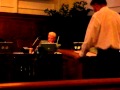 Do you ever wonder what your regular SPLOST 1% sales tax goes for?
Some of it goes to buy vehicles for Valdosta Public Works.
Do you ever wonder what your regular SPLOST 1% sales tax goes for?
Some of it goes to buy vehicles for Valdosta Public Works.