Category Archives: Water

Michael Bryant: “the appalling silence”

Pastor Michael Bryant expands on his previous letter.

-jsq

Dear Pastors and fellow laborers in the Gospel of our Lord and Savior,

I was born and raised here in Lowndes County. Today I am as disturbed as I was in 1973 when I, along with 42 other students, four ministers and their wives, were jailed for protesting unfair treatment of students in the Lowndes County School System. We were arrested while standing in the parking lot awaiting to enter the building for a meeting called by the Lowndes County Board of Education at their office on St. Augustine Road. The meeting was supposed to be a good faith gesture designed to mediate an amicable solution to the picketing which had been in process for nearly six months. After being arrested, we were moved from Big 12 in a prison truck in the dead of night. We were to be housed in the Cook County jail and none of our parents knew where we were. When we exited the truck, both sides of the walk way upon which we had to walk were lined with numerous State Troopers and other Law Enforcement officers sporting riot gear and shotguns. On the following day they refused to feed us breakfast. We began to complain and the judge came upstairs dressed in his robe. He said “I want you to stop making noise, and if you don’t, I can make you stop.”

When we complained again, the cell in which we were jailed was sprayed down with tear gas. We had one toilet and one sink in which to clear our eyes. These are facts that went unreported by the papers. In fact they said we were rabble rousers. The late Ralph Harrington signed all our bonds, and we went through a lengthy trial, represented by the late Mr. C. B. King, Sr., of Albany, GA. At the close of the trial all charges were dismissed and expunged from our records.

As a student then, I witnessed the appalling silence of men and women of God who preached the hell out of people on Sundays, collected their checks, and went home untouched by the happenings in the community. This was much like the appalling silence of ministers who sat on the sidelines while Dr. Martin Luther King, Jr., placed his life on the line for “the least of these.”

Some years ago, Rev. Floyd Rose, two of my sisters and several other

Continue reading

LBJ about Pollution

It’s a really great speech and still relevant 45 years later. This is just a little excerpt:
In the last few decades entire new categories of waste have come to plague and menace the American scene. These are the technological wastes–the by-products of growth, industry, agriculture, and science. We cannot wait for slow evolution over generations to deal with them.

Pollution is growing at a rapid rate. Some pollutants are known to be harmful to health, while the effect of others is uncertain and unknown. In some cases we can control pollution with a larger effort. For other forms of pollution we still do not have effective means of control.

Pollution destroys beauty and menaces health. It cuts down on efficiency, reduces property values and raises taxes.

The longer we wait to act, the greater the dangers and the larger the problem.

Continue reading

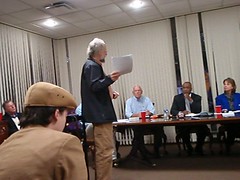
Videos of pro and con biomass speakers at VBOE

Karen Noll took these videos at the 29 September 2010 meeting of the Valdosta Board of Education (VBOE). Much more about that meeting here.

-jsq

Dr. Gretchen Bielmyer speaking against the biomass plant.
Dr. Brad Bergstrom speaking against the biomass plant.
Brad Lofton and Allan Ricketts speaking for the Valdosta-Lowndes County Industrial Authority (VLCIA) and the biomass plant.

Biomass Rezoning Minutes, County Commission, 9 June 2009

In the message from Prof. Manning, he says
I did address the county commission on this topic over a year ago – in a public forum at a scheduled meeting.
He provided no date nor link, but since this is the only Commission meeting minutes for which I can find his name, I’m guessing this is the one he meant. I’ve quoted here the relevant item, and I’ve added paragraph breaks to it to make finding individual speakers’ names easier. See also the VDT writeup. I would like to ask people, especially academics, who want to cite sources to actually cite them, not allude to them by some vague description.

-jsq

LOWNDES COUNTY BOARD OF COMMISSIONERS
MINUTES
Regular Session
Tuesday, June 9, 2009
COMMISSIONERS PRESENT
Chairman Ashley Paulk
Vice Chairperson Joyce E. Evans
Commissioner Richard C. Lee
Commissioner G. Robert Carter
Chairman Paulk called the meeting to order at 5:30 p.m.

[…]

REZ-2009-05 Wiregrass Power, LLC, 2637 Old Statenville Hwy, 0164 025. 22.1 ac., E-A to I-S,

County Planner, Jason Davenport, presented the item, stating that both the Planning Commission and TRC recommended approval with conditions.

Chairman Paulk asked those in attendance to be patient with the Commission as the item was considered, since it was an issue that many in attendance may want to speak.

Dr. Michael Noll, 2305 Glynndale Drive, spoke against the request and presented the Commission with a list of questions prepared by himself, Dr. Brad Bergstrom and Mr. Seth Gunning.

Mr. Fred Deloach III, 1411 New Statenville Highway, addressed the Commission requesting that tires and coal be added to the list of prohibited fuel items.

Continue reading

Perspectives on Biomass Permit

This is Karen Noll’s LTE to the VDT as sent on 12 Aug 2010. It doesn’t seem to have ever turned up in the online version of the VDT, but here it is:
While certain entities see no negative environmental impact of the proposed biomass plant, the information and data that I have does not indicate that incineration of wood is efficient, environmentally sound, or safe for our citizens. Yet others see this as a win-win scenario claiming a vastly different perspective on the situation; economically, environmentally and in regard to the health of our citizens. Why is that?
Continue reading

Video of Biomass Air Quality Hearing, Valdosta, 27 April 2010

A video of a hearing about the biomass plant Wiregrass Power LLC proposes to build in Lowndes County just outside of Valdosta was held in Valdosta on 27 April 2010 by the Air Protection Branch (APD) of the Environmental Protection Division (EPD) of the Georgia Department of Natural Resources (DNR).

Eric Cornwell of APD explains location, process flow, and specific items covered by the permit (soot, SO2, NOX, CO, VOC, HCL, etc., but not CO2). He remarks that Wiregrass Power LLC is building a small plant with a “lower emission limit in order to avoid some of the red tape” by getting a minor permit instead of a major permit. The first half hour concludes with Bob Turner, the plant manager, presenting similar material, ending with:

“No new carbon is added to the atmosphere when burning woody byproducts.”
I beg to differ on that: in the time it takes trees to grow back, there is indeed new carbon dioxide added to the atmosphere. More from Dr. William Sammons on that.

Back to the video of the hearing. Questions start at 00:29:44. Here are some time markers and very brief summaries of Q and A; see the video for the full questions and answers. Continue reading

Water Planning

In 2004 the state of Georgia adopted a water planning system, and in 2008 adopted a water plan, with regional councils appointed in 2009 by the governor, lieutenant governor, and Speaker of the House. While I wonder why this organizational setup inserted a regional layer of government that is unaccountable to the people in the region, it’s good somebody is doing some water planning.
In the event “gaps” between available water and future (or current) demands are identified, the Council will determine which water and land use management practices should be employed to ensure there is sufficient water and assimilative capacity to meet future needs. EPD will use computer models to test the ability of the recommended practices to close any identified “gaps.”
If you remember Atlanta running out of water a few years ago Continue reading

Greyfield Villas

Entrance sign Previously discussing the Glen Laurel subdivision on Old Pine Road near Bemiss, several of the people speaking against at the County Commission meeting mentioned the Greyfield subdivision. That’s Greyfield Villas; see the entrance sign in the picture on the right. It’s in Lowndes County but not in Valdosta; somebody correct me if I’m wrong abo ut that. In that picture it’s hard to read the sign in the background on the north side of North Oak Street Extension. Here’s a closeup:

FOR RENT by Blake Taylor

For Rent. Just inside we see a dumpster with For Rent signs on the houses on either side: Continue reading

Wellhead Protection Overlay, TXT-2010-01 2010 ULDC

Lowndes County Commission 8 June 2010 This is about exclusion zones around wells, and maybe about restrictions on putting new wells next to pollution sources such as cotton fields.

At their 8 June 2010 regular meeting, the Lowndes County Board of Commissioners, at the recommendation of County Planner Jason Davenport, tabled revisions to the Uniform Land Development Code (ULDC) about wellhead protection. Such protections are a new requirment by the Georgia EPD, and it’s taking a while to figure out what is appropriate for the ten wells operated by the county and the 140 private community wells, many of which have trust indentures with the county that require the county to take them over if their current operators do not supply enough water, or of good enough quality.

Picture by John S.Quarterman, video by Gretchen K. Quarterman for LAKE, the Lowndes Area Knowledge Exchange, 8 June 2010.

-jsq

Green Exercise for Mental Health

Quantifying something we can all feel:
ScienceDaily (May 1, 2010) — How much “green exercise” produces the greatest improvement in mood and sense of personal well-being? A new study in the American Chemical Society’s semi-monthly journal Environmental Science & Technology has a surprising answer.

The answer is likely to please people in a society with much to do but little time to do it: Just five minutes of exercise in a park, working in a backyard garden, on a nature trail, or other green space will benefit mental health.

All natural environments were beneficial including parks in urban settings. Green areas with water added something extra. A blue and green environment seems even better for health, Pretty noted.
Here’s a link to a news blurb in the journal:
Pretty says that his goal with this study is not to provide just another recommendation for individuals but to provide data that can be used in policy discussions. Those data “could translate into what the landscape guidelines are for schools or for public housing,” says Nancy Wells, associate professor of community ecology at Cornell University.
Here is a link to the actual article.