Category Archives: Safety

The United Methodist Church declares its opposition to the privatization of prisons and jails

We already heard from the Episcopal, Presbyterian, and Catholic churches,

against private prisons.

Now let’s hear from the

United Methodist Church:


Our Lord began his ministry by declaring “release to the
captives…” (Luke 4:18 NRSV), and he distinguished those who would
receive a blessing at the last judgment by saying, “I was in prison and
you visited me.” (Matthew 25:36b NRSV) Jesus also declared that one
cannot serve two masters and condemned the idolatry of mammon, or wealth.
(Luke 16:13).

Christians, therefore, must have a special concern for those who
are captive in any way, especially for those who are imprisoned,
and for the human conditions under which persons are incarcerated.
Individual Christians and churches must also oppose those policies and
practices which reflect greater allegiance to the profit motive than to
public safety and to restorative justice for offenders, crime victims,
and local communities.

Therefore, The United Methodist Church declares its opposition to
the privatization of prisons and jails and to profit making from the
punishment of human beings.

ADOPTED 2000

The statement has further practical explanation of why this opposition:
Continue reading

Developers refused to budge and Commissioners caved: Glen Laurel


Should the County Commission approve rezoning for a subdivision
just because developers say they won’t compromise any more?

Bill Nijem presented Moody and schools nearby and the proposed
house price as arguments for the Glen Laurel subdivision,
plus county services, which, remember,
were put in for them to use.
This was after
Pine Grove Elementary closed
and moved farther away.

Here’s

Part 1 of 5:

Continue reading

Small lot size means more traffic —Ms. Zaun


A landowner (probably Glynda Faye Zaun) between Old Pine Road and Mulligan Road
says if all those little houses are built her property
values will decrease, and she’ll be surrounded by 94 little homes that
will generate too much traffic.

I am not against growth.
Growth is beneficial to every community; I recognize that.
But it should be constructed in a way that is beneficial
and pleasing to everyone and not just to the developers
or the ones who want to make a lot of money quick and then leave.

Here’s

Part 1 of 3:

Continue reading

Private prisons are a public safety problem

They don’t save money and they do increase escapes.
Justice shouldn’t be for private profit at public expense.

W.W. wrote in The Economist 24 August 2010 about

The perverse incentives of private prisons
:


LAST week authorities

captured two fugitives
who had been on the lam
for three weeks after escaping from an Arizona prison. The convicts and
an accomplice are accused of murdering a holiday-making married couple
and stealing their camping trailer during their run from justice. This
gruesome incident has raised questions about the wisdom and efficacy of
private prisons, such as the one from which the Arizona convicts escaped.

Arizona, the place
Georgia just copied

Continue reading

Citizens are entitled to hear where their elected officials stand —Leigh Touchton

This comment from Leigh Touchton came in today on
“Because it would be monitored. -jsq


Two weeks ago I delivered the official NAACP letter to all City Council
members (and Mayor Fretti) asking for a written response as to their
position on biomass and selling reclaimed water to the Wiregrass, LLC,
proposed incinerator.

No response. Not one.

I have heard that at least two Council members refuse to do so because
“it might be used against them.”

Citizens are entitled to hear where their elected officials stand on
these issues. At least Councilmen Vickers, Wright, and Yost have stated
publicly that they support biomass, even though black infants are already
dying in Valdosta at a rate twice as high as white infants. According
to Mr. Wright,

Continue reading

A letter from a local physician —Dr. Noll

This comment from Dr. Noll came in today on
“Because it would be monitored. -jsq

Because it would be monitored?

Our community could subsequently also “monitor” increases in respiratory
illnesses, cancer rates, cardiovascular diseases, and mortality
rates. Just ask the American Lung Association, the American Cancer
Society, and the American Heart Association.

This is incredible. A city council member who still hides behind an
EPD air permit, and who chooses to ignore the testimony of thousands of
medical professionals throughout the United States. At the same time,
we have a City Council that continues to isolate itself from its citizens
with a policy that undermines open dialogue.

The continued silence of our City Council and Mayor in regard to biomass
is mind-boggling. Haven’t they noticed the developments of the past
couple months? The regular protests? Hundreds and hundreds of signatures
and voices in opposition to biomass? Ashley Paulk’s statement? George
Bennett’s statement? Even a statement, it appears, by Wesley Langdale
who said that biomass is economically not feasible … which is something
WACE stated as far back as October 2010, supported by an article from
the Wall Street journal called “(Bio)Mass Confusion”.

Dr. Mark George once asked all City Council members the following
question: “What is it you still need from us, so that you understand
that biomass is a bad deal”? To my knowledge that question was never
answered.

Last night I shared a letter from a local physician

Continue reading

A real national strategy —Jim Dwyer


What say we make a real national security strategy,
one based on energy independence and a sustainable economy?

Jim Dwyer write 3 May 2011 in the NY Times,

A National Security Strategy That Doesn’t Focus on Threats

“Poorly fitted air conditioners cost New York City 130 to 180 million
dollars a year in extra energy consumption,” one of the strategists,
Capt. Wayne Porter of the Navy, said Tuesday. “They generate 370,525
extra tons of carbon dioxide.”

Suppose, he says, you fixed them. And then you got the 40 states
that waste the most electricity to match the 10 most efficient. The
likely benefits are no surprise — less foreign oil, cost savings,
job creation, decreased pollution.

Now follow that thread to

“A National Strategic Narrative,”

a paper
written by Captain Porter and Col. Mark Mykleby of the Marines, which
calls on the United States to see that it cannot continue to engage the
world primarily with military force, but must do so as a nation powered
by the strength of its educational system, social policies, international
development and diplomacy, and its commitment to sustainable practices
in energy and agriculture.

“We must recognize that security means more than defense,” they
write. After ending the 20th century as the world’s most powerful
country, “we failed to recognize that dominance, like fossil fuel,
is not a sustainable form of energy.”

An army without an economy defends nothing.

Continue reading

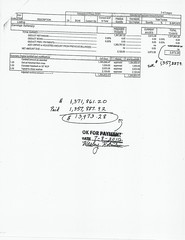
How much does it cost to pave a county road?

How much does it cost to pave 3.5 miles of dirt road?
Apparently $1,413,097.92, or around a million dollars a mile,
when the county insists on paving it like a state highway
at the expense of safety:

How Much To Whom From For What
$7,200.00 Lovell Engineering Associates Valdosta Design of Culvert
$48,010.00 Doyle Hancock & Sons Construc. Doerun Clearing and Grubbing
$1,357,887.92 The Scruggs Company Valdosta Paving
$1,413,097.92 All contractors Total

This financial information comes from an open records request
filed by Carolyn Selby more than a year ago
and finally fulfilled 17 March 2011.
Copies of all the pages received are
in the flickr set.


How many other roads could have been paved for $1.4 million?
If this road had been paved like a local rural road,
instead of like a state highway (literally according to
state highway standards) it would not have cost nearly
as much and probably another shorter road could have been paved, too.
And if other roads were paved like local roads instead of state
highways, how many more of them could be paved?
They still wait while this one got paved to the tune of $1.4 million.

-jsq

Nuclear reactor Vogtle 1 at August shut down

Nuclear really more reliable than wind or solar?
What’s with the unscheduled shutdowns?

Colin McClelland reported for Bloomberg 21 April 2011,

U.S. Nuclear Output Falls as Vogtle Reactor in Georgia Shuts


U.S. nuclear-power output remained near a 4½-year low for a fourth day
as the Vogtle 1 reactor in Georgia shut down unexpectedly, the Nuclear
Regulatory Commission said.

Power generation nationwide decreased 538 megawatts to 71,781 megawatts
from yesterday, or 71 percent of capacity, the smallest amount since
Oct. 22, 2006, according to an NRC report today and data compiled by
Bloomberg. Twenty-nine of the nation’s 104 reactors were offline.

Southern Co. (SO)’s 1,109-megawatt Vogtle 1 reactor automatically
tripped offline yesterday at 5:34 p.m. when it was at full power. The
cause is under investigation, the NRC said.

The shutdown was ironically two days after

an NRC public meeting “to discuss Plant Vogtle’s annual safety evaluation and assessment.”

That would be the same location where,
according to

Tice Brashear back in 18 March 2009
:

Continue reading

Dr. Mark P. George wants a conversation @ VCC 7 April 2011


The mayor prefaced a comment that he’s read (apparently in this blog)
that he’s been criticized for not paying attention while people are speaking.
He clarified that he’s often taking notes.
Then Dr. Mark P. George spoke, wondering when people would get answers
to their more substantive questions.

I have an attorney.
These folks have an attorney.
He’s sitting right there.

Indicating the city attorney.

Here’s

Part 1 of 3:


Dr. Mark P. George @ VCC 7 April 2011 Part 1 of 3:

Regular monthly meeting of the Valdosta City Council (VCC),

Valdosta, Lowndes County, Georgia, 7 April 2011,

Videos by Gretchen Quarterman for LAKE, the Lowndes Area Knowledge Exchange.

Dr. George amplified the not paying attention comments


by adding in body language,
and saying he did appreciate taking notes.
He asked if the meeting is recorded.
Mayor Fretti answered yes.

Dr. George remarked:

It seems to me you are now cloaking the lack of response
in legalities.

Legality does not equal morality.

Council Sonny Vickers remarked that he
already told everyone he is for the biomass plant.

Dr. George recommended conversation,
following up on new information.

The mayor asked Dr. George to wrap up.
Dr. George responded:

There really is no end.

Here’s

Part 2 of 3:


Dr. Mark P. George @ VCC 7 April 2011 Part 2 of 3:

Regular monthly meeting of the Valdosta City Council (VCC),

Valdosta, Lowndes County, Georgia, 7 April 2011,

Videos by Gretchen Quarterman for LAKE, the Lowndes Area Knowledge Exchange.

More back and forth between Dr. George and the mayor
about how or whether or when he or somebody might answer
questions, followed by interchange between Dr. George
and the audience.

Here’s

Part 3 of 3:


Dr. Mark P. George @ VCC 7 April 2011
Part 3 of 3:

Regular monthly meeting of the Valdosta City Council (VCC),

Valdosta, Lowndes County, Georgia, 7 April 2011,

Videos by Gretchen Quarterman for LAKE, the Lowndes Area Knowledge Exchange.

-jsq