Category Archives: Planning

What Are Our Priorities? –Dr. Noll @ LCC 22 March 2011

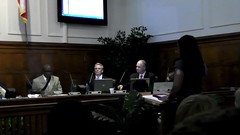
Dr. Noll raised a number of issues about community priorities at the Lowndes County Commission meeting of 22 March 2011 and asked what are our priorities?

The Sierra Club letter he mentions was posted last week. For NOAA Weather Radios see previous posts. Here is the video:


Regular meeting of the Lowndes County Commission, 22 March 2011.
Video by Gretchen Quarterman for LAKE, the Lowndes Area Knowledge Exchange.
Appended is the script Dr. Noll says he was reading. I’ve added a few links to relevant posts. -jsq Continue reading

South Georgia already in drought: parameters for industry?

Droughts and floods: maybe we need to manage water better, including managing industrial use of water.

According to the AP, Ga. foresters brace for busy wildfire season:

A cold, wet winter has left northern parts of the state in decent shape, but in southern Georgia river flows and soil moisture are both at some of the lowest points that would be expected in a century, said David Stooksbury, Georgia’s state climatologist at the University of Georgia.
The nearterm effects:
“We have a good fuel load with plenty of dry vegetation, the soil is dry and there’s a low relative humidity and there’s wind,” Stooksbury said. “That is the simple recipe for a trash fire to get out of control very quickly and become a wildfire.”
Yes, Sunday Georgia Forestry cut off burn permits in Lowndes County because some fires had gotten out of control.

The long term problem? Continue reading

Communities watching boards

Susan Hall Hardy says that in most places industrial authority executives don’t interact with their communities. Well, paraphrasing what Yakov Smirnoff used to say, in Lowndes County, community interact with officials!

Here is her comment from 15 March 2011 on this blog:

Not to be rude, although honesty is very often perceived that way these days, but, the industrial authority executives rarely thank their communities. In the six states I’m most familiar with, these fellows see themselves as beholden only to their employers. After all, they work with their directors, elected officials, a few bankers and city/county department heads. Rarely do they come in direct contact with the average voter, employee or homeowner, although all those people often pay a large part of their salaries and office operating expenses. Despite the public funding, these groups are usually tight lipped about how they do business and rarely provide the public with records or audits. We’ve all put up with that manner of doing business for so long we now see it as just that — the way you do business. We’d never accept that from a nonprofit organization, a charity group or most elected officials. Shame on us all.
Susan, you’re helping by reading, and you’re helping more by posting. Many local officials have noticed LAKE and this blog because they know people read it.

Anyone who wants to help still more, you, too, can go to a meeting. The Industrial Authority is a good one to attend, but I hear the Tree Commission isn’t trying as hard to enforce things, and does anybody know anything the Hospital Authority does? The Airport Authority? Continue reading

Urban growth boundary –Portland

Prof. Dorfman of UGA already explained to us that in Georgia
Local governments must ensure balanced growth, as sprawling residential growth is a certain ticket to fiscal ruin*
* Or at least big tax increases.
Here’s a place that does something about it: Portland, Oregon.


Thanks to Matthew Richard for pointing out this documentary.

As the documentary says, the key to Portland’s way is: Continue reading

Biomass or carbon trading or something else?

To get an idea of why big timber growers might find biomass attractive, here’s an article by Terry Dickson in the Florida Times-Union from 20 June 2005, State’s forestry industry in an ‘alarming decline’
People have long debated whether there is a sound if a tree falls in a forest but nobody is there to hear it.

The fall of revenue from Georgia’s forestry industry, however, has attracted a lot of attention — but $10 billion is hard to ignore.

Continue reading

Adage and Gretna’s mayor

That previous plant in Florida was the one in Gretna, Gadsden County, Florida, cancelled last year, according to John Downey in the Charlotte Business Journal, 16 October 2010. In the Gretna case, the mayor of Gretna posted a press release 16 March 2010 saying:
Mayor Anthony Baker of the City of Gretna announced today that in light of Adage, LLC’s decision to suspend activity on its proposed Bioenergy facility slated for construction in Gretna (as well as suspension of its application for an air permit through the Florida Department of Environmental Protection) that the City now considers this matter closed and will take no further action on Adage’s request to locate this facility in Gretna. Inasmuch as the Bioenergy Plant could neither legally operate nor be sited in Gretna without an air permit, the City concluded that this was no longer a viable project and Adage’s decision to suspend activity on its air permit indicated that further consideration of the project by the City was unwarranted. Since there were no issues pending before the City of Gretna requiring action by its Commission relative to the Plant, the Mayor deemed termination of the project as final disposition of this matter as far as the City is concerned.
This is despite promises of jobs, jobs, jobs: Continue reading

Particulate matter is a killer. –Lisa Jackson, EPA, 17 March 2011

Listening to EPA Administrator Lisa Jackson about EPA’s proposed new mercury rules, for me, the live feed on facebook did not work, but the one on whitehouse.gov did. A few quotes:
Particulate matter is a killer. We know it results in hundreds of thousands of deaths.

That matches some local concerns in Lowndes County.

How much of a killer? Continue reading

Georgia Power plans to decertify two coal plants

According to gapower’s own press release:
ATLANTA, March 16, 2011 /PRNewswire/ — Georgia Power expects to request approval from the Georgia Public Service Commission to decertify two coal-generating units totaling 569 megawatts, the company announced Wednesday.

The request to decertify units 1 and 2 at Plant Branch in Putnam Co. will be included in Georgia Power’s updated Integrated Resource Plan filing with the commission in late summer. The company expects to ask for decertification of the units as of the effective dates of the Georgia Multipollutant Rule, which are currently anticipated to be Dec. 31, 2013 for unit 1 and Oct. 1, 2013 for unit 2.

The decision to decertify the units is based on a need to install environmental controls to meet a variety of existing and expected environmental regulations.

“After an extensive analysis of the cost to comply with environmental regulations, we have determined the continued operation of these units would be uneconomical for our customers,” said Georgia Power President and CEO Paul Bowers. “This decision is in keeping with our focus to provide affordable and reliable electricity for our customers.”

This matches with a report from last July that gapower was turning away from coal. And they suspended work on Plant Branch a year ago. Unfortunately, mostly they’re turning to natural gas and nuclear. Continue reading

Beliefs are good, but facts are better –John S. Quarterman @ VLCIA, 15 March 2011

First I praised the completion of the Wiregrass Solar LLC plant in Valdosta. Then I complimented Brad Lofton on finding his new job and hoped he’d be happy in Myrtle Beach. Then I praised the VDT for its editorial recommending using this opportunity to consult the councils of the various municipalities and the County Commission, and in particular that one way to produce unity in the community as G. Norman Bennett had previously advocated, would be to find out what the community wants VLCIA to do.
I understand the point about beliefs. But it’s not all about just the beliefs of just the people on the board. It’s also about things like is there enough water, and do we want businesses that soak up a lot of water, like Ben Copeland said at the Lake Park Chamber of Commerce. Beliefs are good, but facts are better. Thank you.


John S. Quarterman at the
regular monthly meeting, Valdosta-Lowndes County Industrial Authority (VLCIA)
Norman Bennett, Roy Copeland, Tom Call, Mary Gooding, Jerry Jennett chairman,
J. Stephen Gupton attorney, Brad Lofton Executive Director, Allan Ricketts Program Manager,
15 March 2011.
Video by David Rodock for LAKE, the Lowndes Area Knowledge Exchange.

-jsq

Sunshot: solar cheaper than coal in six years

Solar is expensive at the moment, but that could change rapidly. David Biello writes in Scientific American yesterday:
The U.S. Department of Energy (DoE) aims to change that by bringing down the cost of solar electricity via a new program dubbed “SunShot,” an homage to President John Kennedy’s “moon shot” pledge in 1961.

“If you can get solar electricity down at [$1 per watt], and it scales without subsidies, gosh, I think that’s pretty good for the climate,” notes Arun Majumdar, director of the Advanced Research Projects Agency–Energy (ARPA–e), the DoE’s high-risk research effort. “With SunShot, the goal is to reduce the cost of solar to [$1 per watt] in the next six years.”

Hm, so maybe Ray Kurzweil is right.

DoE Secretary Chu even thinks we could win something else:

“Just because we lost the lead doesn’t mean we can’t get it back,” Chu said. “We still have the opportunity to lead the world in clean energy…but time is running out.”
Meanwhile, we could shift fossil fuel subsidies over to solar and get on with it.

-jsq