Tag Archives: Water

Videos: Airport, alcohol, taxes, road, jail @ LCC 2013-01-22

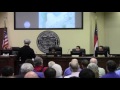
Commissioners discussed several items much more than last year’s Commission at this morning’s Work Session; they vote 5:30 PM tonight at their Regular Session. However, you’d think with an ankle monitoring program Commissioners praised so highly, they’d want the public to know the details. Nope, still none of the documents related to that nor any of the other items they were discussing were revealed to the tax-paying public. They don’t have a press release about that, nor about the Parade of Champions the Chairman talked about (twice) even though it wasn’t on the agenda. He was silent, however, on who the candidates for the Airport Authority are, and none of them were present.

That’s four reports that were not on the agenda: Parade of Champions, ankle monitoring, the county’s wellness program and the upcoming Bird Supper.

Here’s the agenda, with links to the videos and a few notes, followed by the video playlist.

Continue reading

Abandoning a road leading to the Alapaha River @ LCC 2013-01-22

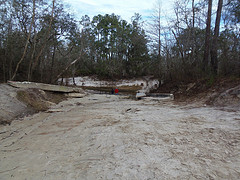
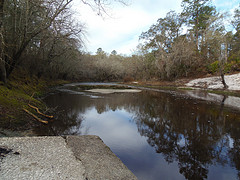
A landowner asked Lowndes County to abandon a road leading to the Alapaha River, in this morning’s Lowndes County Commission Work Session.

Abandonment of a portion of Old State Road (CR 16)

Phillip Connell requests that Old State Road that goes through his property and dead ends at the river be closed.

They’re holding an initial hearing followed by a public hearing “I guess it will be in three weeks at the next regular meeting” because state law requires it, according to County Engineer Mike Fletcher. He also said the bridge had washed away, and there was no access into Lanier County. And the river (it’s the Alapaha River, although I don’t think anybody ever said the name)

…is not classified as a navigable waterway; therefore Mr. Connell owns to the center of the river. You can navigate down the river by boat, but if you step out, if you get out of the boat and step on the land, you’re considered to be trespassing.
Engineer did not cite any statutes for his assertions.

Chairman said he and Commissioners Marshall and Evans had been down Continue reading

Solar: Pieces of a Puzzle —Dr. Michael G. Noll

Op-ed in the VDT today, responding to a response to my op-ed. -jsq

If the attempt of a guest column from Jan 13 was to shine light on solar power, it left everyone in the dark. Neither mockery nor close mindedness will assist us in finding real answers if we want to solve the energy puzzle of the 21st century.

In July 2012, the Financial Times interviewed Jeffrey Immelt, CEO of GE. GE knows perhaps more about the world of energy business than any other company. Immelt stated that

“on a cost basis it is impossible to justfy investing in nuclar power for the future.”

People who sitll claim that solar is more expensive than nuclear are not paying attention. If solar is viable as far north as New Jersey, it certainly is in Georgia. If countries like Germany can excel in solar energy production, so can we. Companies like Walmart, Costco, Apple, and Google are havily investing in solar because it works.

It should also be noted that the nuclear plant on Crystal River has been idle since 2009. As the Tampa Bay Times reported last December,

Continue reading

Georgia legislature still trying to suck up Tennessee River water

Because Atlanta can’t get a grip on its water usage, the Georgia legislature is still trying to suck up Tennessee River water. If the legislature is willing to try that, how long before they try sucking up our Floridan Aquifer water for Atlanta?

Prefiled in December to be up early as the Georgia legisture starts meeting today, is a bill to try to move the northern border of Georgia to match an eighteenth century boundary that just happens to include a bit of the Tennessee River in Georgia. HR 4, Georgia and Tennessee; boundary dispute; propose settlement, was filed by Rep. Harry Geisinger, R – Roswell, District 48, and says in part:

WHEREAS, the State of Georgia proposes to the State of Tennessee that the dispute be resolved by the states agreeing that the current boundary between the two states reflecting the flawed 1818 survey be adopted as the legal boundary between the states except for an area described as follows which shall be made a part of the State of Georgia by which Georgia shall be able to exercise its riparian water rights to the Tennessee River at Nickajack:

Georgia is already in a three-decade-long dispute with Alabama and Florida over the Chattahoochee River. Does adding a dispute over the Tennessee River seem like a good idea to you?

And how can we best stop Atlanta from coming for our Floridan Aquifer?

-jsq

Overwhelming majority of Americans want clean water and renewable energy –poll

A new poll says 94% want new energy balanced with clean air and water, 86% want to shift from coal and nuclear to wind and water power, and 79% are concerned about shale gas fracking affecting water quality.

A few excerpts from the PR Water is High Priority for Bipartisan Majority of Americans, 10 January 2013,

  • 92 percent of Americans think “U.S. energy planning and decision making” should be based on “a comprehensive understanding of what our national water resources are” — a national water roadmap that Congress asked for, but which was never produced. The national water roadmap attracts the support of 92 percent of Republicans, 89 percent of Independents, and 94 percent of Democrats.
  • 86 percent of Americans want leadership on shifting from coal and nuclear energy to wind and solar. Support for this approach exists across party lines, including 72 percent of Republicans, 83 percent of Independents, and 97 percent of Democrats.
  • 86 percent of Americans “support more studies of the health and environmental consequences of the chemicals” used in fracking. Supporters of this approach include 81 percent of Republicans, 84 percent of Independents, and 89 percent of Democrats.
  • Three quarters of Americans have heard of fracking, with 51 percent saying they are very or somewhat familiar with it. 79 percent of Americans are concerned about fracking “as it relates to water quality.”

What is to be done?

Continue reading

The water is not lost. —Forrest H. Williams

Valdosta resident Forrest H. Williams replied in the VDT today to my op-ed of 6 January. His information seems a bit out of date. For example, he cites Progress Energy’s Crystal River nuke as a good example, when it’s been down since 2009 and is still producing zero percent power, both according to the NRC. Readers of this blog know that the blog version of my op-ed already links to sources for everything I said. I may respond more later, but no doubt there are other people who want to get involved in this discussion. And I do thank Forrest H. Williams for airing the sort of disinformation that is out there, so others can dispel it.

Oh, and saying water that is evaporated is not lost is like saying trees that are burned are not lost. Evaporated water is not available for agricultural or wildlife or drinking water use, and thus is indeed lost.

Continue reading

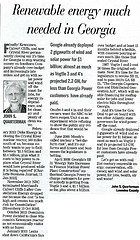
Putting conservation into conservatives —John S. Quarterman

My op-ed in the VDT today. -jsq

Gov. Deal (WABE, 14 Nov 2012) temporarily forgot that “conservative” includes conserving something, like Theodore Roosevelt and national parks, or when Franklin D. Roosevelt established the Okefenokee National Wildlife Refuge which also administers Banks Lake, when Richard Nixon started the EPA, and when Jimmy Carter signed the Soil and Water Conservation Act. If Gov. Deal wants to call conservation “liberal”, I’m happy to be a liberal working for water for our state!

Georgia Water Coalition’s Dirty Dozen

listed the biggest boondoggle of all as #11: the nuclear reactors at Plant Vogtle suck up more water from the Savannah River than all local agriculture and almost as much as the city of Savannah.

If the new Plant Vogtle nukes are ever completed, all four will use more water than Savannah. In 2009 the legislature approved and Gov. Deal signed a law letting Georgia Power charge its customers in advance for building that boondoggle, to the tune of about $1.5 billion so far!

Let’s not forget

Continue reading

Plant the seeds for viable water future

This AJC op-ed is about coastal wetlands, but much of it applies to wetlands such as cypress swamps and streams in Lowndes County and the rest of central south Georgia, especially since our state water plan for the Suwannee-Satilla Region points us at County-Level Population Projections from the Governor’s Office of Planning and Budget that project 45% growth in Lowndes County population in 20 years to 156,650 people by 2030, which means near doubling in 30 years to 2050. -jsq

David Kyler wrote for the AJC 29 December 2006, “Plant the seeds for viable coastal future”,

Recent population projections for the Georgia coast issued by 2010-2030 Change in Population of Georgia Counties Georgia Tech say nothing new. We’re growing at almost 20 percent a decade, meaning a near doubling every 35 years.

The Center for a Sustainable Coast projected a population of about 1 million by 2030 for the 11 counties in the coastal region as defined by the Department of Natural Resources, somewhat higher than the 844,000 predicted by Georgia Tech. This compares with a population of 538,469 reported in the 2000 Census report.

But the accuracy of projections is not the point. Increased population will result in more land clearing and environmental disturbance than in the past—there will be larger homes, bigger lots and fewer people per household.

National studies show up to twice as much land is

Continue reading

Fracking: coming soon to a state near you?

Lest you think fracking is something that happens only in faraway places like Alberta or Pennsylvania, look at this map of North American shale gas basins, extending right through the Appalachians from Pennsylvania through West Virginia, Virginia, Tennessee, and North Carolina into Georgia, Alabama, and Mississippi.

Source: Canada fracking creates ‘test tube‘ residents in B.C., Alberta,
by Lynn Herrmann for Digital Journal 5 January 2012.

How long before Georgia Power or Southern Company decide natural gas would be even cheaper if they fracked in Georgia or Alabama or Mississippi? How long until unavoidable human error starts fracking polluting our local groundwater and rivers? For that matter, isn’t it bad enough already that other people’s water is fracked for cheap gas in Georgia?

We could just get on with solar power, which doesn’t spill.

-jsq

Frack human error

What do you get in a solar spill? A sunny day. What do you get in a fracking spill? Polluted groundwater and drinking water. When do you get it? Whenever somebody makes a mistake, which turns out to be frequently.

Alberta Finds Mismanagement of Errors Causes Fracking Water Contamination,

“There is no amount of regulation that can overcome human error,” said Alberta’s Energy Resources Conservation Board (ERCB) spokesman Darin Barter. ERCB released an investigation report that cites inadequate management of risks as one of the main causes of a September 2011 accident that contaminated groundwater with toxic hydraulic fracturing chemicals, including the cancer causing agent known as BTEX (benzene, toulene, ethylbenzene, and xylene).

At least the company involved in this particular incident did something about it:

Personnel from Crew Energy told the Calgary Herald the company is “embarrassed” about the accident. Rob Morgan, chief operating officer for Crew said, “there’s no question of our appreciation of the severity of this,” adding, “pretty much all of the personnel who were involved in this particular circumstance are no longer with the company.”

But the groundwater is still contaminated. And where will they find replacement personnel who will never make mistakes?

Meanwhile, a solar spill is called a nice day.

-jsq