Tag Archives: Lowndes County

Development authority issues in Erie County, NY

In case you thought local elected and appointed governments in Lowndes County, Georgia were alone in not always being coordinated or strategic, here’s another example.

Not only does Erie County, New York have an industrial authority (ECIDA, the Erie County Industrial Development Agency, aka The Economic Development Corporation for Erie County) but many of the towns also do and there isn’t always coordination. Even in densely developed Erie County, there is a clash between rural and urban development.

Sandra Tan wrote for the Buffalo News 22 April 2012, Bad breaks given by IDAs? As a state lawmaker drafts a bill that would handicap town IDAs, those groups defend the deals they make,

“And there is no way rural communities such as Concord and the Village of Springville would ever get taken seriously by the ECIDA, said Concord Supervisor Gary Eppolito, who heads the least active town IDA in the county.

He recalled an instance where a local business asked the ECIDA for help expanding its agricultural business and was shown properties in the City of Lackawanna.”

-gretchen

More alcohol licenses, another road abandonment, and an RFP for Banking Services @ LCC 2012 04 23

Also an appointment to a Courthouse Preservation Committee and a subdivision infrastructure acceptance.

Here’s the agenda:

LOWNDES COUNTY BOARD OF COMMISSIONERS
PROPOSED AGENDA
WORK SESSION, MONDAY, APRIL 23, 2012, 8:30 a.m.
REGULAR SESSION, TUESDAY, APRIL 24, 2012, 5:30 p.m.
327 N. Ashley Street – 2nd Floor
Continue reading

University at Buffalo installs solar array at entrance

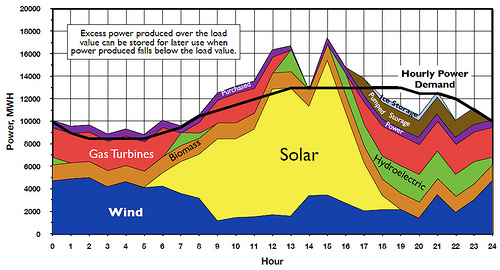
Meanwhile, about a thousand miles north of us, a 750 kilowatt solar array opens in Buffalo, New York.

According to PR of yesterday from the University at Buffalo, UB’s 3,200-Panel ‘Solar Strand’ to be Dedicated at Opening Ceremony: Will provide enough electricity to power hundreds of student apartments on campus,

In celebration of Earth Day and to promote clean, renewable energy development, the University at Buffalo and New York Power Authority (NYPA) will dedicate the UB Solar Strand, the 3,200-panel photovoltaic array, at an opening ceremony on Monday, April 23.

Those panels seem inclined quite a bit more than ones around here. That’s because UB is at 43 degrees north latitude, way north of our 31 degrees. And there’s a lot less sun up there, too. Yet they just installed a solar array more than twice as big as the 350 KW array in Valdosta.

UB is a university, and it uses the project for more than a single practical purpose:

Continue reading

Prisoners as cheap labor

Quite likely you thought massive prison populations used as cheap labor were some sort of medieval tradition. Nope. Here’s an article that debunks that misconception and informs you about many other things I (and perhaps you) didn’t know about prisoners as cheap labor.

Locking Down an American Workforce Steve Fraser and Joshua B. Freeman wrote for TomDispatch 19 April 2012, Prison Labor as the Past — and Future — of American “Free-Market” Capitalism,

Penal servitude now strikes us as a barbaric throwback to some long-lost moment that preceded the industrial revolution, but in that we’re wrong. From its first appearance in this country, it has been associated with modern capitalist industry and large-scale agriculture.

So where and when did it come from?

As it happens, penal servitude — the leasing out of prisoners to private enterprise, either within prison walls or in outside workshops, factories, and fields — was originally known as a “Yankee invention.”

First used at Auburn prison in New York State in the 1820s, the system spread widely and quickly throughout the North, the Midwest, and later the West. It developed alongside state-run prison workshops that produced goods for the public sector and sometimes the open market.

A few Southern states also used it. Prisoners there, as elsewhere, however, were mainly white men, since slave masters, with a free hand to deal with the “infractions” of their chattel, had little need for prison. The Thirteenth Amendment abolishing slavery would, in fact, make an exception for penal servitude precisely because it had become the dominant form of punishment throughout the free states.

In case you’ve never read it or have forgotten, here is the Thirteenth Amendment (emphasis added):

Section 1. Neither slavery nor involuntary servitude, except as a punishment for crime whereof the party shall have been duly convicted, shall exist within the United States, or any place subject to their jurisdiction.

Section 2. Congress shall have power to enforce this article by appropriate legislation.

Got a population you don’t like? Continue reading

Austin Energy changed from anti-solar to pro-solar in one year

At the end of 2003, Austin Energy (AE) suddenly went from very anti-solar to very pro-solar. Formerly coal-smoking Cobb EMC is doing it right now. If AE and Cobb EMC can do it, so can Georgia Power: change in one year from opposed to aggressively promoting solar power.

Mike Clark-Madison wrote for the Austin Chronicle 5 December 2003, AE drops a solar bomb,

In a near-complete turnaround from its public position just a week ago, Austin Energy has announced plans to adopt specific, highly ambitious, and undeniably expensive goals for adding solar energy to the Austin electric and economic mix. At a town hall meeting held Tuesday night to discuss the AE plan — also the subject of a public hearing at City Council today (Thursday) — AE’s Roger Duncan announced the utility’s commitment to develop 15 megawatts of solar generating capacity by 2007, escalating to 100 megawatts by 2020. The AE plan also calls for a study of the “comprehensive value” of solar power — putting a dollar amount on the economic and environmental benefits to Austin, in addition to the cost of solar-generated electricity itself. This would determine the price Austin Energy would pay for electricity generated by privately owned solar installations, just as AE now buys wind power from third parties.

Georgians tend to think Georgia Power’s foot-dragging and disinformation campaign about solar is so entrenched it will never change. But I’ve seen it happen, and it happened despite people’s expectations set by the power utility, and it happened very quickly and very big:

Continue reading

Let’s Be Blunt: It’s Time to End the Drug War

Don’t believe Latin American presidents (former and current) or a global commission including captains of industry or historic statesmen such as Jimmy Carter or major newspapers or Judge Napolitano or law enforcement professionals like Frank Serpico? Ask an economist who spells it out: the War on Drugs is an economic, public safety, and civil rights disaster, and legalization is needed right now.

Economist Art Carden wrote for Forbes yesterday, Let’s Be Blunt: It’s Time to End the Drug War,

April 20 is the counter-culture “holiday” on which lots and lots of people come together to advocate marijuana legalization (or just get high). Should drugs—especially marijuana—be legal? The answer is “yes.” Immediately. Without hesitation. Do not pass Go. Do not collect $200 seized in a civil asset forfeiture. The war on drugs has been a dismal failure. It’s high time to end prohibition. Even if you aren’t willing to go whole-hog and legalize all drugs, at the very least we should legalize marijuana.

OK, why?

Continue reading

Earth Day and Valdosta Farm Days Saturday 21 April 2012

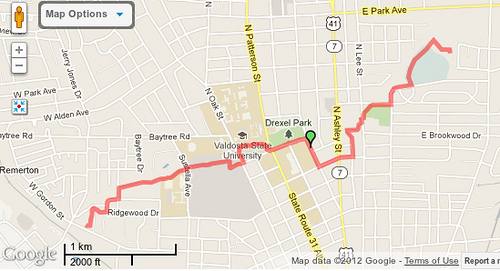
It’s a food festival Saturday in Valdosta! Before, after, or during stocking up on local food at Valdosta Farm Days at the historic Lowndes County Courthouse, you can mosey up Patterson Street to Drexel Park for lunch, music, fun, and education at Earth Day! Drive, bike, or even walk; it’s only a little more than a mile.

What: Come celebrate the Earth with us, and learn about growing your own food!!
When:10AM-3PM Saturday 21 April 2012
Where:Drexel Park,
across Patterson St from VSU,
E. Brookwood Drive,
Valdosta, GA

Appended is the text of the announcement.

-jsq

Continue reading

HB 397 sunshine bill is now law: open government forecast partly cloudy

It’s a cloudy sunrise for open government in Georgia with HB 387 now law. Will anyone enforce it? Will local governments comply? Will the legislature extend this law into a sunshiny day in Georgia?

Aaron Gould Sheinin and Bill Rankin wrote for the AJC yesterday, Governor signs Open Records rewrite into law,

House Bill 397, which took effect upon Deal’s signature, is the first major rewrite of Georgia’s sunshine laws in more than a decade. New provisions in the open records and meetings laws increase fines for offenders. The maximum penalty of $500 is now $1,000, and offenders who commit repeat violations within a year face fines of up to $2,500.

Previously, the sunshine laws allowed only criminal complaints to be filed against suspected violators, meaning a prosecutor would have to prove the case beyond a reasonable doubt. The rewrite now allows the filing of civil complaints, which have a lower burden of proof.

That could be interesting if anyone actually files a complaint.

The rewrite also would provide new exemptions for some gatherings of governing bodies, such as allowing a quorum of members to attend the same civic function, receive training or visit government agencies — provided no official business is discussed or transpires.

So the various elected boards meeting together at the end of last month was probably OK, since they weren’t making decisions, merely educating each other. But the Lowndes County Commission repeatedly hiding from the public while discussing solid waste disposal, among other issues, does not seem to fit that exception.

It also reduces the cost of most documents disclosed under the Open Records Act from 25 cents to 10 cents per page.

That means the price of the Industrial Authority’s old minutes just went down, Continue reading

Parks and Rec Board meets Thursday

According to their website, the Valdosta-Lowndes County Parks & Recreation Authority (VLPRA) board meets Thursday:

Date: Thursday, April 19, 2012
Time: 4:30 P.M.
Location: VLPRA Office 1901 N. Forrest Street, Valdosta

I don’t have a detailed agenda, but their website says they’ll vote on rental rates, and they include links to: Continue reading

Importing illegal immigrants into private Georgia prisons

Ocilla, about an hour north of here, took the private prison gamble, and now is scrambling to import enough prisoners to fill it.

Jim Galloway wrote for the AJC 11 April 2012, Importing illegal immigrants — into private Georgia prisons quoting Hannah Rappleye and Lisa Riordan Seville in The Nation 10 April 2012, How One Georgia Town Gambled Its Future on Immigration Detention,

Deportations have reached record levels under President Barack Obama, and demand for detention facilities has increased. Starting in 2002, ICE had funding for 19,444 beds per year, according to an ICE report. Today, ICE spends about $2 billion per year on almost twice the number of beds.

ICE’s reliance on facilities like the Irwin County Detention Center has put small rural towns at the center of one of today’s most contentious policy arguments—how to enforce immigration law. A yearlong investigation by The Nation shows how much politics has come to rule detention policy. Even as Georgia and Alabama passed harsh new immigration laws last year designed to keep out undocumented immigrants, documents obtained through the Freedom of Information Act reveal that politicians from both states were lobbying hard to bring immigrant detainees in. ICE succumbed to the pressure, sending hundreds of detainees to the financially unstable facility in Georgia that promised to detain immigrants cheaply. That promise came at the expense of the health, welfare and rights to due process of some 350 immigrants detained daily in Ocilla.

Marvelous. Pass a low to eject illegal immigrants, except it really locks up a bunch of them, but not enough to keep Ocilla’s private prison full, so import a bunch of them back in as prisoners.

Aren’t you glad we didn’t accept a private prison in Lowndes County, Georgia?

Ocilla and Irwin County didn’t just make that bad bet once, they doubled down on it:

Continue reading