Tag Archives: health

The extraordinary negative side of coal mining —Jane Osborn @ LCC 13 September 2011

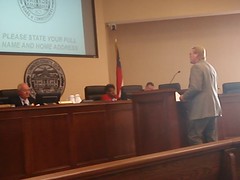
Jane Osborn talked about two health issues: the downside of coal mining, and no institutions for mental health.
…also related to the solar discussion that was begun yesterday, I think a piece we don’t talk about very often is the extraordinary negative side of coal mining. We are taking the tops off of mountains in Appalachia, leaving pristine streams clogged with the debris and the toxic waste of that. So coal is not just the price you see that we pay for it. Coal is seen in the price of people still dying of black lung, every time a mine collapses, and every time another mountain is taken down. I would guess if they were taking mountains down in North Georgia, we’d be fussing about it.
She said she has been a social worker for 33 years. She said starting June the DBHDD there would be a new service she recommended the county advertise on its website.
As of June 1st no person in the state of Georgia with a developmental disability may be placed in an institution.
The new service is a 24/7 toll free number to call for help.

Here’s the video:


The extraordinary negative side of coal mining —Jane Osborn @ LCC 13 September 2011
Regular Session, Lowndes County Commission (LCC),
Valdosta, Lowndes County, Georgia, 13 September 2011.
Videos by Gretchen Quarterman for LAKE, the Lowndes Area Knowledge Exchange.

-jsq

Planning Commission meets tonight

The organization that considers every rezoning request for Lowndes County or any of the cities of Valdosta, Dasher, Hahira, or Lake Park, the Greater Lowndes Planning Commission, meets tonight, 5:30 PM, 29 August 2011. This appointed body decides nothing, but it does make recommendations to the elected governing body of the appropriate county or city, which does take those recommendations into account before deciding. If you want to rezone, or if there’s rezoning near you, you would do well to go to the Planning Commission meeting before it gets to your local elected body.

The Planning Commission’s remit is not just rezoning cases. According to the City of Valdosta’s writeup:

The mission of the Greater Lowndes Planning Commission (GLPC) is to look beyond short-term solutions in planning for the future of the Greater Lowndes community; to improve the public health, safety, convenience and welfare; and to provide for the social, economic and physical development of communities on a sound and orderly basis, within a governmental framework and economic environment which fosters constructive growth and efficient administration.

The Planning Commission meets at the old Lowndes County Commission offices: Continue reading

Appt. to DBHDD Community Service Board —Jane Osborn

Received yesterday on LCC: work session cancelled, regular meeting Tuesday 26 July 2011. -jsq

Another item that was tabled at the last meeting was the selection of the second person from the county to be a member of the Department of Behavioral Health and Developmental Disabilities Community Service Board. I have asked to be appointed, but the item did not get put on this week’s agenda. In this critical period while new systems are going to be put in place for consumers of DBHDD’s services, it is important that people be at the table to hear and react to what is planned by Atlanta for Region IV in which we reside. Linda Floyd, RN from the VSU Nursing program will be re-appointed, but another place is empty.

-Jane Osborn

I promise one can only imagine what it’s like —Susan Leavens

Received today on Because of my mother. -jsq
I promise one can only imagine what it’s like to have a loved one die in your arms from a chronic lung disease like COPD, when every breath is a struggle and each day that passes a long and horrible death is the inevitable, my mother moved here with me from south Florida, her quality of life changed until her death from COPD in 2003. Biomass affects everyone, not just in the county it’s built in.

I personally have children which I would love to see grow with strong healthy lung functions. Some children and adults already have asthma and other lung disorders. I’m not quite sure of the long term effects biomass consist of but I am quite sure were going to be the ones that suffer in the end each and every one of us! It does raise my concern when Dr. Noll speaks about biomass and we all might need to rethink the potential danger it will bring with it. Previously I thought it was a good energy source, I now think otherwise. Speak now or forever hold your peace because I get this feeling… there sneaking in!

-Susan Leavens

Because of my mother —Dr. Noll @ VLCIA 19 July 2011

Dr. Noll, president of WACE, welcomed VLCIA’s new executive director Andrea Schruijer, and then reminded the board that the honking cars outside indicated an ongoing community assessment of biomass, and he encouraged them to consider previously presented materials and to prevent the biomass plant from finding a back door to come back in.

He remarked that he had visited his mother in Germany:

One and half years ago she was in the intensive care unit for about three weeks because she had severe lung issues. She moved away after that to an area where there isn’t the kind of air pollution she was exposed to before hand, and every single day she wakes up she feels like she’s on vacation.

Here’s the video:


Because of my mother —Dr. Noll @ VLCIA 19 July 2011
Regular Meeting, Valdosta-Lowndes County Industrial Authority (VLCIA),
Norman Bennett, Tom Call, Roy Copeland chairman, Mary Gooding, Jerry Jennett,
Andrea Schruijer Executive Director, J. Stephen Gupton attorney, Allan Ricketts Project Manager,
Valdosta, Lowndes County, Georgia, 19 July 2011.
Videos by John S. Quarterman for LAKE, the Lowndes Area Knowledge Exchange.

-jsq

Solar: jobs, leadership, grid, independence, and health

Peak power when you need it: solar. Somebody has been studying it, and addressing problems local decisionmakers right here in south Georgia have been raising.

Solar Power Generation in the US: Too expensive, or a bargain? by Richard Perez, ASRC, University at Albany, Ken Zweibel, GW Solar Institute, George Washington University, Thomas E. Hoff, Clean Power Research. That’s Albany, New York, but it applies even more to Albany, Georgia and Lowndes County, Georgia, since we’re so much farther south, with much more sun.

Let’s cut to the chase:
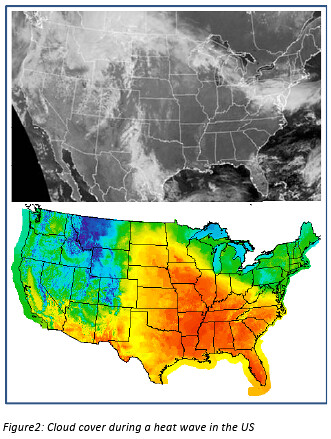
The fuel of heat waves is the sun; a heat wave cannot take place without a massive local solar energy influx. The bottom part of Figure 2 illustrates an example of a heat wave in the southeastern US in the spring of 2010 and the top part of the figure shows the cloud cover at the same time: the qualitative agreement between solar availability and the regional heat wave is striking. Quantitative evidence has also shown that the mean availability of solar generation during the largest heat wave driven rolling blackouts in the US was nearly 90% ideal (Letendre et al. 2006). One of the most convincing examples, however, is the August 2003 Northeast blackout that lasted several days and cost nearly $8 billion region wide (Perez et al., 2004). The blackout was indirectly caused by high demand, fueled by a regional heat wave3. As little as 500 MW of distributed PV region wide would have kept every single cascading failure from feeding into one another and precipitating the outage. The analysis of a similar subcontinental scale blackout in the Western US a few years before that led to nearly identical conclusions (Perez et al., 1997).

In essence, the peak load driver, the sun via heat waves and A/C demand, is also the fuel powering solar electric technologies. Because of this natural synergy, the solar technologies deliver hard wired peak shaving capability for the locations/regions with the appropriate demand mix peak loads driven by commercial/industrial A/C that is to say, much of America. This capability remains significant up to 30% capacity penetration (Perez et al., 2010), representing a deployment potential of nearly 375 GW in the US.

The sun supplies solar power when you need it: at the same time the sun drives heat waves.

The paper identifies the problem I’ve encountered talking to local policy makers, especially ones associated with power companies: Continue reading

Residential home owners of Lowndes County take notice —Vince Schneider @ LCC 14 June 2011

Vince Schneider warned county homeowners that it could happen to them, too:
To permit the establishment of the Foxborough Avenue McDonalds, the county has irreversibly established a most terrible precedence. You too can wake up one morning to find a Fast food store being built in your front yard.
Like many of us, he wondered what the county government is thinking:
I cannot comprehend how the county can possibly benefit from allowing such an establishment to be built in a quite county residential neighborhood. Is it because it provides unskilled low paying jobs? Will this McDonalds look good on a resume? It was my understanding that Valdosta and Lowndes County wanted to attract a more skilled, professional work force. The real estate on Foxborough Avenue the county permitted McDonalds to build on would have been, and is prime real estate for just such a professional enterprise….
Good questions.

Here’s the video:


Residential home owners of Lowndes County take notice —Vince Schneider @ LCC 14 June 2011
Regular Session, Lowndes County Commission (LCC),
Valdosta, Lowndes County, Georgia, 14 June 2011.
Videos by Gretchen Quarterman for LAKE, the Lowndes Area Knowledge Exchange.

After Vince Schneider finished reading his letter, Chairman Ashley Paulk handed him a paper, which was apparently a communication from County Engineer Mike Fletcher.

Appended is the text of the letter Vince Schneider read to the Commission. Continue reading

This is what a mayor with vision sounds like

Mayor Julian Castro of San Antonio speaks at 44:25 about
…the nexus between sustainability and job creation. Every now and then, perhaps once in a generation, there presents itself a moment, an opportunity, for those cities that are willing to seize it, to truly benefit the region for generations to come.
Here’s the video: Continue reading

San Antonio promises to shut down a coal plant

We could do something like this. We’ve already made a start with Wiregrass Solar.

San Antonio, the Clean-Energy City? Look out Austin, SA Mayor Julian Castro promises to shut-down a coal plant by 2018.

At an event this afternoon at UT-San Antonio, Mayor Julian Castro announced a suite of green energy projects that he said would position San Antonio as the nation’s “recognized leader in clean energy technology” and help fulfill his aggressive environmental goals.

Most notably, Castro and leaders from CPS Energy, the city-owned utility, pledged to shut down one of its coal-fired power plants 15 years ahead of schedule. By 2018, the city would mothball the 871-megawatt J.T. Deely Power Plant — a bold move in a growing state that’s seemingly addicted to coal.

So what are they going to use for energy? Continue reading

Healthcare town hall in Atlanta tomorrow

Jane Osborn points out this Healthcare Facility Regulation Division Invites you to an Informal Town Hall Meeting on June 22, 2011:
The Department of Community Health (DCH), Healthcare Facility Regulation Division (HFRD) invites you to attend a Town Hall Meeting on the topic, “Establishing Meaningful Distinctions for Levels of Care in Licensed Personal Care Homes, Assisted Living Communities and Nursing Homes”. The Town Hall Meeting will be held in the DCH Board Room, 5th Floor, 2 Peachtree Street, NW on Wednesday, June 22, 2011 at 11:30 a.m.

The purpose of this Town Hall Meeting is to provide a forum where interested consumers, providers, advocates, stakeholders and regulators may discuss the topic informally. This informal dialogue will assist the DCH in its development of proposed rules for personal care homes and assisted living communities as a result of the passage of SB 178 which creates a licensure category called assisted living communities. Of course, any rules that the DCH ultimately develops would be taken through an informal rules advisory group process and the public rule-making process. If you are unable to attend the Town Hall Meeting, but would like to provide input on this topic, please feel free to send your input electronically to DCH staff using the following email address: sedoughe@dhr.state.ga.us.

That web page also includes some questions for which DCH wants public input.

-jsq