Tag Archives: Education

State needs to rethink locking up nonviolent offenders –Nathan Deal

Conservative Georgia governor Deal wants fewer people in prison, discovering, like Texas before, that Georgia can’t afford it. Jim Galloway reported in the AJC 17 Jan 2011, Georgia Gov: Drug court offers good alternative Cost of crime and punishment is high on new governor Nathan Deal’s list:
Georgia Governor Nathan Deal has said that violent offenders will remain behind bars, but the state needs to rethink the costs of locking up others, like nonviolent drug offenders.
Last May we noted that Georgia spends a billion dollars a year to keep the fourth-largest number of prisoners of any state. Now that the state is cutting every other budget, including huge cuts in education, we just can’t afford to lock so many people up.

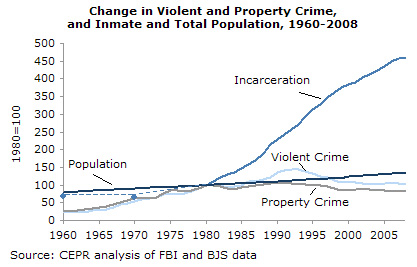
The number of people locked up has grown way faster than violent crime since 1980. The U.S., with 5% of the world’s populatioon now has 25% of the world’s prison population: more than any other country total and per capita: more than China, more than Russia, more than Cuba. As Sen. James Webb remarked in 2009: Continue reading

CCA private prisons and AZ immigration law

Kara Ramos reported in the VDT on 18 Aug 2010 that Private prison company picks Valdosta as potential site:

The Valdosta-Lowndes County Industrial Authority (VLCIA) and Corrections Corporation of America (CCA) announced an economic development partnership for future construction of a private prison.

Who is CCA? NPR’s Laura Sullivan reported on 28 Oct 2010 about Prison Economics Help Drive Ariz. Immigration Law:

Continue reading

VDT on DoJ at SCLC

Reading the VDT’s editorial yesterday morning, DOJ’s lack of Judgment, I noticed this:
Given this era of YouTube, Internet blogs, and citizen journalists, we have to ask why only credentialed members of the media were asked to leave?

Some of the people in attendance during Sunday’s meeting have openly identified themselves in the past as active Internet bloggers.

For example when I stood up in the row behind the VDT reporter and identified myself as taking videos for LAKE for posting on the web? The editorial continues:
Any one of the people in attendance could have recorded the DOJ’s responses and posted them, but the DOJ didn’t ask to collect people’s cell phones.
I also said that due to the sensitive nature of the subject, instead of LAKE’s usual policy of videoing and posting everything that seemed interesting at a public meeting, at this meeting I was only videoing people who asked to be videoed. It wasn’t the DoJ’s responses that were sensitive (they said hardly anything after their introduction): it was what the people in the audience had to say.

I asked “the female DOJ attorney”, as the VDT calls her, Continue reading

Michael Noll: precious gifts to all of us

Dr. Michael Noll sent the appended message to all members of the Valdosta Board of Education yesterday, 13 Oct 2010.

-jsq

Dear VBOE members.

Thanks for giving me the opportunity to share some important documents with you last night. As we recognized during the invocation, our children (and grandchildren) are precious gifts to all of us, and those of us who have healthy children (and grandchildren) can count their blessings every single day.

As a parent of two school-aged children and member of the community, I feel it is my responsibility to bring the issue of our children’s health into a clearer focus. It is my sincere hope that once you have had the chance to reflect on the materials I handed out last night, you will realize just how serious the issue is. As a responsible parent I am compelled to advocate for my childrens’ health.

All of us, whether we are parents, educators or members of the VLCIA,

Continue reading

STPP: Dismantling the School to Prison Pipeline Symposium

Did you know that:
Children are far more likely to be arrested at school than they were a generation ago.

The vast majority of these arrests are for non-violent offenses such as “disruptive conduct” or “disturbance of the peace.” Five year olds are being led out of classrooms in handcuffs for acting out or throwing temper tantrums. Students have been arrested for throwing an eraser at a teacher, breaking a pencil, and having rap lyrics in a locker. These children do not belong in jail.

Why do we pay more to incarcerate people than it would cost to educate them?
Why is this happening? “Zero tolerance” policies criminalize minor infractions of school rules and high-stakes testing programs encourage educators to push out low-performing students to improve their schools’ overall test scores. Students of color are especially vulnerable to the discriminatory application of discipline and push-out trends.
Here’s a chance to do something about it.
The School To Prison Pipeline (STPP) refers to a disturbing national trend in which students are funneled out of public schools and into the juvenile and criminal justice systems. Most of these kids are children of color, and many have learning disabilities or histories of poverty, abuse or neglect, and would benefit from additional educational and counseling services. Instead they are punished and isolated.
The Valdosta Dismantling the School to Prison Pipeline Symposium is one of a series throughout the state of Georgia. It’s 9:30AM – 4PM 30 Oct 2010.

-jsq

Phyllis Stallworth: “I am gravely concerned and disappointed”

I received this on 7 Oct for posting.

-jsq

Valdosta is an innovative city with expanding opportunities for our growing community. Valdosta has recently celebrated 150 years of progress. As a citizen, I have spent most of my adult life experiencing this progress. I’ve seen economic developments through recruitment, retention and expansions that benefit our city, with tremendous support from our communities. I’ve seen job opportunities that improve the livelihood of our citizens, through the recruitment of national companies who have established their businesses in our great city.

Our school systems are innovative, and they serve as models for other school systems in our state, with great parental involvement and encouragement toward improvements. Our University and College systems are some of the best in the state, with phenomenal enrollment and retention of traditional and non-traditional students in our city and abroad.

Our religious establishments are growing from leaps and bounds with more and more people becoming citizens of our great city, who are leaving larger unsafe, polluted, and unproductive cities, for a safer, less polluted and productive small town lifestyle, such as our wonderful city provides.

The development of small businesses, through our downtown projects, have been a great success story for our city. The innovative improvements make our city one of the most visited in our state. We pride ourselves as a Titletown community, through continuous progress over 150 years.

When I contemplate our shared 150 years of progress, I find it disturbing that our Industrial Authority would make such a bad decision as to bring a Biomass incinerator into our community. As an advocate for the welfare of children, women, and families I am gravely concerned and disappointed that such a project has been endorsed by leaders who were elected to carry out the wishes of the community for the betterment of all citizens.

Continue reading

Karen Noll thanks biomass opponents who spoke at VBOE

Karen Noll sent this letter to the Valdosta Board of Education (VBOE) and asked that it be posted here:
Dear Valdosta City Board of Education,

I just wanted to thank you for responding to my concerns about the proposed biomass incinerator by seeking further information. I also want to thank Dr. Brad Bergstom and Dr. Gretchen Bielmyer for coming and speaking before the board. Their expertise in the area of ecology and toxicology provided valuable information to the discussion. At the same time, I greatly appreciate that these two professors’ comments were succinct and to the point.

I am deeply disappointed that the Industrial authority chose to consume the board’s time with a 45 minute presentation that never answered the question: Is this plant safe for our students? Never did Brad Lofton or Allen Pickett come close to discussing the air pollution emissions and their effects on the health of our children. Anecdotal information from hand-picked people in Cadillac, Michigan does not convince me as to the safety of this proposed plant for my children.

Meanwhile, the American Lung Association, a group that I trust, has spoken out against biomass and its emissions in regard to children’s health:

http://www.lungusa.org/get-involved/advocate/advocacy-documents/Letter-to-Reps-Henry-Waxman-and-Edward-Markey-re-American-Clean-Energy-and-Security-Act.pdf

The American Heart Association collected many specialist to look at the relationship between Particulate matter and our health and their findings are frightening:

http://circ.ahajournals.org/cgi/content/full/121/21/2331?maxtoshow=&hits=10&RESULTFORMAT=&fulltext=particulate+matter&searchid=1&FIRSTINDEX=0&resourcetype=HWCIT

The American Cancer Society finds that extended exposure to air pollution increases risks of cancer:

http://www.cancer.org/Cancer/news/News/epa-estimates-cancer-risk-associated-with-air-pollution

Lastly, the world Health Organization presents air quality guidelines to prevent health risks, which pertain to most of the emissions from the plant:

http://www.who.int/mediacentre/factsheets/fs313/en/index.html:

I am appalled at the disrespectful tone that Brad Lofton took when addressing concerned citizens of this community. I am ashamed that the Industrial Authority would be so callous as to waste the Valdosta City Board of Education’s time with an endless sales pitch.

I truly appreciate the board’s effort to become informed about the issue and hope that we can get to the bottom of the paramount question: is the proposed biomass plant safe for our students?

Sincerely,

Karen R. Noll

Results of lack of education

Juarez, Mexico, is farther down the road of emphasizing law and order over education and jobs, as Melissa del Bosque reports in the Texas Observer abo ut Mexico’s Lost Generations:
When Juarez’s (soon to be outgoing) Mayor Jose Reyes-Ferriz visited Austin last April something he said stuck with me.

He told the audience that a failure to invest in schools and other public infrastructure had led to the lawlessness in his city. Instead of schools and daycare centers, city leadership only invested in maquila parks and roads. Children were left on the streets to fend for themselves as their parents worked in the maquila factories for meager wages.

Mexican president Calderon, previously consumed by the drug war, finally noticed and did something:
“More than 5,000 residents have received job-training grants or temporary work sprucing up parks and sidewalks and planting trees. Officials added thousands of families to a government insurance program and handed out 6,000 scholarships in a city where few students were receiving such help.”

“It’s not enough to analyze it only in terms of public safety. You have serious gaps in the social and economic [areas] that have to be closed,” said Antonio Vivanco, a Calderon advisor overseeing the development effort.

Todos somos Juarez (We Are All Juarez).

-jsq

Nix on biomass plant in Traverse City, Michigan

Looking farther afield in Cadillac, Michigan than schools and realtors, there are some people who aren’t completely pleased with the local biomass plant:
Complaints are more frequent along Mary Street, a short stretch a few hundred yards south of the plant. Residents there deal with more intense noise and odors.

Craig Walworth’s home is among the closest to the plant. He walked up to his Jeep — a vehicle he cleaned the day before — and dragged his finger through a layer of film on the hood.

“Every morning, you have that to look forward to,” he said. “I clean my screens three times a year during the summer because they clog up.”

Nonetheless he didn’t say it affected his property values. However, that’s not the only issue.

Meanwhile, about an hour north on the edge of Lake Michigan, in Traverse City local activism caused cancellation of a proposed biomass plant: Continue reading

Cost of Incarceration in Georgia

Carrie Teegardin and Bill Rankin
write in the AJC about A billion-dollar burden or justice? AJC investigation: Georgia leads nation in criminal punishment:
Georgia taxpayers spend $1 billion a year locking up so many criminal offenders that the state has the fourth-highest incarceration rate in the nation. When it comes to overall criminal punishment, no state outdoes Georgia.
They note that scare tactics made that happen.
But today, many public figures with strong anti-crime credentials are asking if that expenditure is smart, or even if it’s making Georgians safer. The debate about crime and punishment, once clearly divided along party lines, is now a debate in which conservatives often lead the charge for change.
Continue reading