Category Archives: Water

Valdosta confused about water uses

Is there an outdoor water restriction in Valdosta, or isn’t there? The city and the newspaper seem confused about that. Also remember much of Lowndes County gets its water indirectly from Valdosta through the county’s utility system. And that with groundwater levels at all-time lows, we need to be conserving all the time anyway, and thinking about how much and what kind of growth we want.

The City of Valdosta front page says:

In the Spotlight

The City of Valdosta has issued an outdoor water restriction suspending all outdoor water uses for 72-hours, or until further notice. Click here for more.

Yet if you click there, you get this error page:

Error The page you have requested does not exist. Please click here to go back to the home page.

Similarly, there was a VDT article on that subject, but that link also goes nowhere now.

Stephen Abel wrote for WALB yesterday, Temporary water restrictions in effect for Valdosta,

Folks in Valdosta need to think twice about washing their cars, or doing anything else that uses much water, this weekend.

“The city of Valdosta is urging all citizens to immediately cease outdoor irrigation use and all other nonessential uses of water. Now and throughout the weekend,” said Public Information Officer Sementha Mathews.

Severe vibrations in the water pumps is what put them out of commission. “The city’s water treatment plant experienced some mechanical issues this week with two of its raw water well pumps which caused the low levels in water,” said Mathews.

So, did the city fix its pumps? Or is it just confused about what to do?

WCTV posted this update, and seemed to indicate the water restrictions were still in place:

The City of Valdosta sincerely thanks the citizens who responded quickly to its request today to cease all outdoor irrigation and non-essential use of water. Currently, there are no water quality issues in the system, and the water provided by the city is safe for all purposes.

People should be conserving all the time anyway. These suggestions from the city are pretty good for a start:

Continue reading

Coal ash at Plant Scherer considered harmful for your health

Penny-wise, pound foolish, that's coal and coal ash, we're all discovering.

S. Heather Duncan wrote for the Macon Telegraph 14 April 2012, Plant Scherer ash pond worries neighbors as Georgia Power buys, levels homes,

The home among the trees was supposed to be Mark Goolsby's inheritance. His 78-year-old mother now lives in the large, white, wood farmhouse that his family built before the Civil War.

But Goolsby says he'll never live there now.

That's because across the street and through those trees is one of the largest coal ash ponds in the country. It belongs to Plant Scherer, a coal-fired plant that came to the neighborhood considerably later than the Goolsby family. In the mid-1970s, Goolsby said, “when (Georgia Power) bought 350 acres from my dad, they told him we'd never know they were there.”

Those acres are now part of an unlined pond where Georgia Power deposits about 1,000 pounds of toxic coal ash a day. Neither federal nor Georgia rules require groundwater monitoring around the pond. The federal Toxic Release Inventory shows that in 2010 alone, the pond received ash containing thousands of pounds of heavy metals and radioactive compounds including arsenic, vanadium, and chromium.

The U.S. Environmental Protection Agency estimates that up to 1 in 50 residents nationally who live near ash ponds could get cancer from the arsenic leaking into wells. The EPA also predicts that unlined ash ponds can increase other health risks, such as damage to the liver, kidneys and central nervous system, from contaminants such as lead.

A massive 2008 spill from a Tennessee coal ash pond led to greater scrutiny of the dams that hold these ponds in place, and the EPA promised new rules for storing coal ash. The process led to broader awareness of a more long-term health threat: groundwater contamination from the ponds.

So what's Georgia Power's solution?

Monroe County property records show Georgia Power has spent about $1.1 million buying property near Plant Scherer between 2008 and the end of 2010. But the true number may be higher.

They're going to have to keep doing that until they buy up a lot more property, I predict.

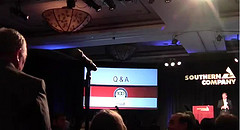
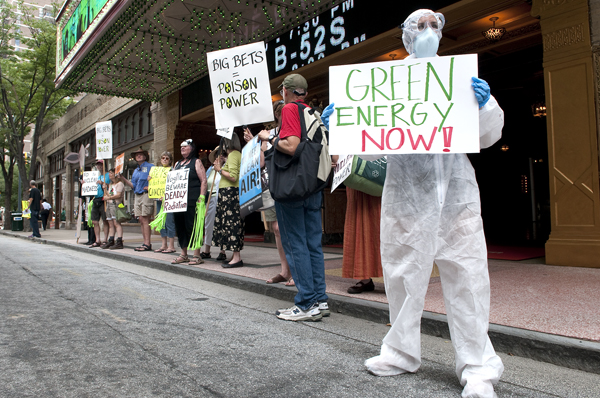
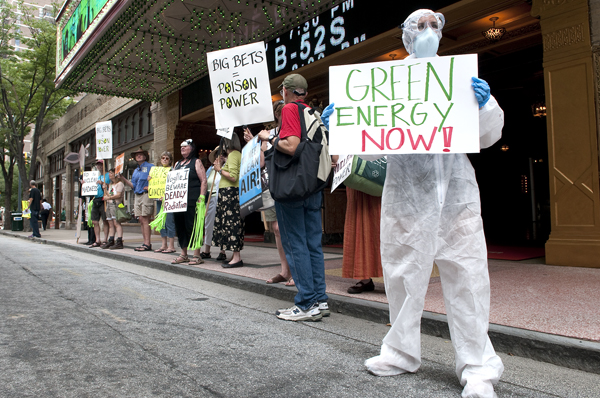
Wouldn't it be cheaper for the future bottom line of Georgia Power and its parent the Southern Company to invest in solar and wind power?

-jsq

East coast wind energy basket

Claudia Collier went to a Bureau of Ocean Energy Management public meeting yesterday at the Coastal Georgia Center in Savannah, and said:

“I suggest you designate the East Coast as the wind energy basket.”
According to Orlando Montoya with GBP yesterday, Offshore Oil Proposal Fuels Debate, she added:
“We have at least five areas out there on the shallow shelf that have designated as very promising for wind. And I just believe that once the East Coast is opened up to oil and gas, they will just take over and wind will go by the wayside.”

Oil exploration, like nuclear, is a distraction from getting on with renewable wind, wave, and solar energy independence. Let’s do the study for energy reliability in Georgia including using the large offshore wind opportunity. Remember the BP Gulf oil spill! What do you get with a wind spill? Um, wind?

The first Claudia Collier quote is by Mary Landers in SavannahNow today, Off-shore Savannah drilling talk draws support, questions. Mary Landers concluded:

The comment period on the document remains open until May 30. A decision on allowing exploration is expected by the end of the year.
Continue reading

Videos @ LCC 2012 04 10

Your county commission might have a problem with transparency when no item in a voting session takes more than a few seconds longer than the invocation and pledge. Or perhaps a public hearing in which the public is not invited to speak.

Another five minute meeting, like the previous morning’s four (Chairman’s count) or five (VDT’s count) minute work session. They did not spend even one minute on any item of the agenda.

We did get to learn that the cryptic

7.a. Seminole Circle Property

is owned by the county which wants to sell it off. Commissioner Richard Raines even read from Georgia Code the reason why the county could do that without putting it up for bids. If you did have any objection, or maybe you wanted to buy it, you’re too late, because a few seconds after we learned what it was, they sold it off. That was the longest item, at 1 minute and 20 seconds.

They didn’t mention that the subject property is apparently a splinter of a much larger 538.31 acre parcel, 0172 119, which is presumably the “land application site” they referred to. According to the 8 December 2009 minutes they use it as a hay field. After land application of what? Continue reading

Videos @ ZBOA 2012 03 06

The Valdosta-Lowndes County Zoning Board of Appeals (ZBOA) had a somewhat unusual case to start out its March meeting, of someone wanting to revert to a previous zoning after the County Commission had approved a rezoning. The owner wants to do a development, but doesn’t have the resources in this economy, so wants to go back to agricultural zoning to make a little money while waiting. It was complicated, with issues of wetlands, costs, advice by county staff, and small business employment. Watch and see!


View Larger Map
They also had a sign request from Denny’s, with input from the neighboring Mobil station and others.

Both of these cases were numbered 2012-01 (one from the county and one from the city). How can they be numbered 01? If I understand correctly, these were the first cases ZBOA has received this year, and this was the first ZBOA meeting this year. That could be an indication of the state of the local economy.

ZBOA mostly considers Continue reading

Videos @ LCC 2012 03 27

Here are videos of the entire 27 March 2012 Regular Session of the Lowndes County Commission (LCC). The audio feed is coming directly from the Commission’s own audio system. We don’t know why County Manager Joe Pritchard is frequently barely audible, nor why the microphone at the audience podium sometimes seems hardly to be working, nor why Commissioners ask people in the audience to speak when there is no microphone pointing at the audience.

Some of these videos have already been blogged:

Here’s a playlist:


Videos
Regular Session, Lowndes County Commission (LCC),
Valdosta, Lowndes County, Georgia, 27 March 2012.
Videos by Gretchen Quarterman for Lowndes Area Knowledge Exchange (LAKE).

-jsq

The costs of coal on your neighbors’ health

We can’t afford the costs of coal on our health.

John Sepulvado wrote for CNN Radio 1 April 2012, A power plant, cancer and a small town’s fears,

The two of them invested their life savings building their home. It’s a large ranch house on several acres, and the plan was the two of them would leave it for their sons and grandchildren. They gave up that dream after Maddox’s mother developed a rare form of ear cancer and died after living at the home for three years.

“I’m not going to bring my grandchildren up in this,” Maddox says. “Anybody who does would be a fool, I think.”

The problem, Maddox explains, is now he and his neighbors are getting sick. For Maddox, the first signs of trouble would come in the middle of the night, when he would wake up with nose bleeds mixed with clear mucus. Then his muscles started twitching, and then he got kidney disease, and then sclerosis of the liver.

Where does he live? Down the road from Plant Scherer in Juliette, Georgia: the nation’s dirtiest coal plant.

Georgia Power’s solution? Buy houses like his, cap the well, and raze the house.

Better solution? Get off of health-destroying moribund coal and get on with clean distributed wind and solar, for the profit (even to Georgia Power), for energy independence, for resilience, and yes, for our health.

-jsq

Savannah River #4 for total toxic discharges

The table shows Savannah River as number four in the nation for toxic discharges. It took two states to do that. I wonder where the Altamaha River ranks? And if they did it normalized per mile of river or by population, how about the Withlacoochee River?

Kiera Butler wrote for Mother Jones today, America’s Top 10 Most Polluted Waterways,

An eye-opening new report (PDF) from Environment America Research and Policy Center finds that industry dishcarged 226 million pounds of toxic chemicals into America’s rivers and streams in 2010. The pollution included dead-zone producing nitrates from food processors, mercury and other heavy metals from steel plants, and toxic chemicals from various kinds of refineries. Within the overall waste, the researchers identified 1.5 million pounds of carcinogens, 626,000 pounds of chemicals linked to developmental disorders and 354,000 pounds of those associated with reproductive problems.

The article says the situation has actually improved, but also notes we don’t really know much about it:

We’ll have to take their word for it, since the companies are not required to release the results of their chemical safety testing to the public, nor do they have to reveal how much of each chemical they are releasing. The Clean Water Act doesn’t even apply to all bodies of water in the US; exactly how big and important a waterway must be to qualify for protection has been the subject of much debate. Rivers get the big conservation bucks; they’re the waterway equivalents of rhinos and snow leopards. But pollutants in oft-neglected ditches, canals, and creeks—the obscure bugs of the waterway world—also affect ecosystems and our drinking water quality. Sean Carroll, a federal field associate in Environment America’s California office, estimates that 60 percent of US waterways aren’t protected. “The big problem,” he says, “is that we don’t know how big the problem is.”

Sounds like room for improvement, starting with better transparency.

-jsq


County quantifies some infrastructure payback times @ LCC 2012 03 31

Water and sewer take decades for return on investment, and roads and bridges probably aren’t any better. That’s worth remembering whenever solar, busses, or trains come up.

David Rodock wrote for the VDT Sunday, Commission wraps up annual retreat: Utility payments, road projects and waste disposal discussed

The cost of one mile of construction for water takes 23 years for a return on the initial investment; sewer takes 21.3 years.

The VDT didn’t specify the similar return times for road paving or bridge construction, but it’s a safe bet they’re at least as long. The farther water or sewer lines or roads or bridges are from population centers, the more they cost both directly in installation and indirectly in trips for fire and sheriff vehicles, and especially school busses. The county commissioned a report on that several years ago, as Gretchen reminded them last year. In the particular rezoning case on Cat Creek they were discussing then (Nottinghil), they made a decision to table which seems to have caused the developer never to come back with that particular sprawl plan. I congratulated the Commissioners at that time, and I congratulate them again on not promoting sprawl.

Sprawl costs the county, payback takes years, and longer the farther out it goes. What if we did something different? More on that later.

-jsq


Videos of 9 Jan 2012 LCC Work Session

This was mostly an ordinary Lowndes County Commission Work Session, except for a few items, perhaps most notably this one:
9.b. Entrance Gate at Davidson and Roberts Roads
More about that later.

Here’s the agenda.

Here’s the playlist for the entire meeting:


Videos of 9 Jan 2012 LCC Work Session
Work Session, Lowndes County Commission (LCC),
Valdosta, Lowndes County, Georgia, 9 January 2012.
Videos by Gretchen Quarterman for LAKE, the Lowndes Area Knowledge Exchange.

-jsq