Category Archives: Politics

SO CEO Fanning: Policy, jobs, and the economy plus fracking

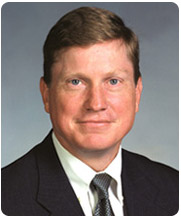
You may have wondered, how was Southern Company (SO) CEO Thomas A. Fanning so ready and able to respond at length to any question at the SO shareholder meeting? Because he’s a class A CEO who does his homework, such as this white paper he wrote dated September 2011: American Energy Policy, Jobs and the Economy, in which he explains what he meant by “the revolution we have seen in the shale gas industry”.

So, natural gas is important, but it’s not a panacea. Here’s why.

First, the reason prices have dropped so far is because of a new technology called fracking, which releases natural gas from so-called tight rock formations, such as shale gas. Fracking is the injection of chemicals underground, which have the effect of fracturing the rock deposits, thereby releasing the natural gas. There are environmental concerns around the chemicals associated with the fracking process. Those concerns have to be resolved.

Those concerns range from polluted groundwater to earthquakes. It’s great that SO is turning away from coal. I don’t think it’s so great to trade dirty air from coal for dirty water and earthquakes from fracking.

Secondly, many of these shale gas deposits are in places where there is no sufficient pipeline infrastructure necessary to move the gas to the places it’s needed to generate the electricity. Pipelines will have to be built. It will take time. We need to resolve that issue, too.

Meanwhile, rooftop solar Continue reading

Gov. Deal freezes state gas tax

Why is the governor freezing an 8/10 cent gas tax just before voters are expected to decide on a 1 cent transportation tax? Why do we need T-SPLOST when we could use that gas tax instead?

According to the Governor’s own press release:

Friday, June 8, 2012

Gov. Nathan Deal announced today that he will stop an increase in the motor fuel tax scheduled to go into effect on July 1. Using the formula established in state law, the Department of Revenue determined that average gas prices over the past six months call for the motor fuel tax to rise to 12.9 cents per gallon from 12.1 cents per gallon.

With that 0.8 cent gas tax, why would we need the 1 cent T-SPLOST sales tax? That 0.8 cent gas tax would have gone into effect just before the 31 July 2012 primary election, when voters till vote on the T-SPLOST referendum. T-SPLOST, which is a one cent sales tax. And a gasoline tax is paid by people who actually use the roads, not by every pedestrian who buys food.

The governor’s PR also said:

“We’re seeing a slow and steady rebound in Georgia’s economy, with our unemployment rate going down and state revenues heading up, but Georgians are still paying gas prices that are high by historical standards,” Deal said in a statement. “The state should not add to that burden at this juncture.”

But we should increase everyone’s food prices with a T-SPLOST tax? How does that make sense?

The governor’s PR also says:

The governor of Georgia has the power to suspend collection of a tax, but the action requires ratification from the General Assembly.

Oh, but this freeze only lasts until January, and the General Assembly doesn’t meet until then. How convenient!

-jsq

REZ-2012-09 Copeland rezoning @ LCC 2012-06-12

How can a man with health care financial troubles make a living with a shop he’s had for decades when some of the neighbors complain about a rezoning that is now required? A controversial case that raised issues ranging from wetlands to public safety to Moody Air Force Base jets flying out of Valdosta Airport made its way through two appointed boards to a Solomonic rezoning decision by the elected Lowndes County Commission. Nobody wanted to deny a man a living, but many people wanted to limit potential commercial uses of the subject property. The Commissioners attempted to take all that into account, yet failed to incorporate two major considerations raised by neighbors, mentioning one of them only to disparage it. Even that isn’t the end of it, since it may head back to the Zoning Board of Appeals for a buffer variance. Here are videos of REZ-2012-09 Copeland at the Lowndes County Commission.

It had been to the Planning Commission for a recommendation on rezoning, it had been to the Zoning Board of Appeals for a buffer variance, Monday morning it had been to the County Commission Work Session at which we learned a bit more, and Tuesday evening it went to the Lowndes County Commission Regular Session for a vote on rezoning.

Monday 11 June 2012 Work Session

At the 8:30 AM Monday Work Session, County Planner Jason Davenport had several updates since Commissioners had received their packets the previous week.

  • An email from a Mr. Bradford in opposition.
  • Some open records requests to be filled after the work session.
  • Some opponents of the rezoning had hired a lawyer. (Those of you who watched Bill Nijem at the Zoning Board of Appeals meeting already would have guessed that. Nijem also spoke the next day at the Regular Session.)
  • Davenport had met with the applicant, Mr. Copeland, who had provided more materials because he believed there were some accusations about lack of continuous operations in the building.

Davenport summarized that he thought there were three camps:

  1. Those not supporting the case.
  2. Those supporting the case,
  3. Those supporting the case with conditions,

He said one possibility would be for he and the county attorney to meet with the opposition attorney to try to work out some conditions.

Tuesday 12 June 2012 Regular Session

The agenda item was

6. Public Hearings – REZ-2012-09 Copeland, 3258 & 3264 Loch Laurel Rd, R-A & R-1 to C-C, well & septic, ~5 acres

Here’s a list of every citizen speaking for, at any of GLPC, ZBOA, or County Commission: John A. Copeland (the applicant), Kevin Copeland (applicant’s son), Nancy Hobby, Charles Miles, Fuller Sorrell, Alan Davis, Robert Roffe, and Norman Bush, plus a petition for.

Here’s a list of every citizen speaking against, at any of GLPC, ZBOA, or County Commission: Bill Nijem (attorney for several neighbors), Jimmy Hiers, Gail Hiers, Greta Vargas, and Patty Haynes.

For the rezoning

Continue reading

Internet speed and access —John S. Quarterman @ LCC 2012-05-08

At a recent Lowndes County Commission meeting, I said:

I was interested to learn two weeks ago that my neighbor Timothy Nessmith was interested in getting DSL on Hambrick Road.

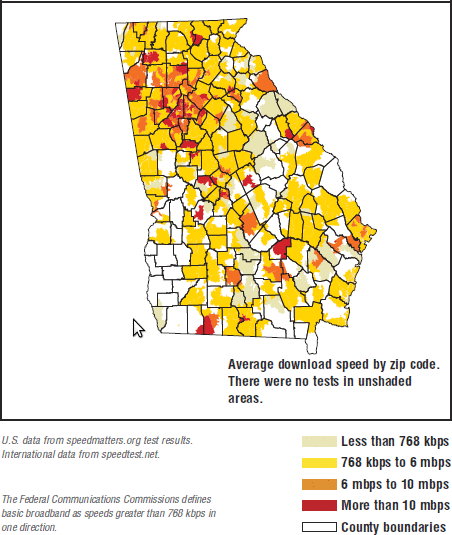
He said you can get it as close to him as Quarterman Road. I can attest to that because I have 3 megabit per second DSL, due to being just close enough to Bellsouth’s DSL box on Cat Creek Road, but most of Quarterman Road can’t get DSL due to distance. There are some other land-line possibilties, involving cables in the ground or wires on poles.

Then there are wireless possibilities, including EVDO, available from Verizon, with 750 kilobit per second (0.75 Mbps) wide area access from cell phone towers.

Verizon’s towers could also be used for WIFI antennas, for up to 8 Mbps Internet access, over a wide scale.

Then there’s metropolitan-area Internet. Chattanooga has the fastest such network, with 1 Gbps (1,000 Mbps). But hundreds of communities around the country have such networks, including (continued after the video)…

Internet speed and access —John S. Quarterman
Regular Session, Lowndes County Commission (LCC),
Valdosta, Lowndes County, Georgia, 8 May 2012.
Video by Gretchen Quarterman for Lowndes Area Knowledge Exchange (LAKE).

…Lafayette, Louisiana, Bowling Green, Kentucky, Lagrange, Georgia, and Thomasville, Georgia. They use it for public safety, education (Wiregrass Tech, VSU), and

It attracts new industry. If you want knowledge-based industry, they’re going to be expecting Internet access not just at work, but at home, whereever they live.

Other uses include Continue reading

Appointments to 3 boards, a rezoning, and more: Video Playlist @ LCC 2012-06-11

Here are videos for the 11 June 2012 Lowndes County Commission Work Session. Including a speed zone ordinance they plan to pass this evening; we the public have no idea what's in it. Here's the agenda.

One item has already been blogged separately: Waste disposal has been decided: when?

Here's a video playlist:

Appointments to 3 boards, a rezoning, and more: Video Playlist
Work Session, Lowndes County Commission (LCC),
Valdosta, Lowndes County, Georgia, 11 June 2012.
Video by Gretchen Quarterman for Lowndes Area Knowledge Exchange (LAKE).

-jsq

Waste disposal has been decided: when? @ LCC 2012-06-11

The Lowndes County Commission continues to make decisions about waste disposal at meetings to which the public is not invited.

County Manager Joe Pritchard said at yesterday morning’s Work Session:

Mr. Chairman and Commissioners, I’d like to give you an update concerning the sales of the trash cards for use for access to the convenience centers. As we discussed in our retreat as well as in consideration of the budget staff will be having, will have these cards ready by this Friday for sale to the public. Cards will be for a six month period. The cost will be $50 for that six month period. We will not be able to allow those cards to be
[interjection from unknown commissioner: “prorated”]
as we did the previous ones. This will enable us to complete the process that Commissioners asked us to do concerning evaluation of several RFQs and RFPs that we will be presenting to you in the next weeks or months. This will be available this Friday. A notice will be placed [inaudible].

So apparently waste disposal was decided at the 4 June 2012 stealth meeting or at their April retreat at an undisclosed location. We don’t know where our elected officials made this decision about a matter that directly affects us. Apparently what they’ve decided so far is they’re going to buy time to pick one or more waste disposal pickup contractors (“RFQs and RFPs”) by issuing trash collection center cards for only six months at a time instead of a year at a time. And oh by the way they won’t prorate any time if you don’t happen to buy yours Friday. So the Commission continues to move towards privatizing the profits of trash pickup and socializing the losses onto landowners (who have to pay for fences and gates), onto the general public (who have to pay for law enforcement to catch dumpers), and onto those who can’t afford to pay for private dump fees (who will get stuck with fines instead).

Here’s the video:

Waste disposal has been decided: when?
Work Session, Lowndes County Commission (LCC),
Valdosta, Lowndes County, Georgia, 11 June 2012.
Video by Gretchen Quarterman for Lowndes Area Knowledge Exchange (LAKE).

-jsq


Solar Lowndes High?

What does the world see driving north up I-75 past Valdosta? The empty roofs of Lowndes High School. Every south-facing one of which could hold solar panels.


View Larger Map

That would do more to put Lowndes County and Valdosta on the map as supporting solar and thus knowledge-based jobs than any amount of exit beautification.

Run out of roof space? What about those parking lots:


View Larger Map

And it wouldn’t take a Ted Turner to do it. In all but a few states the Lowndes County Board of Education (LCBOE) could let a private company finance and install all those solar panels and then lease the electricity for a fixed rate for 20 years, greatly reducing the school’s electricity bill and promoting our local community, all without any expense to we the taxpayers.

But you can’t do that in Georgia! Because Georgia Power doesn’t want us to. Unless we get some laws changed. Follow the link for how.

-jsq

PS: I haven’t forgotten Valdosta High School. All the economic advantages would apply just as well for the Valdosta Board of Education and Valdosta taxpayers. Even Valwood could do this and profit. If we get Georgia law changed to permit it.

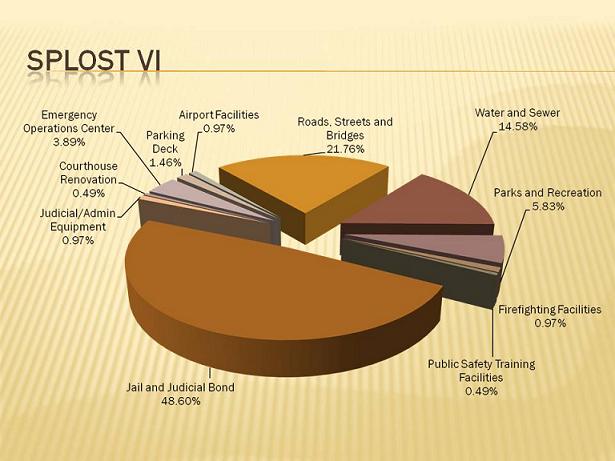
SPLOST with Lowndes County and the cities @ SPLOST 2012-06-11

The second of two meetings on the Lowndes County Commission According to the calendar for Monday morning, 11 June 2011, is about SPLOST, and also involves all the cities in the county.

SPLOST Meeting/ (6/11/2012)

The Lowndes County Board of Commissioners along with the City of Valdosta, City of Hahira, City of Dasher, City of Lake Park and City of Remerton will be holding a SPLOST meeting on Monday, June 11, 2012, at 9:30 a.m. in the Multi-Purpose Room on the 2nd floor of the Administration Building.

SPLOST is not to be confused with LOST (created by the legislature), nor with ESPLOST for educational purposes, and certainly not with T-SPLOST for transportation.

Unlike the work session, which has no description of what it's about, there is at least a link on the county Quick Links for SPLOST, which says:

Special Purpose Local Option Sales Tax (SPLOST)

As of July 1, 1985, Georgia law enabled local jurisdictions to use SPLOST proceeds for capital improvement projects that would otherwise be paid for with General Fund or property tax revenues. SPLOST stands for Special Purpose Local Option Sales Tax. This is a one-cent sales tax, which the State of Georgia allows counties to collect to fund specific improvement projects. SPLOST must be approved by voters in a general referendum in order to be enacted and last for a maximum of 60 months (five years) or until the total amount of revenue specified in the referendum is reached. The SPLOST projects and the amount of money raised by SPLOST were identified prior to voting on the SPLOST referendum. The proceeds of the tax must be spent for capital (non-operating) items by the county government and participating municipalities within the county.

That page also includes a list of SPLOST projects completed by January 2010.

-jsq

No agenda for work session: Lowndes County Commission @ LCC 2012-06-11

According to the calendar for the Lowndes County Commission, there are two meetings scheduled Monday morning, 11 June 2011. There's no agenda posted for either of them.

Lowndes County Work Session (6/11/2012)

Lowndes County Board of Commissioners
327 N. Ashley St – Commission Chambers, 2nd Floor Administration Building
Valdosta, GA
8:30 a.m.

This is the first time in a long time there's been no agenda up less than a day before a County Commission Work Session. Rumor has it that they're going to talk about one of the most contentious and ill-planned issues around: solid waste disposal. Is rumor how we the citizens and taxpayers should hear about that?

The other meeting on the calendar for tomorrow is about SPLOST; see other post.

-jsq

Company installs solar and leases it to New Jersey school: you can’t do that in Georgia

Schools can’t do this in Georgia, because of the Territoriality Law. They can’t have a company finance and install solar panels on their property and lease the power from them at a fixed rate. You can’t, either, not even on your own private property. Does that seem right to you?

US DoE EERE wrote (no date), NJ School Installs 6.1 MW Solar System,

A 100-year old private school, Lawrenceville School, in Lawrenceville, N.J., installed a 6.1 megawatt ground-mounted system on 30 acres of school-owned farm land. The system features 24,934 SolarWorld solar panels, manufactured at the company’s U.S. headquarters in Hillsboro, Oregon. KDC Solar leased the land for the project from the school and owns and maintains the solar equipment. Through a power purchase agreement, the Lawrenceville School will buy electricity produced by the array over the next 20 years.

The school says the Lawrenceville Solar Farm was dedicated 4 May 2012., and adds that they also keep bees on the same land, plus what six megawatts means:

The Lawrenceville School Solar Farm consists of a nearly 30-acre, net metered, 6.1 megawatt solar facility, and honey-producing bee hives, which ring the perimeter of the array. The nearly 900,000 resident honey bees are nourished by a special wildflower mixture planted among and around the solar panels. The Farm offsets 6,388 metric tons of CO2 annually, the equivalent of taking 1,253 cars off the road annually.

The 24,934 solar panels generate six megawatts of energy, covering 90 percent of the School’s needs. During the day, the array can produce nearly twice the amount of energy needed by the School. The excess is imported to the local electrical utility, Public Service Electric & Gas (PSE&G) and credited to the School. The School will draw excess energy and all other required energy from PSE&G after sundown.

Here’s a PDF with more details.

The big picture is: you can do that in all but about four states. Georgia is one of those four states, Continue reading