Tag Archives: China

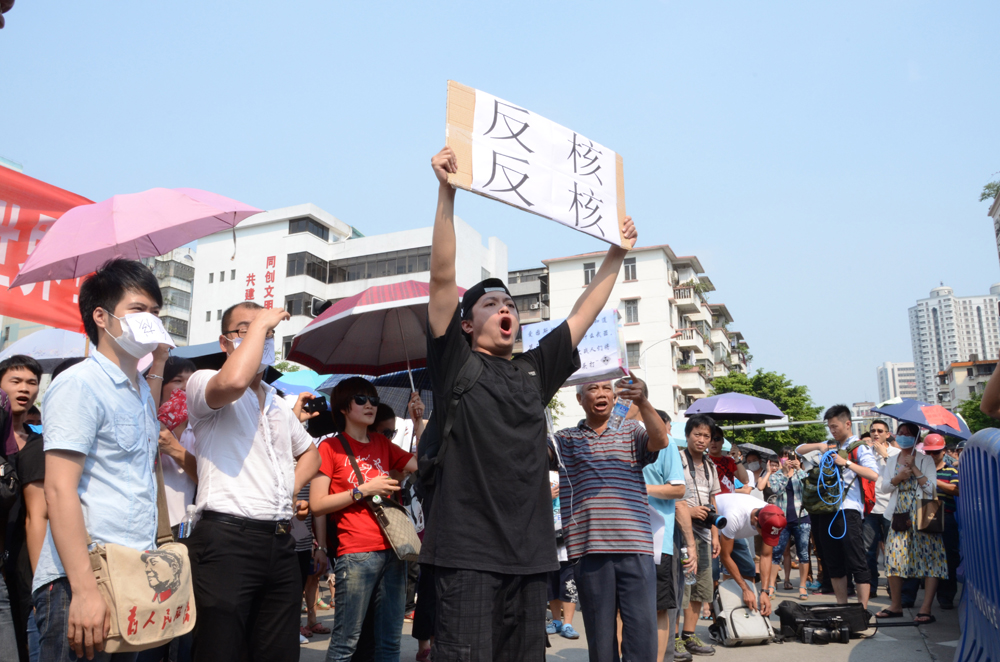
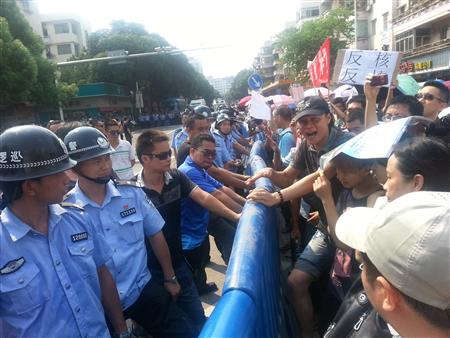
China ends a nuclear treatment plant after demonstrations

“In order to respect the popular will, the government of” the city of Heshan
refused to proceed with a $9 billion uranium processing plant.
That happened after this, yesterday:


The cancellation, unusually fast, demonstrates the increasingly important attention
given by the authorities to environmental concerns that are often expressed at the local level.
Several projects of petrochemical plants and metal processing have recently been postponed or relocated.

Yes, I know the plant may just be relocated somewhere else.
But with enough such demonstrations it won’t be built.
How about some of this respect for the popular will about,
for example, the natural gas pipeline through Georgia from Alabama to Florida,
or the new nukes at Plant Vogtle?

Le Monde, today, Continue reading

Owners want out of uranium enrichment company


Maybe Southern Company and Georgia Power should listen to Urenco’s owners:
the nuclear industry is flatlining after Fukushima.

Stanley Reed wrote for Dealbook.Nytimes.com 27 May 2013,

Powerhouse of the Uranium Enrichment Industry Seeks an Exit
,

The company that operates this uranium enrichment center, Urenco, is
the world leader in the field. It is also plumply profitable. So why
are its owners eager to sell it?

The answer, as with many things involving nuclear power, is a
combination of economics, geopolitics and the Promethean prospect of
an energy source that is as potentially green and abundant as deadly
dangerous….

Continue reading

China carbon cap and Georgia Power


If China implements a carbon tax, will Georgia Power CEO Paul Bowers
change his recent answer to a question about a carbon tax,
which was “why would anyone want that?”


Paul Bowers speaking

In February

the Chinese Ministry of Finance (MoF) said China would soon tax
carbon dioxide (CO2) emissions
,
and that’s getting closer in

the country whose capital Beijing has smog bad it’s literally off the charts
.
Katie Valentine wrote for ThinkProgress 22 May 2013,

Bombshell: China May Be Close To Implementing A Cap On Carbon Pollution
,

China is taking steps to tackle its huge
carbon output. Today, the country announced the
details
of its first carbon trading program, which will begin
in the city of Shenzhen next month. The southern city is one of seven
cities and provinces
, including Beijing, which will take part in
the pilot program, set to be completely implemented by 2014.


And according to one local news source, China could
implement an absolute, nation-wide cap on its carbon
emissions by 2016. China’s 21st Century Business Herald
reported this week that the country’s State Council still needs to
approve
the carbon cap proposal submitted by the National Development
and Reform Commission, a government entity that controls much of the
Chinese economy. The proposal, which the State Council is reportedly likely
to support
, would ensure China’s emissions would
not increase past the country’s target cap, regardless
of economic growth — though it’s still unclear what
that cap would be. The paper reported that the NDRC also predicts
China’s greenhouse gas emissions will peak in 2025, rather than 2030,
as earlier predictions stated.

If the cap is adopted,

Continue reading

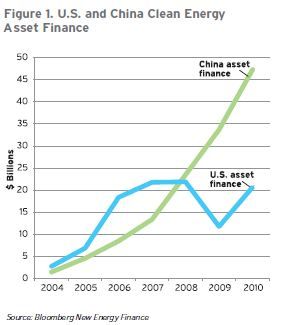
China regains lead in solar and wind investment —Financial Times


Pilita Clark wrote for Financial Times 14 January 2013,

China retakes renewables investment lead
,

China has surged ahead of the US to regain its title as the world's
biggest investor in renewable energy, new figures showed on Monday.


The article continues by trying to downplay solar and wind because
of a drop in investment from other countries,
while not mentioning that solar and wind deployments continue to climb.
According to Todd Woddy in Forbes 22 January 2013, Chinese Solar Market Boomed In Q4, Accounting For Third Of Global Demand.
China has incentive and is doing something about it, as
Feifei Shen and Reed Landberg wrote for
Bloomberg News 30 January 2013,

China to Boost Solar Power Goal 67% as Smog Envelops Beijing
.

How much are the Chinese investing?
The FT story continues:

Continue reading

Carbon tax soon in China


If China can tax CO2, so can the U.S.

Hou Qiang wrote for Xinhua 19 February 2013,

China to introduce carbon tax: official

China will proactively introduce a set of new taxation policies


designed to preserve the environment, including a tax on carbon
dioxide emissions, according to a senior official with the Ministry
of Finance (MOF).

The government will collect the environmental protection tax instead
of pollutant discharge fees, as well as levy a tax on carbon dioxide
emissions, Jia Chen, head of the ministry’s tax policy division,
wrote in an article published on the MOF’s website.

-jsq

Let the Sun Shine: Fact versus Fiction —Michael G. Noll

LTE in the VDT today. I’ve added a few links. -jsq


Fox News recently claimed that “solar won’t work in America because
it’s not as sunny as Germany”. Such statements are common for a
network that has long lost its credibility. Unfortunately too many
take such gibberish at face value. Thus columns like

“environmentalism or obstructionism?”
are not
surprising, but in the end it’s the facts that matter:

  • Global warming is real. For years we have been experiencing record
    heat waves, droughts, wild fires, etc., and while seawater levels
    are rising, storms like hurricane Sandy become major threats

    to low lying areas along coast lines
    .
  • The main culprit for global warming are greenhouse gases like
    carbon dioxide, resulting from the burning of fossil fuels,
    especially coal and oil.
  • While China overall emits more than we do, the US leads in per
    capita emissions. The average US citizen produces three times more
    carbon dioxide than the average Chinese citizen.

Continue reading

China, etc., mining uranium in Niger and Mali

A commenter on
Mali: a French War for Uranium
suggested that if "that zone" (presumably
the Sahara in Mali and Niger)
were such an El Dorado the U.S. and the Chinese would have long been interested.
Actually, it turns out numerous countries are involved, especially along
the
Uranium Highway in the Uranium Province in Niger.
Not the Americans so much, but definitely the Chinese.


According to

World Information Service on Energy Uranium Project
,
in

Mali
, it's the Canadians (Cascade Resources Ltd.,
Northern Canadian Uranium Inc., Rockgate Capital Corp.) and
the Australians (Oklo Uranium Ltd).:

The following companies are performing uranium prospection and/or exploration in Mali:


Cascade Resources Ltd. ,
Northern Canadian Uranium Inc. ,
Rockgate Capital Corp. ,
Oklo Uranium Ltd


Faléa uranium/silver project

> View deposit info
Opposition to uranium mining in Faléa: Association des ressortissants et
amis de la Commune de Faléa (ARACF)

Pre-Feasibility study on Faléa mine project started:


On Nov. 15, 2012, Rockgate Capital Corp. announced the commencement of a Pre-Feasibility study on its Faléa U-Ag-Cu project in south-west Mali. Rockgate has engaged the services of the DRA Group of Johannesburg, South Africa to complete the study.

Environmental and social baseline studies commissioned on Faléa mine project:
On April 26, 2010, Rockgate Capital Corp. announced that it has commissioned environmental and social baseline studies on the Faléa Project, Mali.

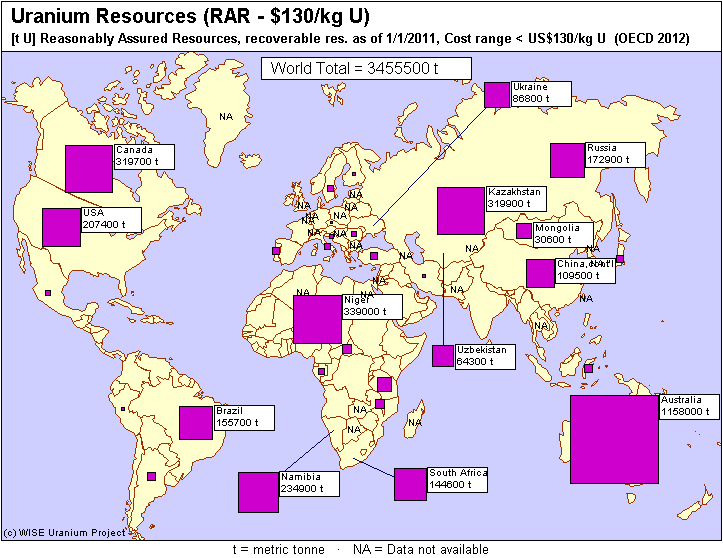
Apparently Niger has more recoverable Uranium than either the U.S. or Canada;
more than Kazakhstan; more than any country except Australia.


In Niger
, it's Russia, Korea, India, and here are a few notes
about Chinese involvement:


Areva ready to give Chinese access to Imouraren uranium mine:

French nuclear giant Areva is ready to open up to a Chinese partner the

Continue reading

Real discussion for real education: Shanghai

Here’s how they do it in the best education system in the world:


Shanghai’s education system is distinctive and superior—and not
just globally, but also nationally. Hong Kong, Beijing, and ten Chinese
provinces participated in the 2009 PISA, but their results reflected
education systems that were still the same-old knowledge acquisition
models, whereas Shanghai had progressed to equipping students with
the ability to interpret and extrapolate information from text and
apply it to real world situations—what we would normally refer to
as ‘creativity.’ Twenty-six percent of Shanghai 15 year-olds could
demonstrate advanced problem-solving skills, whereas the OECD average
is 3 percent.

I do mean that literally, the best in the world:

Every three years, the Organisation for Economic Co-operation and
Development (OECD) administers its worldwide
Programme for International Student Assessment
(PISA) to measure how well a nation’s education
system has been preparing its students for the global knowledge
economy. Nations such as South Korea, Finland, and Singapore have
traditionally topped the rankings, but, apparently, even they are no
match for Shanghai, which shoved the others into lower positions in its
very first year of participation in the programme, in 2009.

That’s according to
Jiang Xueqin writing in the Diplomat 1 August 2011,

How Shanghai Schools Beat Them All
.

So, how did they do it?

Continue reading

“Debate is not allowed.” Well, why not?

The real problem with education around here is the adults who refuse
to hold a civil discussion.

I hear this all the time around here:


“We’re not going to get into debate.”


“We will not, however, debate you over e-mail.”


“There’s been enough debate.”


“one more public meeting with 15 minutes of pros and cons and
then hopefully that will be the end of discussion.”


“I’m not going to debate you about that.”


“Debate is not allowed.”

Well, why not?
When did “debate” become a dirty word?
What if we call it a civil discussion, will that make it sound better?
Nobody seems to know how to do that, either.

And that, my friends, is the real failure of the local education system.

Next:
how they do it in the best education system in the world.

-jsq

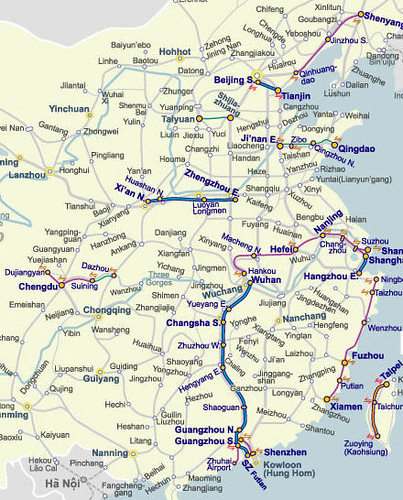
Real High Speed Rail: in China


Here in the U.S., we’re still thinking about maybe doing some high
speed rail lines.
None in Georgia.
And even the slow-speed passenger proposed rail network bypasses Valdosta
and Lowndes County.

Meanwhile, in China:


(Click on the detail map for the full map from johomaps 2010.)

Continue reading