Tag Archives: Agriculture

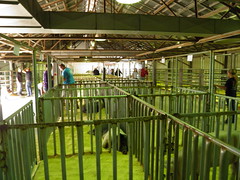
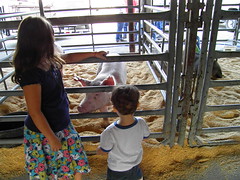
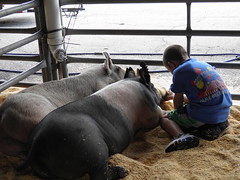
No inhumane treatment issues other than the pot belly pig?

Received Sunday a PDF of a letter from Joe Pritchard, County Manager, to Mary Greene, GA Dep. of Ag. together with the appended cover letter from Susan Leavens. -jsq

Mr. Prichard has made many comments in reference to several of his employees; in recent news paper articles and on the evening news indirectly of course that “they” had bios opinions and even questioned my character in one article.

Mr. Prichard also informed everyone there were no inhumane treatment issues other than the pot belly pig. Well I believe in this document from County Manager Joe Prichard to Ms. Mary Green with Department of Agriculture animal protection says otherwise. I believe Mr. Prichard’s recent statement to the media was though our investigation we found no wrong doing… lets list them here.

Continue reading

Prison slave labor infects beef with rat feces

In case you thought prison slave labor didn’t affect you, watch Mike Elk on Democracy Now today, New Exposé Tracks ALEC-Private Prison Industry Effort to Replace Unionized Workers with Prison Labor:
“more than 14 million pounds of beef infected with rat feces processed by inmates were not recalled, in order to avoid drawing attention to how many products are made by prison labor.”
Is this what you want for yourself and your children? If not, it’s time to stop ALEC crafting state laws to lock people up and then exploit them as slave labor.

We can start by not accepting a private prison in Lowndes County, Georgia. Spend those tax dollars on rehabilitation and education instead.

Update 9:35 AM 6 Aug 2011: Fixed the links to the Democracy Now story. Thanks for catching that, Barbara!
Here’s a bonus link to the story in The Nation.

-jsq

PS: This post owed to Cheryl Ann Fillekes.

Not clear houses are more important than agriculture —John S. Quarterman @ LCC 12 July 2011

If somebody puts a subdivision next to your field, beware of trash, and the same if you buy a lot in it. For that matter, why do we need more houses?

Some of what I said:

To expand a little bit on that subdivision next to our west field, one of the builders continued to push trash into our field until I had to sue him for trespass in Superior Court to get him to stop.
I meant to say in Magistrate’s Court.
I called code enforcement multiple times and they did nothing to help stop it. Now that there’s a new fire chief perhaps things are better, but anybody who’s got a field nearby might want to watch for that.

Anyone who hopes to buy houses in the subdivision might want to watch to see if there are any dumpsters in there, because the subdivision near us, the trash was buried in the yards; you can ask anyone who owns one of those lots.

As far as needing houses for Moody, there are usually ten houses for sale in that subdivision, and roughtly 10 or 15 more that are for rent. So it’s not clear we actually need more houses.

As far as lot size, this is the same issue as came up last year with Glen Laurel on Old Pine Road. … The room was filled with people for the same reasons that you’re hearing now. At that time the commission decided to say ….

You can see for yourself what happened in May of last year: Continue reading

Traffic on Cat Creek Road at Nottinghill —Thomas E. Stalvey Jr. @ LCC 12 July 2011

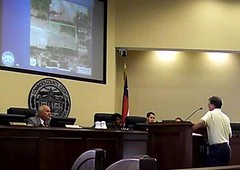
Schoolchildren, safety, and farmland: three topics that often seem forgotten in discussions of development. Opposing the proposed rezoning for Notthinghill, neighbor Thomas E. Stalvey Jr. noted that traffic on Cat Creek Road is already a problem, and adding a subdivision would make it worse. He noted that it’s traffic routed down Cat Creek to Moody that accounts for a lot of it. He said school children stood out on the road and they were already in danger.
“If we put 49 more houses out there, it’s just going to up the risk.”

He explicitly linked road widening to development: Continue reading

What are they going to put for a buffer for farms at Nottinghill —Calvin Marshall @ LCC 12 July 2011

Neighboring landowner demolishes developers’ arguments; explains agriculture to Lowndes County Comission.

Neighboring landowner Calvin Marshall, speaking against rezoning for REZ-2011-10 Nottinghill, said neighbors,

“We’re not interested in a Bluepool, We’re not interested in a Chatham Place. And we’re certainly not interested in what they built out on Val Del Road. We’ve also looked at what they’ve done with Old Pine, and we’re definitely not interested in that, either. Too small lots, small homes.”
That last one is presumably Glen Laurel, which had a roomful of neighbors opposing it last year.

Calvin Marshall asked for the Commissioners to deny the Nottinghill rezoning request.

He also asked:

“The other thing that we asked the developer … what you going to do about the neighbors that have got a farm on each side? What kind of buffer are you going to put there?

We farm that land, we grow crops, we run cows, we run goats, we run hogs, and we’re going to continue to do that.

We don’t have an answer as to what they’re going to do for a buffer.”

Calvin Marshall continued with the economic argument:

“There’s three or four generations of property owners in this room tonight. These people go back for three or four generations. And these people have worked hard.
Continue reading

GA HB 87 ridiculed in California editorial

The Ventura County Star in California editorialized Sunday:
Laws sometimes have unintended consequences, and laws hastily passed in time of high political passions inevitably do.
Continue reading

Hispanics and farmers strike in Moultrie

Alan Mauldin wrote for the Moultrie Observer 29 June 2011, Stay-at-home protest: Latinos hope to show their impact:
Colquitt County’s Latino community is gearing up to make its presence known by, well, disappearing, at least as much as possible for the largest minority group.

On Friday, the day a strict new immigration law takes effect, many will stay home from work and refrain from shopping to help make others aware of the impact of their contributions in the county.

It’s not just workers participating: Continue reading

The Atlantic dissects Georgia’s anti-immigrant law

The VDT’s pan of HB 87 gets national notice. Why we don’t need a law that puts south Georgia farmers out of business while profiting private prison company CCA at taxpayer expense.

Megan McArdle wrote in the Atlantic 21 June 2011, Georgia’s Harsh Immigration Law Costs Millions in Unharvested Crops. She started by quoting Jay Bookman, who quoted the VDT. She then goes into the economics:

The economics here aren’t particularly complicated, and I’m sure they won’t be new to the sophisticated readers of the Atlantic, but they are useful to look at and consider explicitly when thinking about issues like this.

It goes like this. If you’re not going to let illegal immigrants do the jobs they are currently being hired to do, then farmers will have to raise wages to replace them. Since farmers are taking a risk in hiring immigrant workers, you can bet they were getting a significant deal on wage costs relative to “market wages”. I put market wages here in quotations, because it’s quite possible that the wages required to get workers to do the job are so high that it’s no longer profitable for farmers to plant the crops in the first place.

Yes, that would be the problem. A law that benefits private prison company CCA at the expense of Georgia taxpayers while putting Georgia farmers out of business.

She concludes: Continue reading

GA HB 87 ridiculed in Atlanta; VDT cited

Who could have forseen this? Well, other than anyone who actually knows Georgia farmers. And the VDT becomes thought leader to the world:
“Maybe this should have been prepared for, with farmers’ input. Maybe the state should have discussed the ramifications with those directly affected. Maybe the immigration issue is not as easy as &lquo;send them home,&rquo; but is a far more complex one in that maybe Georgia needs them, relies on them, and cannot successfully support the state’s No. 1 economic engine without them.”
Except of course HB 87 doesn’t just send them home: it also locks up as many as it can catch, to the profit of private prison company CCA, at the expense of we the taxpayers.

That’s as quoted by Jay Bookman in the AJC 17 June 2011, Ga’s farm-labor crisis playing out as planned:

After enacting House Bill 87, a law designed to drive illegal immigrants out of Georgia, state officials appear shocked to discover that HB 87 is, well, driving a lot of illegal immigrants out of Georgia.

It might be funny if it wasn’t so sad.

Continue reading

Many rural farmers are taking notice of HB 87 —Patrick Davis

Patrick Davis points out from Macon that HB 87 is producing Lowndes County farm employment problems, and maybe local farmers should take that into account when they vote.

Patrick Davis wrote, Rural Republicans in Georgia can’t have it both ways on immigration reform

With the law passed and ready for implementation, many rural farmers—especially in Central and South Georgia—are taking notice to the exodus of migrant workers and immigrants which has left some farmers without workers to pick crops.

Many of these same farmers that are hurting economically and losing crops in these rural counties had voted Republican for years.

Valdosta’s Ellis Black who represents parts of Lowndes County as a state representative helped to pass Gov. Nathan Deal’s conservative and punitive agenda and consequently it has contributed to drive an increasing number of migrant workers out of the Peach State.

Black has continued to justify his HB-87 vote and attempt to support Gov. Deal’s ridiculous assertion in regard to the use of probationers as a solution.

That last link is to Parolees to replace migrants? Gov. Deal says put probationers in fields by David Rodock in the VDT 15 June 2011, which included: Continue reading