Meeting notes for the past year or so are are on the LAKE web pages.
If you’re looking for something to do, like Jane says, all of our nonprofit boards are in need of board members….
Videos by Gretchen Quarterman for LAKE.
Meeting notes for the past year or so are are on the LAKE web pages.
If you’re looking for something to do, like Jane says, all of our nonprofit boards are in need of board members….
Videos by Gretchen Quarterman for LAKE.
City Manager Larry Hanson read the election results.
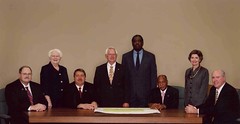
Deidra White was elected for the first time, to District 2. Here she organizes the news photographers, gets sworn in, and gets a standing ovation. The Valdosta Daily Times doesn’t appear to have posted a story about this meeting afterwards, but it did post a story beforehand, spelling her first name wrong, and concluding: Continue reading
 If they can do this in Silicon Valley, we can do it here.
Joe Rodriguez writes in the San Jose Mercury News that
“Latino theater director quits the limelight to help poor people grow food at home”:
If they can do this in Silicon Valley, we can do it here.
Joe Rodriguez writes in the San Jose Mercury News that
“Latino theater director quits the limelight to help poor people grow food at home”:
Sugar peas, butter lettuce, red and white Spanish onions, cauliflower and other veggies filled the 4-by-8-foot planter boxes, which Lozano gave them. With four children of their own, the Lopezes live in a small house with two other families, 14 people in all.Who will be the Raul Lozano of Lowndes County? Continue readingThe modest harvest won’t eliminate Lopez’s trips to the food pantry, but it does save the family the cost of fresh vegetables it would otherwise have to buy at the market.
“This is saving us quite a bit of money,” said Arturo Lopez, a wall-framer who hasn’t worked since injuring his back last year. “Our children are eating better. They come back here and eat a leaf of lettuce like candy.”
…the economic crisis forced states to reconsider who they put behind bars and how long they keep them there, said Kim English, research director for the Colorado Division of Criminal Justice.In Texas, parole rates were once among the lowest in the nation, with as few as 15% of inmates being granted release as recently as five years ago. Now, the parole rate is more than 30% after Texas began identifying low-risk candidates for parole.
In Mississippi, a truth-in-sentencing law required drug offenders to serve 85% of their sentences. That’s been reduced to less than 25%.
California’s budget problems are expected to result in the release of 37,000 inmates in the next two years. The state also is under a federal court order to shed 40,000 inmates because its prisons are so overcrowded that they are no longer constitutional, Austin said.
Some states even try not to lock up as many people in the first place:
States also are looking at ways to keep people from ever entering prison. A nationwide system of drug courts takes first-time felony offenders caught with less than a gram of illegal drugs and sets up a monitoring team to help with case management and therapy.Maybe Georgia could stop locking up so many people for drug and other minor offenses, not keep them in as long, and do something to integrate them back into the community instead of locking them up again.Studies have touted significant savings with drug courts, saying they cost 10% to 30% less than it costs to send someone to prison.
“I don’t think they work — I know so,” said Judge John Creuzot, a state district judge in Dallas.
 Sometimes Atlanta has data which can be applied to the rest of Georgia.
An Emory University press release of 26 Mar 2009 says
Study Focuses on Barriers to Successful Prisoner Re-Entry Into Atlanta Communities:
Sometimes Atlanta has data which can be applied to the rest of Georgia.
An Emory University press release of 26 Mar 2009 says
Study Focuses on Barriers to Successful Prisoner Re-Entry Into Atlanta Communities:
Gaining employment was hindered by multiple obstacles: In addition to low levels of education and work experience, and the reluctance of employers to hire someone who has served time in prison, they also lacked the personal networks to help them identify and secure jobs. Those findings echoed the experiences of government and community-based reentry service providers.So it’s a difficult problem, but the first step is obvious.However, “housing was identified as the most central issue and need people faced immediately upon their return or move to Atlanta,” said Owens. “For those released from prison without obtaining a guaranteed bed at a transitional house or shelter, and possessing only their $25 in ‘gate money,’ finding a place to stay that was secure, decent and accessible was often impossible.”
And there’s a basic reason for doing something:
“In many ways, the success or recidivism of former inmates has a tremendous impact on the communities where they settle, but given the stigma attached, it hasn’t exactly been a cause championed by many. But, positive reentry is a necessity, not an option, when it comes to public safety, preserving families and the development and stability of neighborhoods,” said assistant professor of political science Michael Leo Owens, coauthor of the study “Prisoner Reentry in Atlanta: Understanding the Challenges of Transition from Prison to Community.” View the prisoner reentry study (PDF).Helping prisoners re-enter the community reduces crime and increases employment, so it would seem like something everyone would want.
Faced with soaring prison costs, states are finally focusing on policies that would help former prisoners stay out of jail after they are released. Some legislatures are reshaping laws that land parolees back inside for technical violations that should be dealt with on the outside. More than a dozen cities and counties have taken steps that make it easier for qualified ex-offenders to land government jobs, except in education and law enforcement and other sensitive areas from which people with convictions are normally barred by law.The specific example they consider is New Jersey, but Texas has also led in throwing people into jail and now is starting to try to do something about ex-prisoners once they get out. Paying as much per prisoner as would cost to send them to college, in a time of chronic budget shortfalls, is not very attractive. Georgia could also make changes to reduce recidivism, and reduce its prison population.Still, the nation as a whole needs to do much more about laws that marginalize former offenders — and often drive them back to jail — by denying them voting rights, parental rights, drivers licenses and access to public housing, welfare and food stamps, even in cases where they have led blameless lives after prison.
 Instead of planting fast-growing slash or loblolly pines just to burn up in a biomass plant,
how about
plant the south’s iconic longleaf pine trees to capture and hold carbon from the atmosphere?
Instead of planting fast-growing slash or loblolly pines just to burn up in a biomass plant,
how about
plant the south’s iconic longleaf pine trees to capture and hold carbon from the atmosphere?
“Longleaf should be the centerpiece of land-based carbon sequestration efforts in the Southeast,” the report states, urging that national policymakers make the ecosystem as high a priority as the Everglades or Chesapeake Bay.The report is Restoring the Longleaf Pine: Preparing the Southeast for Global Warming, Published December 10, 2009 by the National Wildlife Federation and two southeast forest conservation groups, America’s Longleaf, and The Longleaf Alliance.
People rightly worry about deforestation in the Amazon basin of Brazil, but forget or never knew that we already did that right here in the southeast: Continue reading
 Chris Kahn writes in Mail Times about
Solar power coming to a store near you:
Chris Kahn writes in Mail Times about
Solar power coming to a store near you:
Solar technology is going where it has never gone before: onto the shelves at retail stores where do-it-yourselfers can now plunk a panel into a shopping cart and bring it home to install.You can’t get tham at Lowe’s of Valdosta yet.Lowe’s has begun stocking solar panels at its California stores and plans to roll them out across the country next year.
This shows how far the highest of the high-tech alternative energy technologies has come. Solar power is now accessible to anyone with a ladder, a power drill, and the gumption to climb up on a roof and install the panels themselves.
The article also says Home Depot offers panels on its web pages.
In either case, to get the Georgia 35% state tax installation rebate you’d have to have them installed by a certified Georgia solar installer.
Even so, commodity solar panels in doit it yourself stores is a big step. If nothing else, it should keep prices down on panels bought through installers.
And if you really want to buy them yourself, what appear to be the same 80 watt Sharp panels Lowe’s lists on its web pages go for $343 at Affordable Solar online. The article says Lowe’s sells 175 watt panels; Home Depot lists those for $997.97. Affordable Solar list them for $594; plus shipping, of course. Solar Blvd lists them for $541.50. Or you can buy panels with more wattage, or more panels. If you want to buy your own solar panels, you can.
You can also find out your local rebates and sales tax exemptions online from DSIRE.
 White House press release:
The Open Government Directive, called for by President Obama on his first full day in office, puts accountability and accessibility at the center of how the federal government operates. It instructs agencies to share information with the public through online, open, accessible, machine-readable formats. Agencies are to inventory existing information and establish a timeline for publishing them online to increase agency accountability and responsiveness; improve public knowledge of the agency and its operations; further the core mission of the agency; create economic opportunity; or respond to need and demand as identified through public consultation.Agency accountability and responsiveness! What a novel idea. Why I wonder if such a thing could be tailored to local governments?
Second, it aims to instill the values of transparency, participation, and collaboration into the culture of every agency by requiring every agency to formulate an Open Government Plan and website. Specifically, each agency will be required to develop its own, unique roadmap in consultation with the American people and open government experts, rather than prescribing a one-size-fits-all approach. Once again, these ideas came directly from the public’s suggestions.Government listening to the public’s suggestions? Local government department accountability? As Gandhi is reputed to have said about western civilization: “that would be a good idea!”
 The Valdosta Daily Times seems to have
a reading comprehension problem:
The Valdosta Daily Times seems to have
a reading comprehension problem:
In denying the Lowndes County Commission the right to expand under the current proposed “superdistrict” plan, the DOJ stated in its opinion, “Our analysis of the evidence precludes a determination that the county has met its burden of showing that the proposed plan was not adopted, at least in part, with the purpose of making minority voters worse off.” In addition to stating that the plan was done deliberately to disenfranchise black voters, the letter of explanation that the DOJ sent to the county Tuesday regarding its denial of the petition states that the proposed plan was not in compliance with the Voting Rights Act regarding discrimination.Saying the county has not shown that it has not done something is not the same as saying the county deliberately did that thing.
The commission chairman seems to be forgetting his history:
Paulk said he is certain that the map met all of the criteria in the Voting Rights Act. The initiative was approved by the state’s General Assembly and voters approved the plan on Nov. 4, 2009.In denying the proposal, Paulk says the DOJ is denying the right of the people to vote on a plan of their choosing, noting that it passed overwhelmingly in the majority minority districts.
“We had a democracy when we drew those maps, not the socialist government we have now,” Paulk said.
The county districts currently in use were required in 1984 as part of a court settlement under that well-known socialist, Ronald Reagan.
That’s a good point about the plan passing overwhelmingly in the majority minority districts, but it also passed when nothing else was on the ballot for the county (everything else was for the various cities in the county), so few people outside Valdosta, Hahira, and Dasher voted on it. This problem was noted beforehand by state representative Ellis Black:
“My concern is about the inequity where it’s a special election in the unincorporated areas but it’s a regular city election,” Black said. “I’m concerned about the impact on the turn out as there will be a greater emphasis on city voters more so than the unincorporated voters.”The VDT quoted Ashley Paulk as saying he didn’t want to spend the money to hold a special election: “$40,880 minimum.” This from a county government that just spent $15 million for a bridge that few people use and $1.5 million to pave a road the majority of whose residents didn’t want paved. Is the will of the people in the unincorporated areas so unimportant? In any case, it looks like the county will now need to pay for developing another redistricting plan.
The VDT quotes Joe Pritchard, County Manager:
“We are satisfied that we did everything we possibly could to create a plan that met all of the criteria,” he said.If so, apparently all they could do was not enough. Also, the plan the county government proposed was not the only possible plan.
Back in 1997 a plan was proposed that would have put two commissioners in each of the two districts. The voters voted it down, and for that one the VDT wondered if the voters got it right, because the SPLOST tax was the big issue at the time, not commission expansion.
Another way would be to split the current districts lengthwise, creating two out of each of them. I don’t think that possibility was ever seriously entertained by the current commissioners. Why not is mysterious.
The DoJ was aware of the possibility of splitting at least the existing minority district, and said so:
Moreover, the evidence establishes that this retrogression was avoidable. Several alternatives exist that meet the county’s stated criteria and do not have a prohibited retrogressive effect. For example, it is possible to create an illustrative plan that follows the county’s 3-2 configuration, but which, unlike the county’s proposed plan, creates a second district in which census data show that the African American community would be able to elect a candidate of choice. The most recent data indicate that African Americans constitute 53 percent of the registered voters in this illustrative district. Although the county’s contention that the 2000 Census data understate this district’s current African American population percentage appears to be correct, it does not alter our conclusion, based on an analysis of voter registration data from October 2009, that the district would not afford black voters the ability to elect candidates of choice to office.That’s the paragraph in the DoJ letter immediately before the passage the VDT quoted. Neither the VDT nor the county government has chosen to put a copy of the DoJ letter on the web, but fortunately the DoJ did, so we don’t have to go by what we’re told to think; we can read the letter for ourselves.
 The VDT article about redistricting history neglects to mention that another plan was put to a vote around 1983 that would have expanded the county commission to 9 members, if I recall the number correctly from the VDT article of that period I saw in the county museum. That plan was only narrowly defeated by the people of the county. Perhaps a similar plan, better prepared and presented, might fare better today.
Thomas County, with about half the population of Lowndes County, has eight commissioners.
The VDT article about redistricting history neglects to mention that another plan was put to a vote around 1983 that would have expanded the county commission to 9 members, if I recall the number correctly from the VDT article of that period I saw in the county museum. That plan was only narrowly defeated by the people of the county. Perhaps a similar plan, better prepared and presented, might fare better today.
Thomas County, with about half the population of Lowndes County, has eight commissioners.
Current commissioners are aware of that mid-1980s plan, and at least one of them objects to it because it would have created a district entirely within Valdosta, which is already represented by the Valdosta City Council. This makes me wonder if all the voters in the current county commission districts who happen to live inside Valdosta (or Hahira, or Remerton, or Dasher, or Lake Park) don’t count? That would be ironic, since they’re the ones who just voted for the plan these same commissioners favored.
The county government also did everything it thought it possibly could to create a new county waste disposal plan last year, but external reality intervened in that case, too. The county couldn’t get bids for its plan at the minimum it required. This was just as well, since there were strenuous objections to the county’s plan, voiced by hundreds of people at the meetings the county held not to get early input, rather to tell the people what the county government had decided.
The incoming chairman, Ashley Paulk, came up with a new, simpler plan that addressed most of the objections of the old waste disposal plan and that’s the one now working fine. The current waste plan was sort of an emergency solution arrived at without much external input.
Here’s a chance for the new chairman to once again demonstrate the adaptability of the county government. Given that circumstances have repeatedly indicated that the county government’s solution to a problem isn’t necessarily correct just because the county government believes it is, perhaps this time a transparent process for citizen participation could be used so that the people and the DoJ could be convinced that a solution is correct.