Category Archives: Incarceration

Open record requests and jail deaths —George Boston Rhynes

George Rhynes complimented Ashley Paulk for having provided information about people in jail when Paulk was Sheriff, and noted that unfortunately that had not been the case since. He asked if someone could point him to where he could get such information. Chairman Paulk reminded him that the Sheriff is a constitutional officer, and the Commission did not direct him. George Rhynes responded:
Everywhere I go, I hear that. I go to Brooks County, and they inform me of the same thing.
Chairman Paulk noted:
… by state law.
They agreed on that, and George said he thought nonetheless:
Seems like somebody in the state of Georgia would know how to get that information, if it is open.

George also said: Continue reading

Are you gonna get the parents involved? —Roy Taylor @ LCBOE 4 October 2011

Roy Taylor said his grandson graduated from Lowndes County High. He must be a lot older than he seems, since LCHS closed about 1968 when it was combined with Hahira High School to create Lowndes High School.

He did have a good point, though (paraphrasing): 80% of prisoners are less than 30 years old.

  • $60,000 a year to keep a person in prison.
  • $30,000 a year to keep them in college.
His question:
Are you gonna get the parents involved?
Lowndes County Schools Supt. Smith responded that they are working diligently through Community Partners in Education to do that. He also talked about Valdosta and Lowndes schools already improving their graduation rates. And school, home, and community as three legs of a stool.
We’re striving to do better every day.

Here’s the video: Continue reading

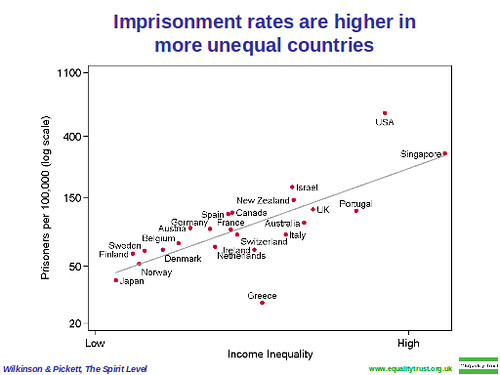
Imprisonment rates are higher in more unequal countries

Here’s yet another reason the 1% owning and controling everything is bad for everyone. Guess which country is the most unequal in income of big countries? That’s right, the one with by far the most prisoners: the U.S.A. Prisoners are shown on a log scale, so that’s not just a little bit higher, it’s about three times higher than Canada or UK.

Why is the USA so high? It’s not more crime, of the violent homicide and robbery variety. It’s harsher sentencing, especially for drug-related crimes. That’s one of many points Richard Wilkinson makes in this TED Talk from July 2011, in which he uses hard data to tie income inequality not only to imprisonment, also to child conflict, drug abuse, infant mortality, life expectancy, mental illness, obesity, high school dropouts, teenage births, and social mobility. The most socially mobile country? Denmark. The least? The USA.

I got his slides from The Equality Trust.

Oh yes: we don’t need a private prison in Lowndes County, Georgia to make a few CCA executives and shareholders richer at the expense of the rest of us. Spend those tax dollars on rehabilitation and education instead.

-jsq

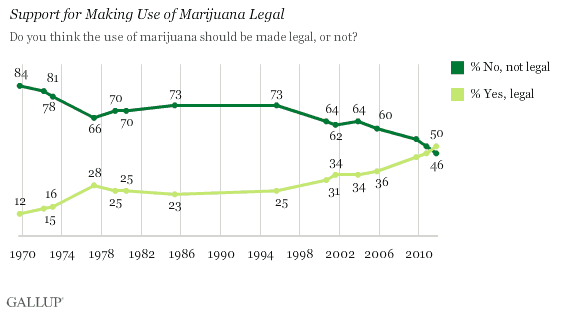
Why a private prison would close: a majority of the American people favor legalizing marijuana use

For the first time ever, a majority of Americans favor legalizing marijuana use, which is one of the major dangers to CCA’s private prison business plan, according to CCA itself.

Emily Ekins wrote for Reason-RUPE 18 October 2011, New Gallup Survey: A Majority of Americans Favor Legalizing Marijuana Use

The latest Gallup poll shows a record high of 50 percent of Americans in favor of legalizing marijuana use. This follows a consistent upward trend, picking up speed in 2006 when 36 percent of Americans favored marijuana legalization.

CCA wrote in its 2010 Annual Report to the SEC: Continue reading

Private prison operator sued for sexual abuse

Yes, it’s CCA, the same company that wants to build a private prison in Lowndes County, Georgia, sued for sexual abuse at its immigration detention center in Taylor, Texas. CCA runs the ICE center in Georgia, too.

Elise Foley wrote for Huff Post yesterday, Immigrant Detainees Report Nearly 200 Instances Of Sexual Abuse

More than 180 sexual abuse complaints have been reported in immigration detention centers since 2007, according to government documents obtained by the American Civil Liberties Union as part of a class-action suit filed this week….

All three women in the ACLU lawsuit were held for a time in the T. Don Hutto Residiental Center in Taylor, Texas, a 512-bed detention center privately run on a government contract by private prison giant Corrections Corporation of America.

The suit targets Corrections Corporation of America along with three ICE officials, a former facility manager of the Hutto facility, and a former Hutto guard named Donald Dunn, who was charged last year with assaulting five women and has been accused of abusing more.

This is also the same CCA that runs a prison in Idaho commonly known as Gladiator School because it has twice the rate of assaults as other prisons in that state.

We don’t need a private prison in Lowndes County, Georgia. Spend those tax dollars on rehabilitation and education instead.

-jsq

Private prisons —Matt Flumerfelt

Received yesterday. -jsq
Dear Andrea, We spoke not long ago by phone. I just want to let you know that plans to bring in a private prison here are not going to sit well with many of us. In fact, it will most likely bring about a repeat of the recent Biomass issue. I don’t mean we are opposed to it. I mean we are vehemently opposed to it. It seems that Allen Ricketts and the other Board members don’t understand that Valdosta’s citizens don’t want to be informed of, for example, what finished products and raw materials will be stored in the distribution center slated to locate in Valdosta AFTER the contract has been signed. We have a right to know beforehand what kind of facility it is and what will be stored there. Informing us after the fact is not transparency. This is an issue that will continue to be revisited as long as the VLCIA continues to act unilaterally without considering the wishes of those who live here. We don’t want to be presented with a fait accompli. Also, the VLCIA is really not doing due diligence when it continues to court businesses that raise concerns over the ethical standards of the Board itself. Thanks. Matt Flumerfelt

Opposed to a private prison in Lowndes County, Georgia. —John S. Quarterman, et al.

A private prison in Lowndes County would be a bad business decision: it would not increase employment, it would be likely to close because of lack of “customers”, and it would drive away knowledge-based workers. The letter I read to the Industrial Authority Board and Staff Tuesday on behalf of some members of the community sumarizes appended documentation of all those and other points.

If you’d also like to sign, I’m still collecting signatures, and will periodically drop off more signed copies. Or, even better, write your own letter and send it to the Industrial Authority. Submit it to this blog and we’ll probably publish it.

Here’s the video:


Opposed to a private prison in Lowndes County, Georgia. —John S. Quarterman
Regular Meeting, Valdosta-Lowndes County Industrial Authority (VLCIA),
Norman Bennett, Tom Call, Roy Copeland chairman, Mary Gooding, Jerry Jennett,
Andrea Schruijer Executive Director, J. Stephen Gupton attorney, Allan Ricketts Project Manager,
Valdosta, Lowndes County, Georgia, 18 October 2011.
Videos by Gretchen Quarterman for LAKE, the Lowndes Area Knowledge Exchange.

Text of the letter is appended; follow the link for the documentation. Continue reading

No Private Prison —John S. Quarterman

At the MLK Monument last Friday, I brought up private prisons. Most of the 150 people marching to Occupy Valdosta did not know that the Industrial Authority is helping Corrections Corporation of America (CCA) build a private prison in Lowndes County. Even though it would not decrease unemployment, it would compromise public safety, and it would probably compete with local labor.

We don’t need a private prison in Lowndes County, Georgia. Spend those tax dollars on rehabilitation and education instead.

Here’s the video:


No Private Prison —John S. Quarterman
We are the 99%,
Marching to Occupy Valdosta, Occupy Valdosta,
Valdosta, Lowndes County, Georgia, 14 October 2011.
Videos by Gretchen Quarterman for LAKE, the Lowndes Area Knowledge Exchange.

-jsq

Industrial Authority Board meets Tuesday 5:30 PM

Sure, most of the interesting stuff like Project Excel (the CCA private prison) is hidden under
  • Project Report-Allan Ricketts
Also, aren’t they supposed to say what an executive session is for?

But at least they do post an agenda now!

So, when will they be posting minutes?

Valdosta-Lowndes County Industrial Authority
Agenda
Tuesday, October 18, 2011 5:30 p.m.
Industrial Authority Conference Room
2110 N. Patterson Street
Continue reading

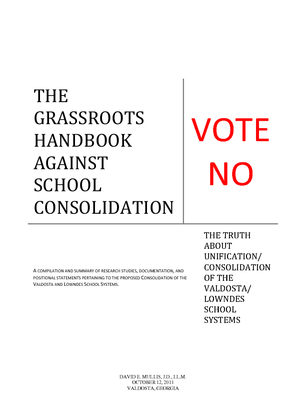
The Grassroots Handbook Against School Consolidation

Received yesterday, The Grassroots Handbook Against School Consolidation: The Truth About Unification/Consolidation of the Valdosta/Lowndes School Systems By David E. Mullis, J.D., LL.M., October 12, 2011. It’s a 43 page exhaustive compendium of all the statements against consolidation by both school boards, the Valdosta City Council, etc., together with detailed debunking of every argument CUEE has made.

I think this passage on page 3 sums it up:

In other words, we can offer a great education, provide incentives for students to perform, make modifications to education to help students succeed, and provide technical help, but if the child is homeless, left home alone for long periods of time, living in a high crime area, living in a home with substance abuse, or just downright defiant, there is only so much the school can accomplish in helping these students succeed. Good parental, home and community environments are critical to the success of underprivileged children.

Therefore, CUEE and the Chamber of Commerce’s efforts are focused on the wrong methods of improving our school statistics. Unification will not accomplish any of their stated goals, but will create an enormous financial burden on the community and its families during this time of recession and high unemployment. The business community and volunteer organizations should instead focus on providing educational awareness and success clinics in low income areas. They should organize efforts to reduce poverty by bringing in industry with good wages and sponsoring basic community literacy and vocational training and tutoring. They should focus on programs to promote the value of education. They should organize drug awareness and rehabilitation programs in low income areas. They should focus their efforts in decreasing poverty. They should focus on encouraging community diversity. If they will do this, the educational problems will take care of themselves in good systems like Valdosta and Lowndes.

However, CUEE and the Chamber have insisted on pushing forward with their unification agenda despite the certain negative effect it will have on the community and the education of our children. They deny there will be any negative effect, but they have no personal accountability if they are wrong. They ignore all relevant studies and dismiss the results as being misleading. Then they state their own misleading and false assertions and claim them to be FACTS.

Indeed, what qualifies the Chamber of CUEE to talk about education? Judging by their track record, nothing does.

This Handbook is a great resource, and I applaud David Mullis for producing it.

-jsq