Tag Archives: legalization

How to end the epidemic of incarceration

There are historical reasons for why we lock up so many people,
some going back a century or more, and some starting in 1980 and 2001.
Knowing what they are (and what they are not)
lets us see what we can do to end the epidemic of
incarceration that is damaging education and agriculture in Georgia.

Adam Gopnik wrote for the New Yorker dated 30 January 2012,

The Caging of America:
Why do we lock up so many people?

More than half of all black men without a high-school diploma go


to prison at some time in their lives. Mass incarceration on a scale
almost unexampled in human history is a fundamental fact of our country
today—perhaps the fundamental fact, as slavery was the
fundamental
fact of 1850. In truth, there are

more black men in the grip of the
criminal-justice system—in prison, on probation, or on
parole—
than were in slavery then.


In Georgia,

1 in 13 of all adults is in jail, prison, probation,
or parole:
highest in the country (1 in 31 nationwide).
Georgia is only number 4 in adults in prison, but we’re continuing
to lock more people up, so we may get to number 1 on that, too.


Over all, there are now more people under
“correctional supervision” in America—more than
six million—than
were in the Gulag Archipelago under Stalin at its height. That city of
the confined and the controlled, Lockuptown, is now the second largest
in the United States.

The accelerating rate of incarceration over the past few decades is just
as startling as the number of people jailed: in 1980, there were about


two hundred and twenty people incarcerated for every hundred thousand
Americans; by 2010, the number had more than tripled, to seven hundred
and thirty-one. No other country even approaches that. In the past two
decades, the money that states spend on prisons has risen at six times
the rate of spending on higher education.

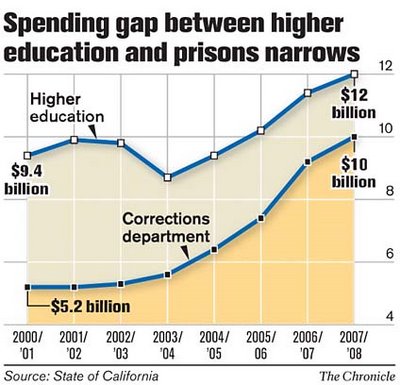
And we can’t afford that, especially not when we’re cutting school budgets.
That graph of education vs. incarceration spending is for California.
Somebody should do a similar graph for Georgia.

The article does get into why we lock up so many people:
Continue reading

Why a private prison would close: a majority of the American people favor legalizing marijuana use

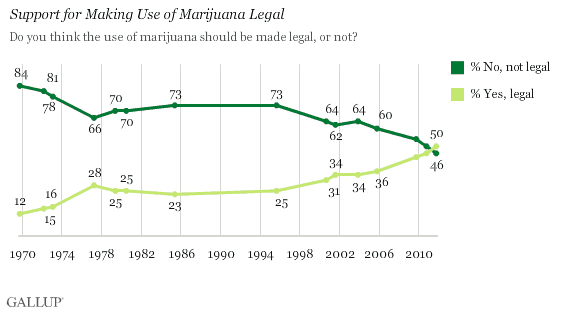
For the first time ever, a majority of Americans favor legalizing marijuana use,
which is one of the major dangers to CCA’s private prison business plan,
according to CCA itself.

Emily Ekins wrote for Reason-RUPE 18 October 2011,

New Gallup Survey: A Majority of Americans Favor Legalizing Marijuana Use

The latest Gallup poll shows a record high of 50 percent of Americans
in favor of legalizing marijuana use. This follows a consistent upward
trend, picking up speed in 2006 when 36 percent of Americans favored
marijuana legalization.


CCA wrote in its
2010 Annual Report to the SEC:

Continue reading

Drug war fail: devastating consequences —Global Commission on Drug Policy

Stop locking up drug users who harm no others,
legalize drugs starting with marijuana,
switch to health and treatment,
stop harrassing farmers,
abandon zero tolerance and invest instead in youth activities,
focus on reducing harm,
and do it now, so says a commission of business moguls, former heads of state,
financial professionals, writers, and activists.

Writes Douglas Stanglin today in USA TODAY,


“The global war on drugs has failed, with devastating consequences for
individuals and societies around the world,” says the Report of the
Global Commission on Drug Policy in its opening statement. “Fifty years
after the initiation of the U.N. Single Convention on Narcotic Drugs,
and 40 years after President Nixon launched the U.S. government’s war on
drugs, fundamental reforms in national and global drug control policies
are urgently needed.”

According to whom?

The 19-member commission, a private venture chaired by ex-Brazilian
president Fernando Henrique Cardoso, includes George Schultz, President
Reagan’s Secretary of State; Richard Branson, founder of the Virgin
Group; former U.N. Secretary General Koffi Anna; George Papandreou,
prime minister of Greece; Paul Volcker, former chairman of the Federal
Reserve, and Javier Solana,former EU foreign minister.

Here’s their full report.

What do they recommend?

Continue reading

A radical plan to stop many police deaths: legalize drugs

Retired State Police Major Neill Franklin, Executive Director of

Law Enforcement Against Prohibition (LEAP)
,
told

Judge Napolitano
:

“Prohibition didn’t work in the past, and it’s not working today”.

Franklin said LEAP now represents 50,000 members worldwide.

Few issues unite people across the political sprectrum like this one,
from the NAACP to Grover Norquist.

We don’t need a private prison in Lowndes County to lock up more people.
We need fewer people in prison so we can afford to educate people.

-jsq

Cairo in Mexico City

The U.S. media paid little attention to

Mexico’s Arab moment:
Protesters demand the resignation of Mexico’s top drug war official.

But while such stories have become tragically common in Mexico, this was
the first time the mourners could vent their grief in front of tens of
thousands of sympathizers and TV cameras from across the world.

And in this media spotlight, the protesters made a new demand — amid
the failure of the government to provide security, they cried, the Public
Safety Secretary Genaro Garcia Luna must resign.


“We don’t want more dead. We don’t want more hate,” protest leader
Javier Sicilia told the crowd. “President Felipe Calderon — show
you are listening to us, and make the public safety secretary resign.”

The demand announced at Sunday’s rally gave a new edge to a movement
that has been steadily rising amid the massacres and mass graves of
Mexico’s drug war.

Up until then, protesters had come out with a mix

Continue reading

Former Mexican president Vicente Fox urges drug legalization

Sandra Dibble writes in signonsandiego 6 April 2011 that

Former Mexican president urges drug legalization


Photo by Omar Martinez — Frontera

Legalization of drugs in Mexico would not only lead to lowered violence
and drug consumption but also boost its economy, former Mexican President
Vicente Fox said Wednesday during a speech to a convention of newspaper
editors from the United States and Latin America.

“Things are going very badly for Mexico with the issues of organized
crime and violence,” Fox said in Spanish. “We’re losing large
volumes of tourists, if not in the interior, then at the border. We’re
losing a great number of investments.”

And if there were more jobs in Mexico, from tourism and investments,
there would be fewer Mexicans trying to sneak into the U.S. for jobs.

Will legalization cause more drug use? No:

On Wednesday, Fox cited the example of Portugal, where he said drugs
use has fallen by 25 percent a decade after they were legalized there.

That would be better than
locking up more people for private profit

while not decreasing drug use, and that’s what we’re doing now.

-jsq

“consider ending drug prohibition” “stop the hypocrisy.” –Frank Serpico

One of our readers doesn’t believe Frank Serpico is for legalization of drugs, despite what
filmmaker Connie Littlefield
and LEAP say.

Fair enough: that’s circumstantial evidence.
Let’s see what Serpico himself says.

Frank Serpico in his blog,

27 March 2007:


DAMAGE DONE

THE DRUG WAR ODYSSEY

THE FILM

THE COPS

THE FILM MAKERS

After 30 years of drug war, illegal narcotics are decreasing in price,
increasing in purity and demand continues to surge. The heroes of
this film are veterans of the drug war and they urge us to consider
ending drug prohibition. They have had a complete revolution in their
thinking. Now they are working to end the War on Drugs. Find out what
happened to change their minds.

http://www.drugwarodyssey.com/

Serpico

quoted in the website for the film he recommends:


“I think Prohibition is causing the public to lose their respect because
they’re enforcing laws that basically aren’t hurting anybody. I think
we have to stop the hypocrisy.”

That website’s

summary of the film:

Continue reading

Serpico for legalization of drugs


Connie Littlefield remarks that

Legalizing marijuana makes pot smoking uncool
:

I was in Amsterdam because my documentary, Damage Done: The Drug War
Odyssey, was being screened as part of a Cannabis Tribunal. Former NYPD
detective Frank Serpico, who is in my film, travelled with me.

We were invited to speak because Damage Done is about a group of cops,
including Frank, and Canadian Senator Larry Campbell, who believe that
the War on Drugs does more harm than the drugs themselves.

We presented a copy of our film to the chief of the Amsterdam-Amstelland
Police, who told me that he became a cop because of Frank.

Her film is

DAMAGE DONE: The Drug War Odyssey
,
here describe on the LEAP site:

Continue reading