Category Archives: Economy

Why doesn’t VLCIA buy locally?

Col. Ricketts reminded VLCIA board members at their most recent regular meeting (2012 01 17) that he had asked them for input about trees for Miller and Westside Business Parks.
We have identified trees from a nursery, Select Trees, in Athens, Georgia, with a special five year warranty on those trees, that meet our landscape plans for both Miller and Westside Business Park. As we discussed in our last board meeting, there is some cost savings available to us, and the ability for us to select trees now and hold them if we make a deposit.
OK, I commend VLCIA staff and board for trying to save we the taxpayers money.

But isn’t VLCIA supposed to be promoting local business and agriculture? Why is our Industrial Authority outsourcing to a company halfway across the state? Why doesn’t it buy locally, even if it costs a little more?

For that matter, aren’t there plenty of local trees, like sycamores, magnolias, and even longleaf pines that would cost very little to transplant to a local business park? Maybe those are the types of trees they’re buying. We don’t know, because only the board got the list of trees.

For that matter, why didn’t VLCIA put out a public request for bids for the trees?

Here’s the video:


Why doesn’t VLCIA buy locally?
Regular Meeting, Valdosta-Lowndes County Industrial Authority (VLCIA),
Norman Bennett, Tom Call, Roy Copeland chairman, Mary Gooding, Jerry Jennett,
Andrea Schruijer Executive Director, J. Stephen Gupton attorney, Allan Ricketts Project Manager,
Valdosta, Lowndes County, Georgia, 17 January 2012.
Videos by John S. Quarterman for LAKE, the Lowndes Area Knowledge Exchange.

-jsq

How to end the epidemic of incarceration

There are historical reasons for why we lock up so many people, some going back a century or more, and some starting in 1980 and 2001. Knowing what they are (and what they are not) lets us see what we can do to end the epidemic of incarceration that is damaging education and agriculture in Georgia.

Adam Gopnik wrote for the New Yorker dated 30 January 2012, The Caging of America: Why do we lock up so many people?

More than half of all black men without a high-school diploma go to prison at some time in their lives. Mass incarceration on a scale almost unexampled in human history is a fundamental fact of our country today—perhaps the fundamental fact, as slavery was the fundamental fact of 1850. In truth, there are more black men in the grip of the criminal-justice system—in prison, on probation, or on parole—than were in slavery then.
In Georgia, 1 in 13 of all adults is in jail, prison, probation, or parole: highest in the country (1 in 31 nationwide). Georgia is only number 4 in adults in prison, but we’re continuing to lock more people up, so we may get to number 1 on that, too.
Over all, there are now more people under “correctional supervision” in America—more than six million—than were in the Gulag Archipelago under Stalin at its height. That city of the confined and the controlled, Lockuptown, is now the second largest in the United States.

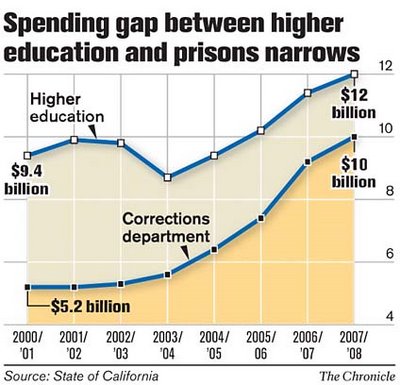
The accelerating rate of incarceration over the past few decades is just as startling as the number of people jailed: in 1980, there were about two hundred and twenty people incarcerated for every hundred thousand Americans; by 2010, the number had more than tripled, to seven hundred and thirty-one. No other country even approaches that. In the past two decades, the money that states spend on prisons has risen at six times the rate of spending on higher education.

And we can’t afford that, especially not when we’re cutting school budgets. That graph of education vs. incarceration spending is for California. Somebody should do a similar graph for Georgia.

The article does get into why we lock up so many people: Continue reading

Prisons as old age homes

Planning? Prisons aren’t for planning!

David Crary wrote for AP today,

In corrections systems nationwide, officials are grappling with decisions about geriatric units, hospices and medical parole as elderly inmates – with their high rates of illness and infirmity – make up an ever increasing share of the prison population.

At a time of tight state budgets, it’s a trend posing difficult dilemmas for policymakers. They must address soaring medical costs for these older inmates and ponder whether some can be safely released before their sentences expire.

The latest available figures from 2010 show that 8 percent of the prison population — 124,400 inmates — was 55 or older, compared to 3 percent in 1995, according to a report being released Friday by Human Rights Watch. This oldest segment grew at six times the rate of the overall prison population between 1995 and 2010, the report says.

“Prisons were never designed to be geriatric facilities,” said Jamie Fellner, a Human Rights Watch special adviser who wrote the report. “Yet U.S. corrections officials now operate old age homes behind bars.”

No, they were designed to be profit centers for prison profiteers.

Look at this sob story: Continue reading

Coal EMCs: no budget for this boondoogle —Katherine Helms Cummings

Received yesterday on Coal Plants Washington and Ben Hill not quite dead yet. -jsq
I asked Washington EMC Chair Mike McCoy today after their monthly board meeting what their budget is for 2012 and this boondoggle. They haven’t got a budget. They are meeting next week with the four remaining co-ops (assuming some don’t peel off before then) and they will work on a budget then.

You can check my blog out for more of the hair raising and mind boggling details of what they are doing in the “best interests” of the owner members and community.

-Katherine Helms Cummings

On her blog, Rural and Progressive, she posted yesterday Is Washington EMC “winging it” on Plant Washington finances? and today WEMC Board Member supports forensic audit. Very interesting.

-jsq

Car part manufacturer locates in Dublin, Georgia

First MAGE SOLAR, now this. Somebody in Dublin and Laurens County, Georgia, is successfully attracting new, clean industry.

A press release Tuesday on the Governor’s website, German automotive supplier to create 178 jobs in Dublin

Erdrich Umformtechnik to invest $39 million in Laurens County, Deal reports

Gov. Nathan Deal announced today that Erdrich Umformtechnik GmbH & Co.KG (Erdrich), a German-based automotive supplier, will construct a state-of-the-art metal stamping facility in Dublin in Laurens County. The company will create 178 jobs and invest $39 million in the construction of this plant.

“Automotive industry suppliers find in Georgia the logistics infrastructure, skilled workforce and overall business environment necessary for them to compete globally while meeting the needs of their customers,” Deal said. “I am also encouraged to see yet another German company call Georgia home, indicating even further that our efforts to build and foster international relationships are yielding positive results. Georgia proudly welcomes Erdrich to our state.”

Erdrich is a midsized family-owned company that produces complex metal parts and subassemblies for the automotive industry, and has been in the metal stamping business for more than 50 years. The company has two plants in Germany, one in the Czech Republic and another in China that supplies parts to other automotive supplier companies as well to BMW, Mercedes and Volkswagen.

“Following an extensive multistate search for the right U.S. business location for our company, we were delighted to find the right fit in Dublin, Georgia,” said CEO Georg Erdrich. “This very pro-business community met our requirements with respect to logistics to our customers, access for our suppliers, operating costs, workforce and quality of life. The economic development leadership at the state and local level worked closely with us to make our decision based on confidence in the data, the business analysis and the leadership.”

So apparently at least one locality in Georgia is capable of attracting this kind of industry.

-jsq

Solar surging in Savannah

Near Savannah a couple of doctors are pioneering ways for everyone to profit from solar now. Yesterday, the Driftaway Cafe started serving up with solar.

WJCL and WTGS wrote yesterday, Solar Power Surges in Savannah

A ground breaking project is underway in the coastal empire that harnesses the power of the sun and hopes to pave the way for the future of clean energy. One main part of this project is for everyone to be able to supply their own power.

Clean, sustainable energy has been a hot topic for some time now, especially, energy that doesn’t send our money overseas.

“We need to develop every available source of American energy,” says President Obama.

The problem is that until now alternate sources have been out of reach or too expensive for most of us.

“It’s very important we learn how to harness our own power and how we structure that today is important for future generations,” says Dr. Sidney Smith, co-owner of Lower rates for Customers.

“Lower Rates for Customers” is hoping to do just that. The plan is to make solar power the way of the future and affordable for everyone. They have an all encompassing plan that can have anyone generating their own electricity within 45 days, even if you don’t have the land to put up solar panels.

“We provide you with the place, the hook up, the technology and Georgia power will send you a check to supplement your power bill,” says Dr. Pat Godbey, co-owner of Tabby Power.

Business like the Driftaway Cafe jumped on the chance to get involved.

“Their financial model for the future just struck a nerve with me and I wanted to be a part of it,” says Driftaway owner, Robyn Quattlebaum.

Cheaper, cleaner, and accessible: that’s good business sense!

-jsq

Coal Plants Washington and Ben Hill not quite dead yet

Somebody’s been watching too much Twilight. Plant Washington now joins the undead. But maybe Plant Ben Hill is really dead.

Dave Williams wrote for the Atlanta Business Journal yesterday, Georgia coal plant project to push on,

Cobb Electric Membership Corp.‘s board of directors voted Tuesday to pull out of the $2.1 billion 850-megawatt Plant Washington project, citing the uncertain impacts of tightened federal regulation of carbon emissions. Cobb EMC was the largest participant in the consortium Power4Georgians.

The consortium began looking for other partners to replace Cobb EMC well before Wednesday’s decision, which had been anticipated, said Dean Alford, spokesman for Power4Georgians.

“This in no way changes the course,” he said. “It’s still full steam ahead.”

But he wouldn’t say who else would help fund it. We’ll see whether he’s blustering or actually has any further backers.

John Roach and Kim Isaza in MJDOnline yesterday, EMC backs out of plan to build coal-fired plant, had a list of the other current partners: Continue reading

Commission had not seen Moody AFB gate contract with Scruggs before Work Session @ LCC 2012 01 23

We still don’t know what the county is going to do about that cost overrun for the Moody AFB gate. Nobody said at the work session yesterday morning; maybe they’ll say at the regular session tonight when they vote on a contract with some sort of revised dollar figures in it.

County Manager Mike Fletcher waved around a copy of the revised contract with Scruggs Company for the new Moody AFB gate, but said he had not provided it to the Commissioners. I wonder if they’ll see it before they vote tonight? He said it was 226 pages long, but most of that was DOT boilerplate, and only something like 20 pages was the actual county contract. Seems like they could read that much by tonight.

So could we, the public, if it was somewhere we could see it.

He also didn’t say what happened to the $128,497.05 cost overrun. The Commissioners asked no questions.

Here’s the video:


Commission had not seen Moody AFB gate contract with Scruggs before Work Session @ LCC 2012 01 23
Work Session, Lowndes County Commission (LCC),
Valdosta, Lowndes County, Georgia, 23 January 2012.
Videos by Gretchen Quarterman for LAKE, the Lowndes Area Knowledge Exchange.

-jsq

Just as prohibition of alcohol failed… the war on drugs has failed —Richard Branson

Richard Branson wrote for the Telegraph yesterday, It’s time to end the failed war on drugs
Just as prohibition of alcohol failed in the United States in the 1920s, the war on drugs has failed globally. Over the past 50 years, more than $1 trillion has been spent fighting this battle, and all we have to show for it is increased drug use, overflowing jails, billions of pounds and dollars of taxpayers’ money wasted, and thriving crime syndicates. It is time for a new approach.

Too many of our leaders worldwide are ignoring policy reforms that could rapidly reduce violence and organised crime, cut down on theft, improve public health and reduce the use of illicit drugs. They are failing to act because the reforms that are needed centre on decriminalising drug use and treating it as a health problem. They are scared to take a stand that might seem “soft”.

But exploring ways to decriminalise drugs is anything but soft. It would free up crime-fighting resources to go after violent organised crime, and get more people the help they need to get off drugs. It’s time to get tough on misguided policies and end the war on drugs.

Branson isn’t just a billionaire speaking his mind, he was also on the Global Commission on Drug Policy that studied the problem and recommended last summer that we end prohibition.

Branson does bring his business experience to bear: Continue reading

Pop the drug war balloon: legalize and regulate the drug trade —Terry Nelson, LEAP

LTE in the WSJ, 21 January 2012:
The article illustrates what I learned over my 30-year career as a federal agent: Cracking down in one place doesn’t make drugs disappear, it only moves the trade elsewhere. This so-called “balloon effect,” combined with the insatiable demand for drugs across the globe, means that no level of law-enforcement skill or dedication can make a significant dent.

The only way to pop the proverbial balloon is to legalize and regulate the drug trade, which would eliminate the opportunity to make enormous black-market profits. It wasn’t easy for me to come to this revelation after dedicating so many years to enforcing drug laws, but it is common sense. Law-enforcement officers don’t have to chase gangsters selling booze from town to town because we ended the failed experiment of alcohol prohibition decades ago. It is time we do the same for other drugs.

Terry Nelson
Executive Board Member
Law Enforcement Against Prohibition
Granbury, Texas

And that will pop the incarceration bubble, as well, according to CCA’s own 2010 report to the SEC. -jsq